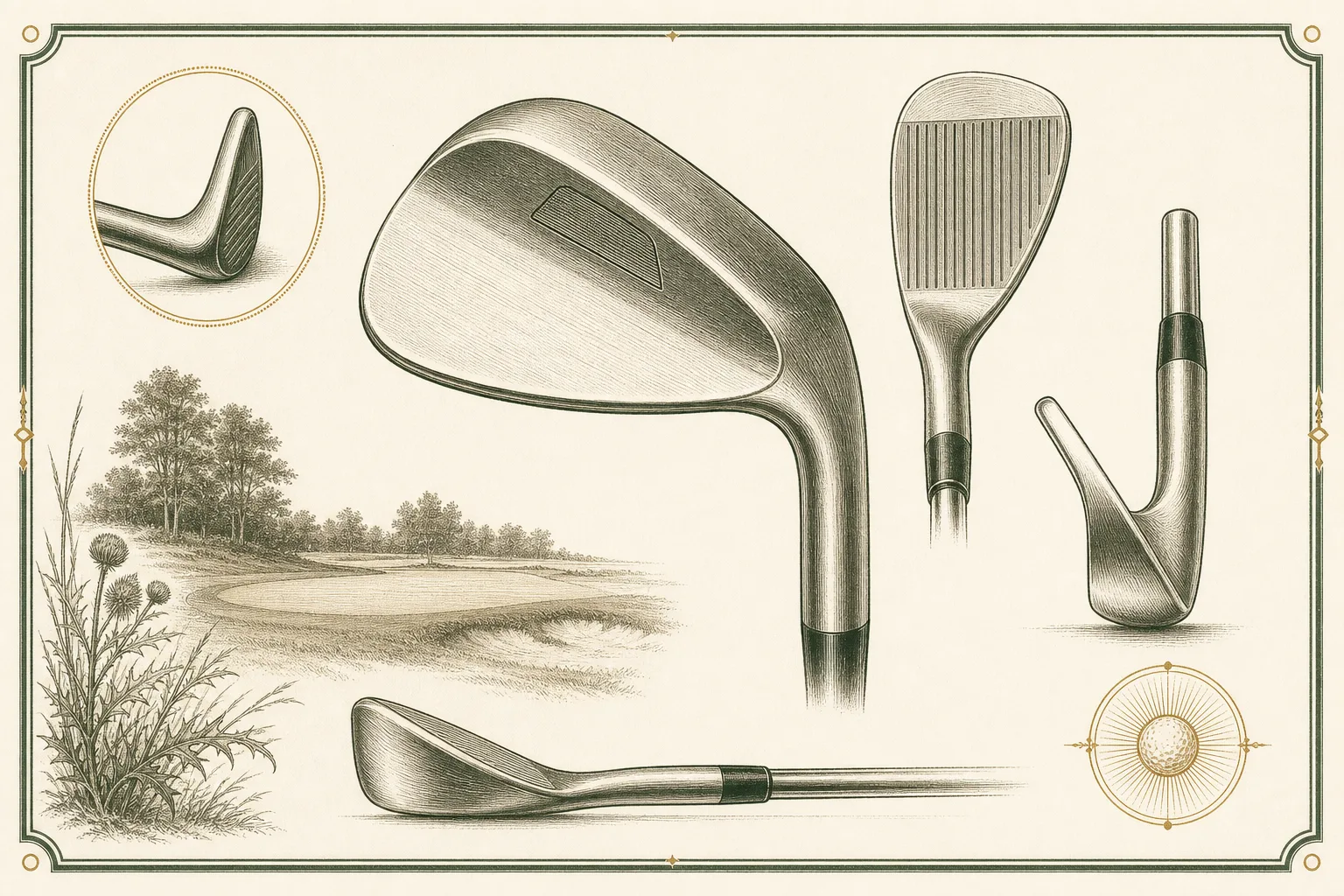
The 588 RTG ('Raw Tour Grind') is a 2005-era variant of Cleveland's legendary 588 wedge family, distinguished by an unplated raw carbon-steel face left to rust naturally. Cleveland marketed the rust finish as functional rather than cosmetic: as it oxidizes, the roughened surface cuts glare in bunkers and off tight lies and, according to enthusiast reports, increases spin over time as the face weathers. It carried the 588's tour-proven shaping and sole grind into a lower-cost, feel-focused package rather than introducing new geometry of its own.
It borrows real credibility from the 588 name — user reviews on golfreview.com run 4.9/5 across 120 reviews, and it is frequently called out as excellent value ('as good as clubs 10x the price') — but the RTG is a finish/price variant within the broader 588 family rather than the specific model responsible for the family's legendary status, which belongs to the original 1988 588 Tour Action.
A strong fit for a value-focused mid-to-low handicap player who wants the 588 family's tour-proven feel and doesn't mind a wedge that cosmetically rusts over its life. Less ideal for a player who wants a clean chrome look to stay that way, or a high-handicapper who would be better served by the cavity-back 588 RTX 2.0 released later in the same family.
Sat within Cleveland's mid-2000s wedge lineup alongside the 588 Chrome and Black Pearl finish options, competing with Titleist's Vokey SM4/SM5 generation and Callaway's early Mack Daddy-predecessor forged wedges. It preceded the RTX-branded 588 generations (RTX, RTX 2.0) that introduced Rotex face milling and, eventually, a cavity-back option.
Shares the 588 family's traditional forged-wedge shaping: a wide face for its era and dependable turf interaction, but a thin topline and minimal offset consistent with a better-player's tool rather than a cavity-back forgiveness design. The main forgiveness-adjacent feature is the raw face's spin consistency as it ages, not shape-driven mis-hit forgiveness.
Calibrated across the whole catalog — a tour blade scores low here on purpose; it means control, not ease.
Realistic 2026 private-party/2nd Swing pricing runs roughly $30-$72 depending on condition (observed 2nd Swing range $30.99-$71.99), consistent with a 20-year-old forged wedge whose value now rests on feel and reputation rather than current technology.
Reading is one thing — hitting is another. Book a bay and see the numbers for yourself before you buy anywhere.
The 588 RTG ('Raw Tour Grind') is a 2005-era variant of Cleveland's legendary 588 wedge family, distinguished by an unplated raw carbon-steel face left to rust naturally. Cleveland marketed the rust finish as functional rather than cosmetic: as it oxidizes, the roughened surface cuts glare in bunkers and off tight lies and, according to enthusiast reports, increases spin over time as the face weathers. It carried the 588's tour-proven shaping and sole grind into a lower-cost, feel-focused package rather than introducing new geometry of its own.
It borrows real credibility from the 588 name — user reviews on golfreview.com run 4.9/5 across 120 reviews, and it is frequently called out as excellent value ('as good as clubs 10x the price') — but the RTG is a finish/price variant within the broader 588 family rather than the specific model responsible for the family's legendary status, which belongs to the original 1988 588 Tour Action.
A strong fit for a value-focused mid-to-low handicap player who wants the 588 family's tour-proven feel and doesn't mind a wedge that cosmetically rusts over its life. Less ideal for a player who wants a clean chrome look to stay that way, or a high-handicapper who would be better served by the cavity-back 588 RTX 2.0 released later in the same family.
Sat within Cleveland's mid-2000s wedge lineup alongside the 588 Chrome and Black Pearl finish options, competing with Titleist's Vokey SM4/SM5 generation and Callaway's early Mack Daddy-predecessor forged wedges. It preceded the RTX-branded 588 generations (RTX, RTX 2.0) that introduced Rotex face milling and, eventually, a cavity-back option.
Shares the 588 family's traditional forged-wedge shaping: a wide face for its era and dependable turf interaction, but a thin topline and minimal offset consistent with a better-player's tool rather than a cavity-back forgiveness design. The main forgiveness-adjacent feature is the raw face's spin consistency as it ages, not shape-driven mis-hit forgiveness.
Calibrated across the whole catalog — a tour blade scores low here on purpose; it means control, not ease.
Realistic 2026 private-party/2nd Swing pricing runs roughly $30-$72 depending on condition (observed 2nd Swing range $30.99-$71.99), consistent with a 20-year-old forged wedge whose value now rests on feel and reputation rather than current technology.
Reading is one thing — hitting is another. Book a bay and see the numbers for yourself before you buy anywhere.