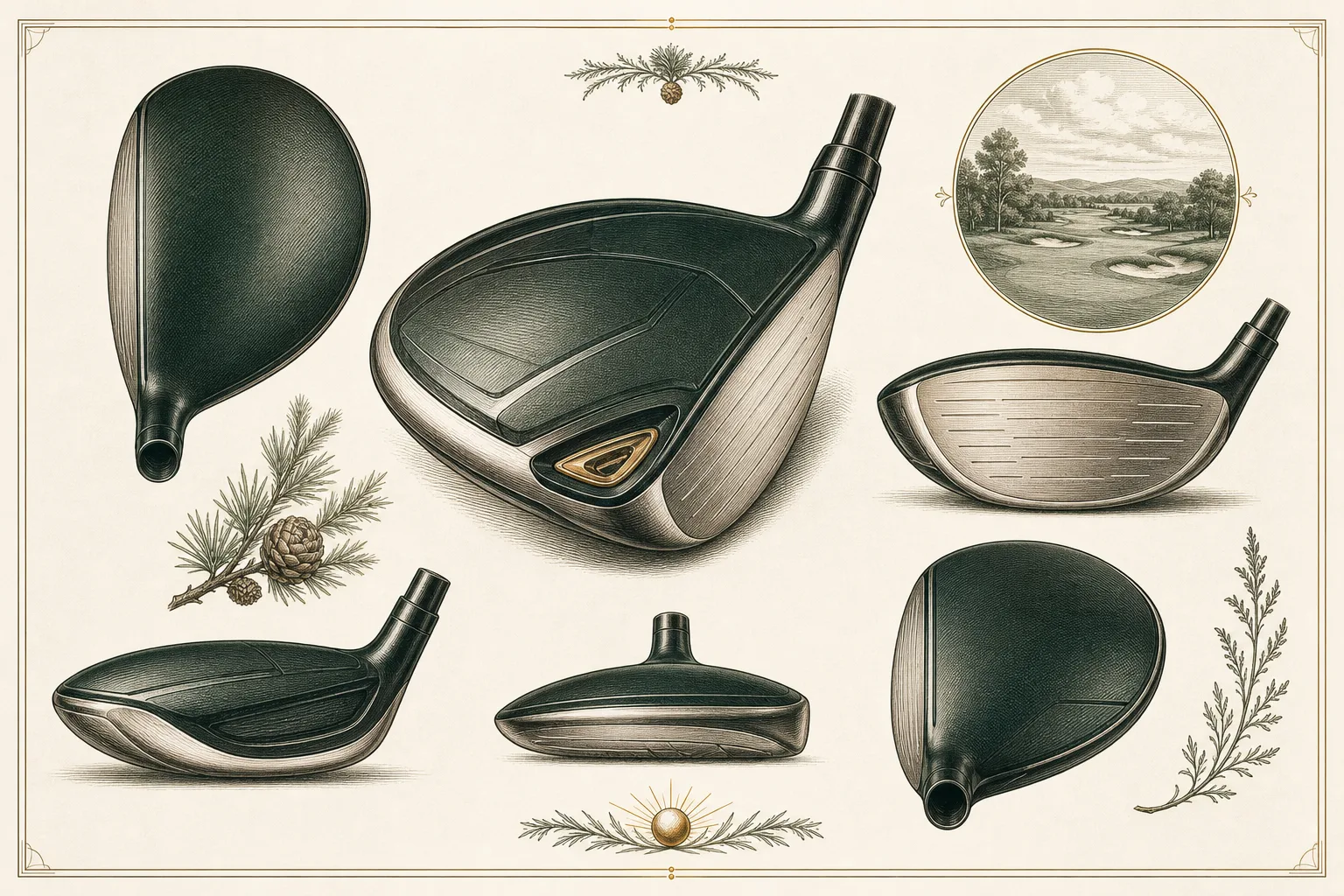
“The Jan 2026 fairway partner to the JPX One driver: no NanoAlloy here (face too small to benefit), but a re-engineered CorTech Chamber that varies the sole-to-chamber gap to spread face flexion toward heel and toe, plus a Speed Bevel sole for cleaner turf interaction. Lofts run 15-24 including a 7-wood and a tour 3T head, with a wide five-flex stock shaft matrix down to ladies. Rung-2 standard - an easy current-generation fit for most mid-speed players.”
The JPX ONE fairway (demo/presale 12 January 2026, in stores 22 January) is the 2026 successor to Mizuno's ST metalwoods, folding the range under the JPX ONE banner. Its core update is a re-engineered CORTECH Chamber: Mizuno increased the gap between the suspended high-density weight (in its TPU-filled pocket) and the body, especially toward the heel and toe, so the multi-thickness MAS1C steel face flexes more on off-center strikes for higher launch and preserved ball speed on mishits. A wrap-around carbon-composite crown extends lower down the sole to drop CG, and an updated Speed Bevel sole cleans up turf interaction. Reviewers pegged it as an easy-launching, forgiving, straight 'quiet achiever' that trades a few yards of the lowest-spin distance for stability, with average ball speeds around 143 mph.
Too new (2026) for any cult standing, but launched to strong reviews rather than as anonymous stock: an 8.2 consensus across 11 sources on Reading the Break and repeated 'quiet achiever / consistency machine' verdicts from Today's Golfer and Golf Monthly for forgiveness and feel. It is a well-reviewed current club, not a landmark or collectible one.
Best for mid-to-high handicaps and slower-to-moderate swing speeds who prioritize easy launch, straight flight and forgiveness over squeezing out maximum low-spin distance, and who value Mizuno's feel. Reviewers noted a deeper-faced 3T tour option for better players who want a more penetrating flight; low-spin-seeking fast swingers should test that or a dedicated low-spin model.
A January 2026 release competing with the TaylorMade Qi35, Callaway Elyte, Ping G440 and Titleist GT-series fairways. It directly replaces the ST-Z/ST-X/ST-Max 230 fairways in Mizuno's line, unifying them under JPX ONE, and adds a 9-wood to meet demand for higher-lofted fairways.
Built for forgiveness: the wider heel/toe CORTECH gaps give an 18%-wider high-COR zone than the prior ST-Z generation, and the low-CG carbon crown makes it easy to launch and straight, with off-center strikes holding speed well. The deliberate trade is spin: the higher-spinning, easy-launch profile that drives the forgiveness costs a few yards versus the lowest-spin fairways, and a lower-lofted 3-wood still asks for decent speed. An 8 sits it alongside the ST-Max as a forgiveness-led model, below only the most extreme high-MOI outliers.
Calibrated across the whole catalog — a tour blade scores low here on purpose; it means control, not ease.
As a brand-new 2026 model the used market is thin: clean examples trade close to the $350 retail (roughly $250-330 private-party for early lightly-used units), and reconditioned/open-box store listings hover just under retail. Expect normal fast first-year depreciation once it is no longer current; no collectible premium exists.
Reading is one thing — hitting is another. Book a bay and see the numbers for yourself before you buy anywhere.
“The Jan 2026 fairway partner to the JPX One driver: no NanoAlloy here (face too small to benefit), but a re-engineered CorTech Chamber that varies the sole-to-chamber gap to spread face flexion toward heel and toe, plus a Speed Bevel sole for cleaner turf interaction. Lofts run 15-24 including a 7-wood and a tour 3T head, with a wide five-flex stock shaft matrix down to ladies. Rung-2 standard - an easy current-generation fit for most mid-speed players.”
The JPX ONE fairway (demo/presale 12 January 2026, in stores 22 January) is the 2026 successor to Mizuno's ST metalwoods, folding the range under the JPX ONE banner. Its core update is a re-engineered CORTECH Chamber: Mizuno increased the gap between the suspended high-density weight (in its TPU-filled pocket) and the body, especially toward the heel and toe, so the multi-thickness MAS1C steel face flexes more on off-center strikes for higher launch and preserved ball speed on mishits. A wrap-around carbon-composite crown extends lower down the sole to drop CG, and an updated Speed Bevel sole cleans up turf interaction. Reviewers pegged it as an easy-launching, forgiving, straight 'quiet achiever' that trades a few yards of the lowest-spin distance for stability, with average ball speeds around 143 mph.
Too new (2026) for any cult standing, but launched to strong reviews rather than as anonymous stock: an 8.2 consensus across 11 sources on Reading the Break and repeated 'quiet achiever / consistency machine' verdicts from Today's Golfer and Golf Monthly for forgiveness and feel. It is a well-reviewed current club, not a landmark or collectible one.
Best for mid-to-high handicaps and slower-to-moderate swing speeds who prioritize easy launch, straight flight and forgiveness over squeezing out maximum low-spin distance, and who value Mizuno's feel. Reviewers noted a deeper-faced 3T tour option for better players who want a more penetrating flight; low-spin-seeking fast swingers should test that or a dedicated low-spin model.
A January 2026 release competing with the TaylorMade Qi35, Callaway Elyte, Ping G440 and Titleist GT-series fairways. It directly replaces the ST-Z/ST-X/ST-Max 230 fairways in Mizuno's line, unifying them under JPX ONE, and adds a 9-wood to meet demand for higher-lofted fairways.
Built for forgiveness: the wider heel/toe CORTECH gaps give an 18%-wider high-COR zone than the prior ST-Z generation, and the low-CG carbon crown makes it easy to launch and straight, with off-center strikes holding speed well. The deliberate trade is spin: the higher-spinning, easy-launch profile that drives the forgiveness costs a few yards versus the lowest-spin fairways, and a lower-lofted 3-wood still asks for decent speed. An 8 sits it alongside the ST-Max as a forgiveness-led model, below only the most extreme high-MOI outliers.
Calibrated across the whole catalog — a tour blade scores low here on purpose; it means control, not ease.
As a brand-new 2026 model the used market is thin: clean examples trade close to the $350 retail (roughly $250-330 private-party for early lightly-used units), and reconditioned/open-box store listings hover just under retail. Expect normal fast first-year depreciation once it is no longer current; no collectible premium exists.
Reading is one thing — hitting is another. Book a bay and see the numbers for yourself before you buy anywhere.