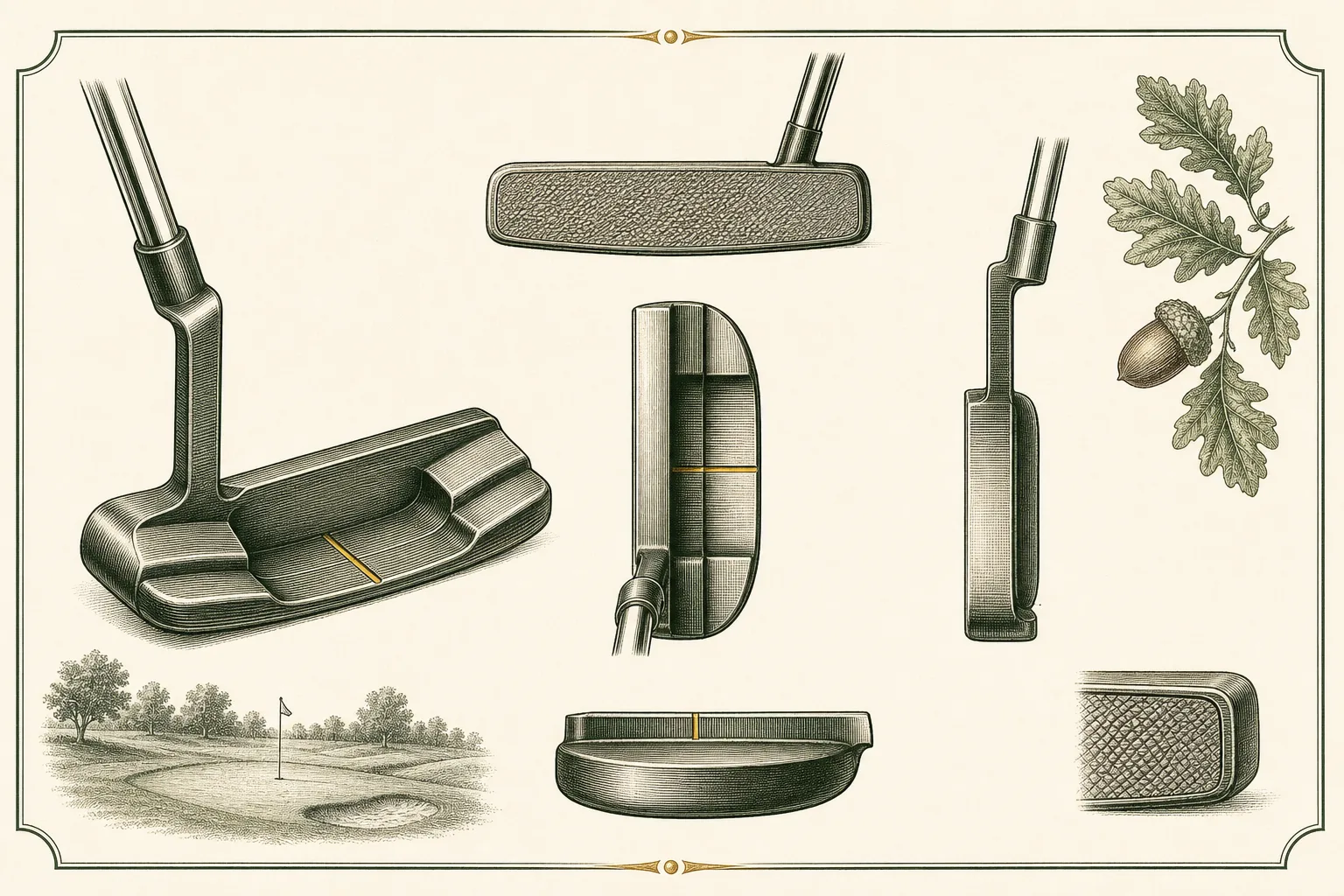
“A classic Robert Bettinardi milled blade from the Ben Hogan collaboration era, a collectible piece of the brand's roots. Traditional toe-hang blade for an arc stroke with the firm one-piece milled feel.”
The Baby Ben is the putter that put Bettinardi on the map – and it did it as an emergency substitution. Days before the 2003 U.S. Open at Olympia Fields, the USGA declared Jim Furyk's gamer non-conforming (a crown 'tongue' not connected to the sole). Bettinardi's shop was 25–30 minutes from the course; Furyk arrived around 11 a.m., spent roughly seven hours testing, and walked out with a wide-body aluminum mallet Bettinardi calls 'probably one of the first high-MOI putters ever made.' Furyk won by three. A gold commemorative Baby Ben now sits at Bettinardi HQ, and the model secured the company's first major just five years after it went independent.
A major-winning putter (2003 U.S. Open) with a documented, dramatic seven-hour-fitting origin story and status as one of the earliest high-MOI mallets, memorialized in a gold display at Bettinardi's headquarters. That provenance is covered by independent golf media (Golf.com, MyGolfSpy) – more than a check-mark, genuinely storied, though not a mass-market icon.
Players with a straighter, straight-back-straight-through stroke who want a stable, forgiving mallet head – the same profile Furyk (a notably steady, mechanical putter) chose. Collectors and Bettinardi/Furyk fans are a real secondary audience given the major-win provenance. Confirmed arc-stroke players who need toe hang should look at a Bettinardi blade (BB1) instead.
Emerged from Bettinardi's early independent years (the brand went solo in 1998 after milling putters for Titleist/Scotty Cameron 1993–98). Its 2003 win coincided with the 'Hogan Milled by Bettinardi' alliance (2003–05), when some Bettinardi putters were stamped with the Hogan name. As an early high-MOI mallet it predates and helped point toward the mallet-forgiveness arms race later dominated by Odyssey 2-Ball and TaylorMade Spider designs.
Scored as the high-MOI mallet it actually is: a wide-body aluminum head with mass pushed to the perimeter, engineered for stability on off-center strikes – pioneering for its 2003 era and the whole reason Furyk trusted it under U.S. Open pressure. It resists twisting on mis-hits far better than a blade, which is why it lands at 8. It is not a modern spider-style super-MOI putter and lacks today's alignment aids, so it stops short of 9–10.
Calibrated across the whole catalog — a tour blade scores low here on purpose; it means control, not ease.
A vintage, low-production putter with genuine collector interest because of the Furyk major win, so it trades on scarcity rather than a set market. Clean private-party examples realistically run roughly $150–350 in 2026, with tour-issue, Hogan-stamped, or commemorative variants commanding well more and standard well-worn examples less. Expect wide price scatter and occasional inflated 'collector' asks – condition, stampings and provenance drive it more than any book value.
Reading is one thing — hitting is another. Book a bay and see the numbers for yourself before you buy anywhere.
“A classic Robert Bettinardi milled blade from the Ben Hogan collaboration era, a collectible piece of the brand's roots. Traditional toe-hang blade for an arc stroke with the firm one-piece milled feel.”
The Baby Ben is the putter that put Bettinardi on the map – and it did it as an emergency substitution. Days before the 2003 U.S. Open at Olympia Fields, the USGA declared Jim Furyk's gamer non-conforming (a crown 'tongue' not connected to the sole). Bettinardi's shop was 25–30 minutes from the course; Furyk arrived around 11 a.m., spent roughly seven hours testing, and walked out with a wide-body aluminum mallet Bettinardi calls 'probably one of the first high-MOI putters ever made.' Furyk won by three. A gold commemorative Baby Ben now sits at Bettinardi HQ, and the model secured the company's first major just five years after it went independent.
A major-winning putter (2003 U.S. Open) with a documented, dramatic seven-hour-fitting origin story and status as one of the earliest high-MOI mallets, memorialized in a gold display at Bettinardi's headquarters. That provenance is covered by independent golf media (Golf.com, MyGolfSpy) – more than a check-mark, genuinely storied, though not a mass-market icon.
Players with a straighter, straight-back-straight-through stroke who want a stable, forgiving mallet head – the same profile Furyk (a notably steady, mechanical putter) chose. Collectors and Bettinardi/Furyk fans are a real secondary audience given the major-win provenance. Confirmed arc-stroke players who need toe hang should look at a Bettinardi blade (BB1) instead.
Emerged from Bettinardi's early independent years (the brand went solo in 1998 after milling putters for Titleist/Scotty Cameron 1993–98). Its 2003 win coincided with the 'Hogan Milled by Bettinardi' alliance (2003–05), when some Bettinardi putters were stamped with the Hogan name. As an early high-MOI mallet it predates and helped point toward the mallet-forgiveness arms race later dominated by Odyssey 2-Ball and TaylorMade Spider designs.
Scored as the high-MOI mallet it actually is: a wide-body aluminum head with mass pushed to the perimeter, engineered for stability on off-center strikes – pioneering for its 2003 era and the whole reason Furyk trusted it under U.S. Open pressure. It resists twisting on mis-hits far better than a blade, which is why it lands at 8. It is not a modern spider-style super-MOI putter and lacks today's alignment aids, so it stops short of 9–10.
Calibrated across the whole catalog — a tour blade scores low here on purpose; it means control, not ease.
A vintage, low-production putter with genuine collector interest because of the Furyk major win, so it trades on scarcity rather than a set market. Clean private-party examples realistically run roughly $150–350 in 2026, with tour-issue, Hogan-stamped, or commemorative variants commanding well more and standard well-worn examples less. Expect wide price scatter and occasional inflated 'collector' asks – condition, stampings and provenance drive it more than any book value.
Reading is one thing — hitting is another. Book a bay and see the numbers for yourself before you buy anywhere.