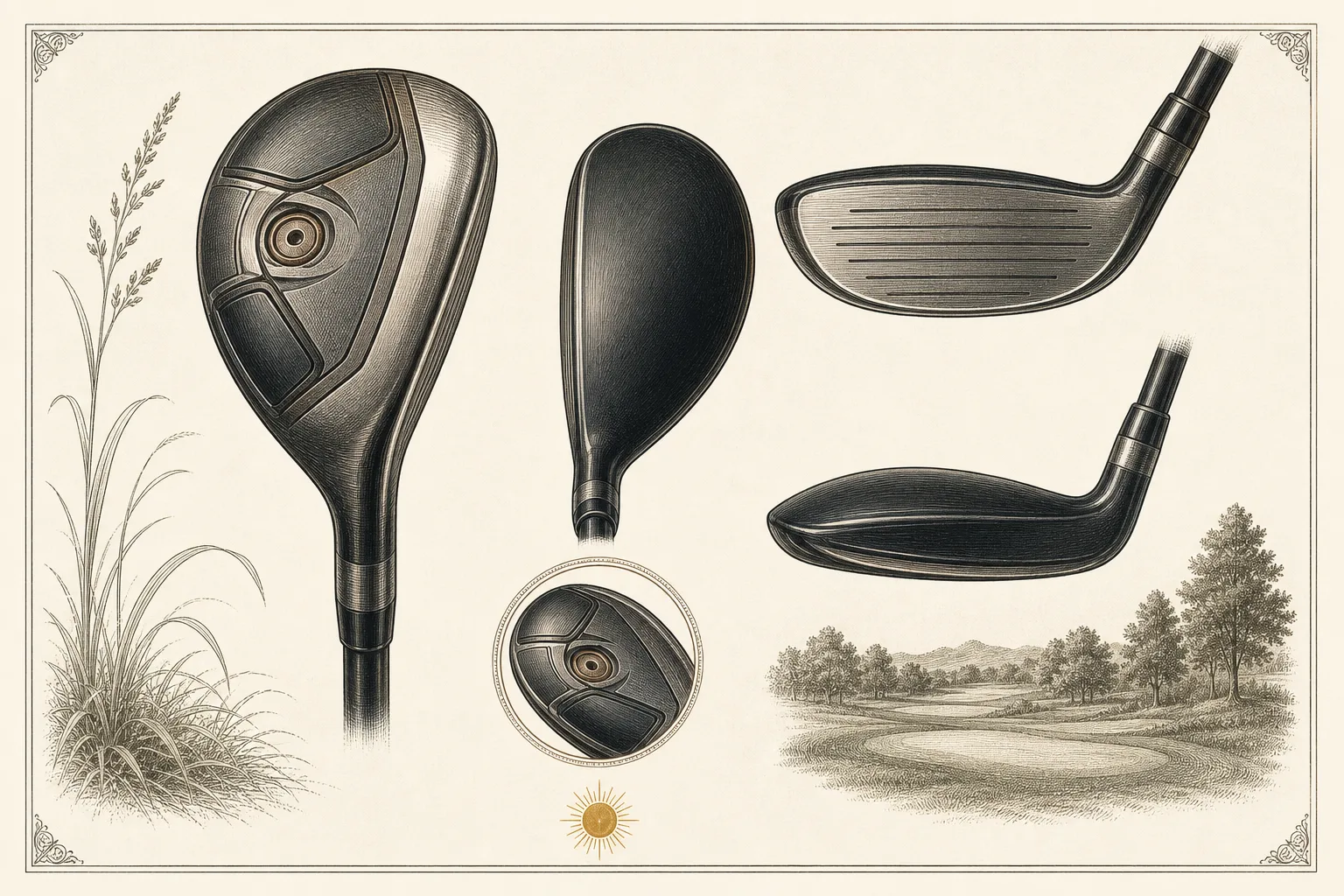
“A driving-iron style utility with an AM-355 cup face for ball speed and a curved Planet Sole that stays smooth even out of long rough. Max forgiveness for the player who wants a launchable, forgiving long-game replacement over a traditional 3/4 iron.”
The HI-877 replaced the HI-858 as Fourteen's utility/driving iron but skews more toward hybrid-like forgiveness: an AM355P steel cup face for ball speed sits on an ST-22 steel body with Fourteen's curved 'Planet Sole,' engineered to glide through turf and rough alike rather than dig like a traditional driving iron. A deep, high center of gravity promotes an easy, penetrating launch aimed at golfers bridging the gap between fairway wood and long iron. Sources vary slightly on exact loft spread (18-26 vs. 18-30 degrees across generations), and it retailed for around $350 in some listings against Clubhouse's catalogued $250 MSRP. Its yellow-accented face graphic was designed for the Japanese market and toned down for the eventual US release.
Received solid trade coverage (MyGolfSpy first look, GolfWRX spotted-in-the-wild posts, dedicated YouTube club test) as a well-engineered niche utility club, but nothing in the sourced coverage indicates scarcity, resale premium, or forum-driven pursuit beyond normal positive interest in a new Fourteen release.
Players who want a long-iron replacement that launches more easily than a traditional driving iron (like the HI-858) but keeps a more iron-like look and lower flight than a full hybrid. Golfers wanting maximum forgiveness and the highest, softest-landing flight from their long clubs should choose a true hybrid instead.
Launched to succeed the HI-858 as Fourteen moved its utility-iron category toward more forgiving, hybrid-adjacent design, competing against driving-iron/utility offerings like Titleist's U-500/U-505 and TaylorMade's UDI for golfers wanting a low, penetrating long-game replacement.
The AM355P cup face for ball speed, ST-22 body and curved Planet Sole (designed to stay smooth through long rough rather than dig) combine for real forgiveness in the driving-iron/utility category, and the deep-and-high CG makes it easier to launch than a traditional driving iron. It still asks more of the swing than a true wide-bodied hybrid, sitting between the HI-858 driving iron and a full hybrid on the forgiveness spectrum.
Calibrated across the whole catalog — a tour blade scores low here on purpose; it means control, not ease.
As a single-club utility iron, realistic private-party resale runs roughly $90-150 in 2026; 2nd Swing-style graded listings price clean examples somewhat higher, around $160-200, reflecting condition grading rather than genuine scarcity.
Reading is one thing — hitting is another. Book a bay and see the numbers for yourself before you buy anywhere.
“A driving-iron style utility with an AM-355 cup face for ball speed and a curved Planet Sole that stays smooth even out of long rough. Max forgiveness for the player who wants a launchable, forgiving long-game replacement over a traditional 3/4 iron.”
The HI-877 replaced the HI-858 as Fourteen's utility/driving iron but skews more toward hybrid-like forgiveness: an AM355P steel cup face for ball speed sits on an ST-22 steel body with Fourteen's curved 'Planet Sole,' engineered to glide through turf and rough alike rather than dig like a traditional driving iron. A deep, high center of gravity promotes an easy, penetrating launch aimed at golfers bridging the gap between fairway wood and long iron. Sources vary slightly on exact loft spread (18-26 vs. 18-30 degrees across generations), and it retailed for around $350 in some listings against Clubhouse's catalogued $250 MSRP. Its yellow-accented face graphic was designed for the Japanese market and toned down for the eventual US release.
Received solid trade coverage (MyGolfSpy first look, GolfWRX spotted-in-the-wild posts, dedicated YouTube club test) as a well-engineered niche utility club, but nothing in the sourced coverage indicates scarcity, resale premium, or forum-driven pursuit beyond normal positive interest in a new Fourteen release.
Players who want a long-iron replacement that launches more easily than a traditional driving iron (like the HI-858) but keeps a more iron-like look and lower flight than a full hybrid. Golfers wanting maximum forgiveness and the highest, softest-landing flight from their long clubs should choose a true hybrid instead.
Launched to succeed the HI-858 as Fourteen moved its utility-iron category toward more forgiving, hybrid-adjacent design, competing against driving-iron/utility offerings like Titleist's U-500/U-505 and TaylorMade's UDI for golfers wanting a low, penetrating long-game replacement.
The AM355P cup face for ball speed, ST-22 body and curved Planet Sole (designed to stay smooth through long rough rather than dig) combine for real forgiveness in the driving-iron/utility category, and the deep-and-high CG makes it easier to launch than a traditional driving iron. It still asks more of the swing than a true wide-bodied hybrid, sitting between the HI-858 driving iron and a full hybrid on the forgiveness spectrum.
Calibrated across the whole catalog — a tour blade scores low here on purpose; it means control, not ease.
As a single-club utility iron, realistic private-party resale runs roughly $90-150 in 2026; 2nd Swing-style graded listings price clean examples somewhat higher, around $160-200, reflecting condition grading rather than genuine scarcity.
Reading is one thing — hitting is another. Book a bay and see the numbers for yourself before you buy anywhere.