“A hugely popular, dependable game-improvement set with wide sole and forgiving cavity; launches easily and stays straight. Ideal budget bag-filler for mid-to-high handicaps.”
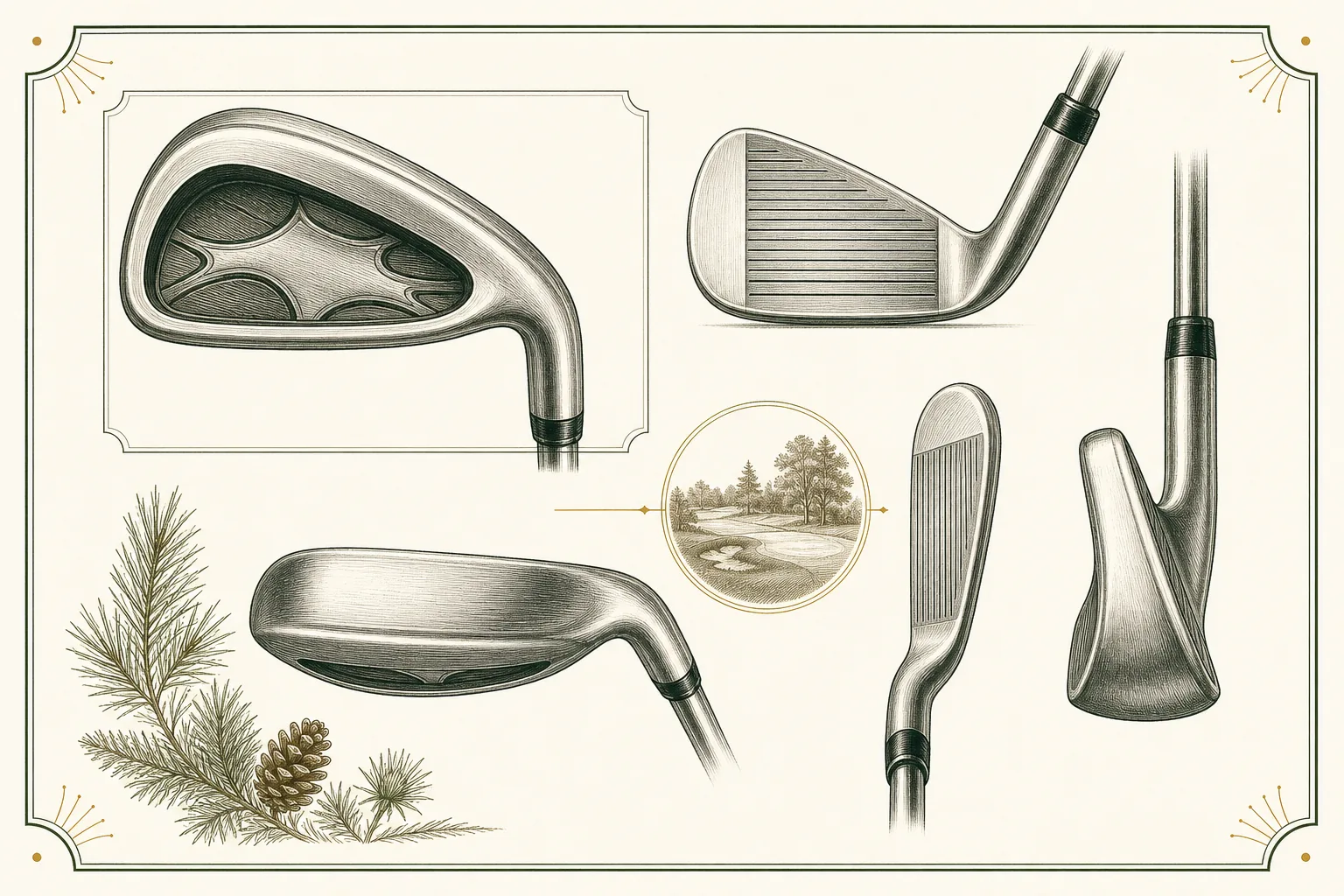
The Steelhead X-16 (2002) succeeded the beloved X-14 and refined the X-series toward a slightly more player-friendly midsize shape. Its headline was a notch weighting system — mass carved out of the center and pushed into the heel and toe to raise stability and MOI, so off-center strikes held line and speed. Callaway kept VFT (variable face thickness) tuning long-iron launch and short-iron control, plus the S2H2 hollow hosel and bore-through construction. Versus the X-14, the X-16 was tightened up: less offset, slightly shorter blades, a somewhat thicker topline — a nudge from pure oversized GI toward a cleaner look. It launched at ~$700–$800 a set as Callaway's mainstream cast-stainless GI iron before the X-18 and the annual X-series churn continued.
No cult and, notably, less lasting affection than the X-14 it followed — it's a competent mid-series GI iron that sold, was superseded on Callaway's refresh cadence, and today is a plentiful, inexpensive old set. golfreview.com shows a 4.0/5 across 76 reviews (solid but below the X-14's 256-review score). Its value is functional, not collectible; this is the honest commodity verdict.
For mid-to-high handicaps who want GI forgiveness in a slightly less bulky, less offset package than the X-14 — a fit for an improving player who has started to dislike heavy offset but still wants help. Not for players chasing modern distance/feel, a compact blade look, or workability. A current used GI or players-distance iron will out-launch and out-distance it for similar money.
Launched 2002 against Ping's i3/G2, Titleist DCI 981/755, and TaylorMade's RAC OS — the mainstream GI shelf of the early 2000s. It sat between the Steelhead X-14 (2000) and the X-18 (2004), continuing Callaway's roughly two-year X-series refresh. Its move to less offset and a tidier head foreshadowed the direction later X-series and Fusion/X-Forged models would take. A modern equivalent is a Callaway Apex DCB or Paradym GI iron — same 'forgiving but not maximal' brief with modern lofts.
Forgiving GI iron, scored a notch below the X-14/X-12 (8) on purpose: Callaway deliberately reduced offset, shortened the blade slightly and moved toward a cleaner midsize head, trading a sliver of raw forgiveness and draw-help for a better look and marginally more control. The notch heel-toe weighting keeps MOI high and off-center strikes on line, and VFT plus a wide sole still launch it easily — but it is a touch less 'idiot-proof' than the biggest X-series cavities. Still far more forgiving than any players' iron.
Calibrated across the whole catalog — a tour blade scores low here on purpose; it means control, not ease.
Reconditioned-retail (2nd Swing) lists roughly $336–$455 for graded/warrantied sets — that materially overstates owner value. Realistic 2026 private-party value is far lower, roughly $50–$110 for a complete clean steel set on eBay/SidelineSwap, a bit more for clean graphite or larger sets, less in rough condition. It's an early-2000s GI set made in volume; it does not appreciate and is worth its on-course utility.
Reading is one thing — hitting is another. Book a bay and see the numbers for yourself before you buy anywhere.
“A hugely popular, dependable game-improvement set with wide sole and forgiving cavity; launches easily and stays straight. Ideal budget bag-filler for mid-to-high handicaps.”
The Steelhead X-16 (2002) succeeded the beloved X-14 and refined the X-series toward a slightly more player-friendly midsize shape. Its headline was a notch weighting system — mass carved out of the center and pushed into the heel and toe to raise stability and MOI, so off-center strikes held line and speed. Callaway kept VFT (variable face thickness) tuning long-iron launch and short-iron control, plus the S2H2 hollow hosel and bore-through construction. Versus the X-14, the X-16 was tightened up: less offset, slightly shorter blades, a somewhat thicker topline — a nudge from pure oversized GI toward a cleaner look. It launched at ~$700–$800 a set as Callaway's mainstream cast-stainless GI iron before the X-18 and the annual X-series churn continued.
No cult and, notably, less lasting affection than the X-14 it followed — it's a competent mid-series GI iron that sold, was superseded on Callaway's refresh cadence, and today is a plentiful, inexpensive old set. golfreview.com shows a 4.0/5 across 76 reviews (solid but below the X-14's 256-review score). Its value is functional, not collectible; this is the honest commodity verdict.
For mid-to-high handicaps who want GI forgiveness in a slightly less bulky, less offset package than the X-14 — a fit for an improving player who has started to dislike heavy offset but still wants help. Not for players chasing modern distance/feel, a compact blade look, or workability. A current used GI or players-distance iron will out-launch and out-distance it for similar money.
Launched 2002 against Ping's i3/G2, Titleist DCI 981/755, and TaylorMade's RAC OS — the mainstream GI shelf of the early 2000s. It sat between the Steelhead X-14 (2000) and the X-18 (2004), continuing Callaway's roughly two-year X-series refresh. Its move to less offset and a tidier head foreshadowed the direction later X-series and Fusion/X-Forged models would take. A modern equivalent is a Callaway Apex DCB or Paradym GI iron — same 'forgiving but not maximal' brief with modern lofts.
Forgiving GI iron, scored a notch below the X-14/X-12 (8) on purpose: Callaway deliberately reduced offset, shortened the blade slightly and moved toward a cleaner midsize head, trading a sliver of raw forgiveness and draw-help for a better look and marginally more control. The notch heel-toe weighting keeps MOI high and off-center strikes on line, and VFT plus a wide sole still launch it easily — but it is a touch less 'idiot-proof' than the biggest X-series cavities. Still far more forgiving than any players' iron.
Calibrated across the whole catalog — a tour blade scores low here on purpose; it means control, not ease.
Reconditioned-retail (2nd Swing) lists roughly $336–$455 for graded/warrantied sets — that materially overstates owner value. Realistic 2026 private-party value is far lower, roughly $50–$110 for a complete clean steel set on eBay/SidelineSwap, a bit more for clean graphite or larger sets, less in rough condition. It's an early-2000s GI set made in volume; it does not appreciate and is worth its on-course utility.
Reading is one thing — hitting is another. Book a bay and see the numbers for yourself before you buy anywhere.