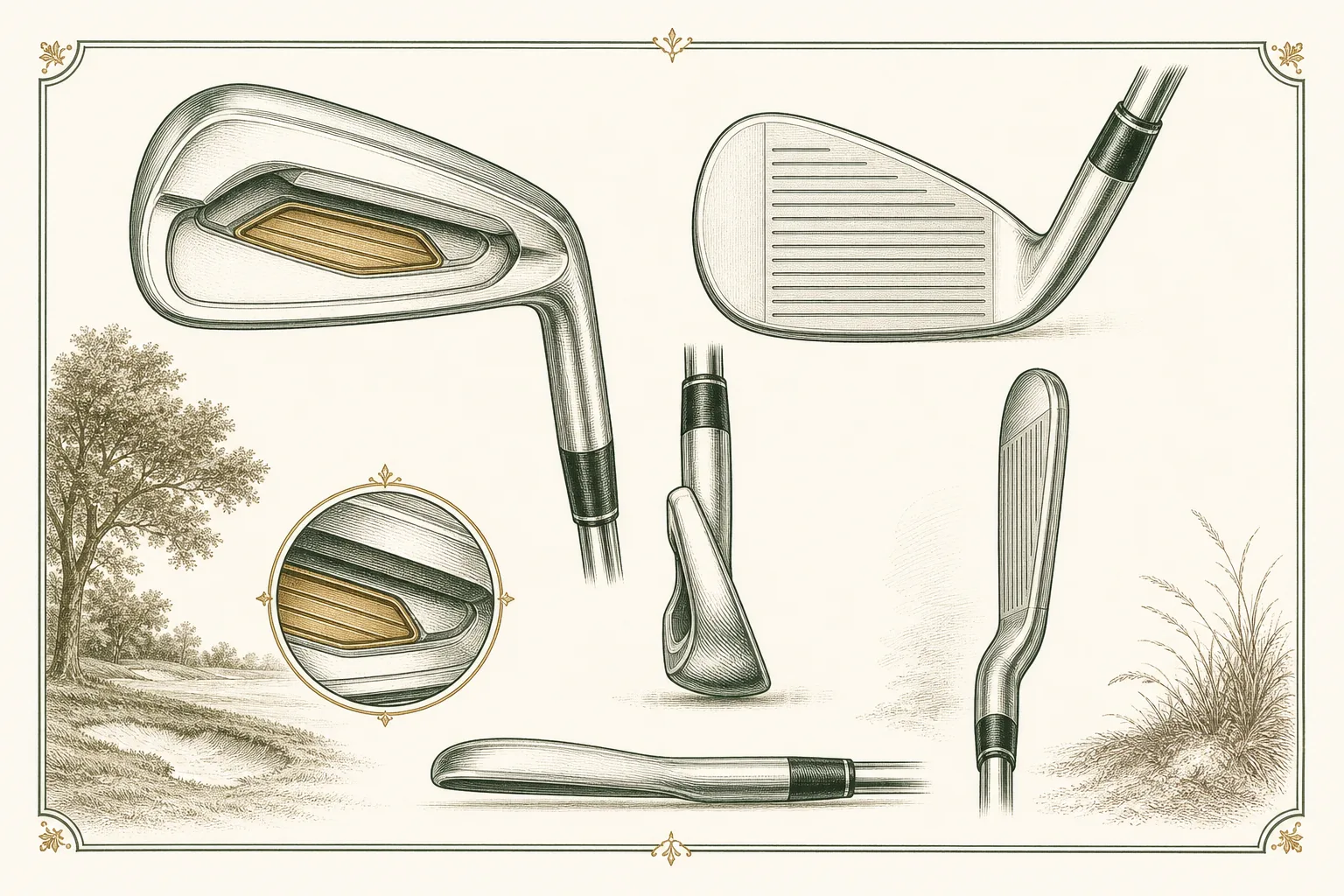
“Edge CFT (Cast Face Technology) - an early-2000s GI iron. Rung-1, a vintage buy.”
Launched March 13, 2003 as part of Ben Hogan Golf's 50th-anniversary push under Spalding ownership, mere months before Spalding's Top-Flite division filed for bankruptcy and handed the Hogan name to Callaway. CFT stood for Compression Forged Titanium: a titanium face compression-forged then welded to a stainless/carbon-steel cavity body and packed with polycarbonate foam to quiet vibration, riding the brief early-2000s fad for titanium-faced game-improvement irons before manufacturers largely abandoned the tech. Heads ran roughly 12% larger than Hogan's own players-cavity PTx of the same era, aimed at a distinctly more forgiving buyer, and launched alongside Colin Montgomerie's endorsement deal.
No collector cult and no forum mythology, but it is a genuine artifact of a specific, short-lived fad: titanium-faced game-improvement irons that briefly promised extra face speed before the category faded by mid-decade on durability and diminishing-returns concerns. MyGolfSpy's own 'History's Mysteries' retrospective treats it as a curiosity worth remembering rather than a club anyone chases, and golfreview.com's aggregate of 4.2/5 across 80 owner reviews reads as well-liked commodity, not cult item.
Mid-to-high handicappers of the mid-2000s wanting forgiveness with more traditional looks than the era's boxiest GI irons. Not a fit for today's better player chasing distance or feel - a 20-year-old titanium-faced GI iron is outpaced by any current players-distance iron, and if the compression-forged face ever cracks, replacement parts are effectively unobtainable.
Released under Spalding ownership days before Spalding's Top-Flite division filed for bankruptcy in 2003; Callaway Golf bought the Ben Hogan, Top-Flite and Strata brands out of that bankruptcy for $169 million later the same year and folded Edge-derived tech into the Apex Edge/Apex FTx lines through 2004 before discontinuing Ben Hogan clubs entirely in 2008. It has nothing to do with the DTC 'reborn' Ben Hogan of 2015 onward - a completely different company under a completely different ownership, a decade apart.
A deep, extended cavity plus foam-damped titanium face pushed CG low and back for a genuinely game-improvement iron of its moment - roughly 12% more effective hitting area than Hogan's own PTx players cavity, forgiving on thin and toe strikes. It falls short of a modern max-GI iron's forgiveness (today's hollow-body construction carries far more discretionary weight), but was a legitimately easy-swinging iron for 2003.
Calibrated across the whole catalog — a tour blade scores low here on purpose; it means control, not ease.
Titanium-faced GI irons from this era carry little collector premium; expect roughly $60-$130 for a complete used steel set in 2026, similar to other forgotten early-2000s GI irons, with condition (face cracking is the specific risk with a 20+ year old compression-forged titanium face) driving most of the price swing. No reconditioned-retail channel exists for a set this old, so private-party listings (eBay, GolfWRX classifieds) are effectively the only market.
Reading is one thing — hitting is another. Book a bay and see the numbers for yourself before you buy anywhere.
“Edge CFT (Cast Face Technology) - an early-2000s GI iron. Rung-1, a vintage buy.”
Launched March 13, 2003 as part of Ben Hogan Golf's 50th-anniversary push under Spalding ownership, mere months before Spalding's Top-Flite division filed for bankruptcy and handed the Hogan name to Callaway. CFT stood for Compression Forged Titanium: a titanium face compression-forged then welded to a stainless/carbon-steel cavity body and packed with polycarbonate foam to quiet vibration, riding the brief early-2000s fad for titanium-faced game-improvement irons before manufacturers largely abandoned the tech. Heads ran roughly 12% larger than Hogan's own players-cavity PTx of the same era, aimed at a distinctly more forgiving buyer, and launched alongside Colin Montgomerie's endorsement deal.
No collector cult and no forum mythology, but it is a genuine artifact of a specific, short-lived fad: titanium-faced game-improvement irons that briefly promised extra face speed before the category faded by mid-decade on durability and diminishing-returns concerns. MyGolfSpy's own 'History's Mysteries' retrospective treats it as a curiosity worth remembering rather than a club anyone chases, and golfreview.com's aggregate of 4.2/5 across 80 owner reviews reads as well-liked commodity, not cult item.
Mid-to-high handicappers of the mid-2000s wanting forgiveness with more traditional looks than the era's boxiest GI irons. Not a fit for today's better player chasing distance or feel - a 20-year-old titanium-faced GI iron is outpaced by any current players-distance iron, and if the compression-forged face ever cracks, replacement parts are effectively unobtainable.
Released under Spalding ownership days before Spalding's Top-Flite division filed for bankruptcy in 2003; Callaway Golf bought the Ben Hogan, Top-Flite and Strata brands out of that bankruptcy for $169 million later the same year and folded Edge-derived tech into the Apex Edge/Apex FTx lines through 2004 before discontinuing Ben Hogan clubs entirely in 2008. It has nothing to do with the DTC 'reborn' Ben Hogan of 2015 onward - a completely different company under a completely different ownership, a decade apart.
A deep, extended cavity plus foam-damped titanium face pushed CG low and back for a genuinely game-improvement iron of its moment - roughly 12% more effective hitting area than Hogan's own PTx players cavity, forgiving on thin and toe strikes. It falls short of a modern max-GI iron's forgiveness (today's hollow-body construction carries far more discretionary weight), but was a legitimately easy-swinging iron for 2003.
Calibrated across the whole catalog — a tour blade scores low here on purpose; it means control, not ease.
Titanium-faced GI irons from this era carry little collector premium; expect roughly $60-$130 for a complete used steel set in 2026, similar to other forgotten early-2000s GI irons, with condition (face cracking is the specific risk with a 20+ year old compression-forged titanium face) driving most of the price swing. No reconditioned-retail channel exists for a set this old, so private-party listings (eBay, GolfWRX classifieds) are effectively the only market.
Reading is one thing — hitting is another. Book a bay and see the numbers for yourself before you buy anywhere.