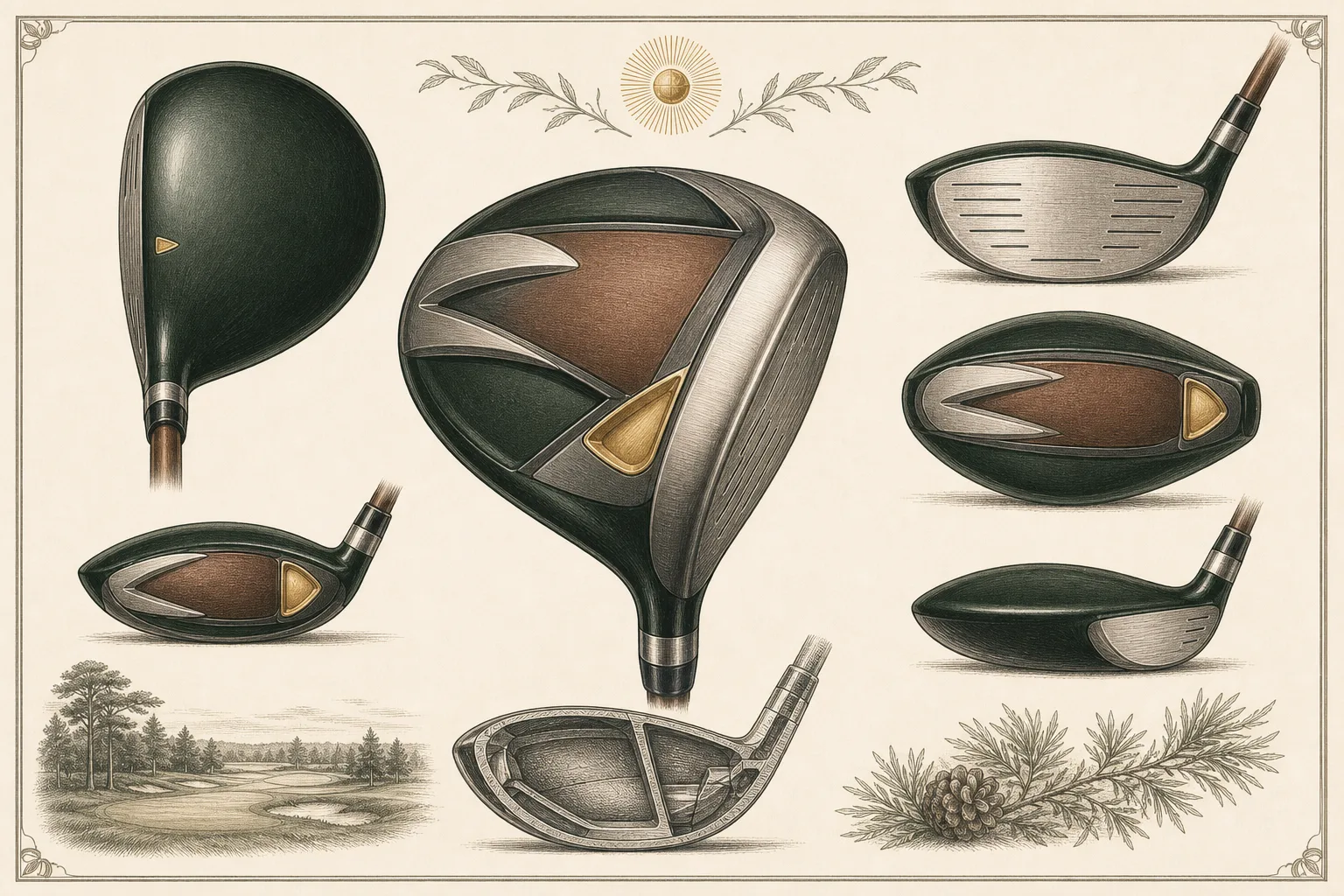
“A stable, easy-launch fairway from the Sumo era. Still a fine rung-1 option off the deck for a moderate swing.”
The SasQuatch Sumo fairway was Nike's 2007 forgiveness play, the smaller sibling to the driver that made the 'Sumo' name a golf punchline. Cast from 455 Carpenter stainless steel, it wrapped Nike's PowerBow technology — a heavy bar of mass pushed into the rear sole — around a compact fairway head to drop the center of gravity low and deep, chasing a high, easy launch and a wide sweet spot rather than workability. It was engineered to get mid-to-high handicappers airborne off the deck and to hold line on toe and heel strikes, sold as 3-, 5- and 7-woods (15/18/21 degrees). It rode the coattails of the polarizing square-headed Sumsquared driver era: not a landmark club, but a competent, forgiving fairway from Nike's most-talked-about equipment years.
The fairway itself carries no collector premium — it was a mainstream game-improvement wood that sold in volume and now sits cheap and plentiful on the used market. The fame belongs to the SQ Sumo/Sumsquared DRIVER (the square-headed 'greatest/worst driver ever' meme that golf media still writes odes to), not to this fairway. Honest verdict: functional value only.
Built for mid-to-high handicaps and moderate swing speeds who struggle to get a fairway wood up off the turf and want mishits punished less. As a cheap, easy-launching 3/5/7-wood or a fill-in for a beater bag it still does its job. Who should skip it: better players wanting to flight or shape the ball, or anyone chasing modern adjustable-hosel fairways — this is a fixed-loft, launch-it-high tool.
Launched 2007 against TaylorMade's Burner fairways, Callaway's Big Bertha/FT fairways and Ping's G10 woods. It was part of Nike's SasQuatch family that peaked with the square Sumsquared driver (2008); Nike then moved to the VR/Victory Red and later Covert lines before exiting the club business entirely in 2016. A modern equivalent is any max-forgiveness fairway like a Ping G430 SFT or Callaway Paradym X — same low-spin-off-the-deck, launch-it-easy brief with two decades of materials science added.
Genuinely forgiving for a fairway wood: the PowerBow rear weighting and 455-steel perimeter construction push CG low and deep for a high MOI, so off-center strikes hold distance and line and the ball launches easily off tight lies — exactly the mid-to-high-handicap brief. The trade-off is the reverse of a tour fairway: minimal shot-shaping, a ball flight that wants to go high and straight, and a chunky, deep footprint at address that better players find hard to work or flight down.
Calibrated across the whole catalog — a tour blade scores low here on purpose; it means control, not ease.
A cheap commodity in 2026: realistic private-party value is roughly $20-$50 on eBay/SidelineSwap depending on shaft, flex and head wear, with clean examples at the top of that band. Graded reconditioned-retail listings can show more, but that is store markup, not what an owner will get. It does not appreciate — value is purely what it can still do on the course.
Reading is one thing — hitting is another. Book a bay and see the numbers for yourself before you buy anywhere.