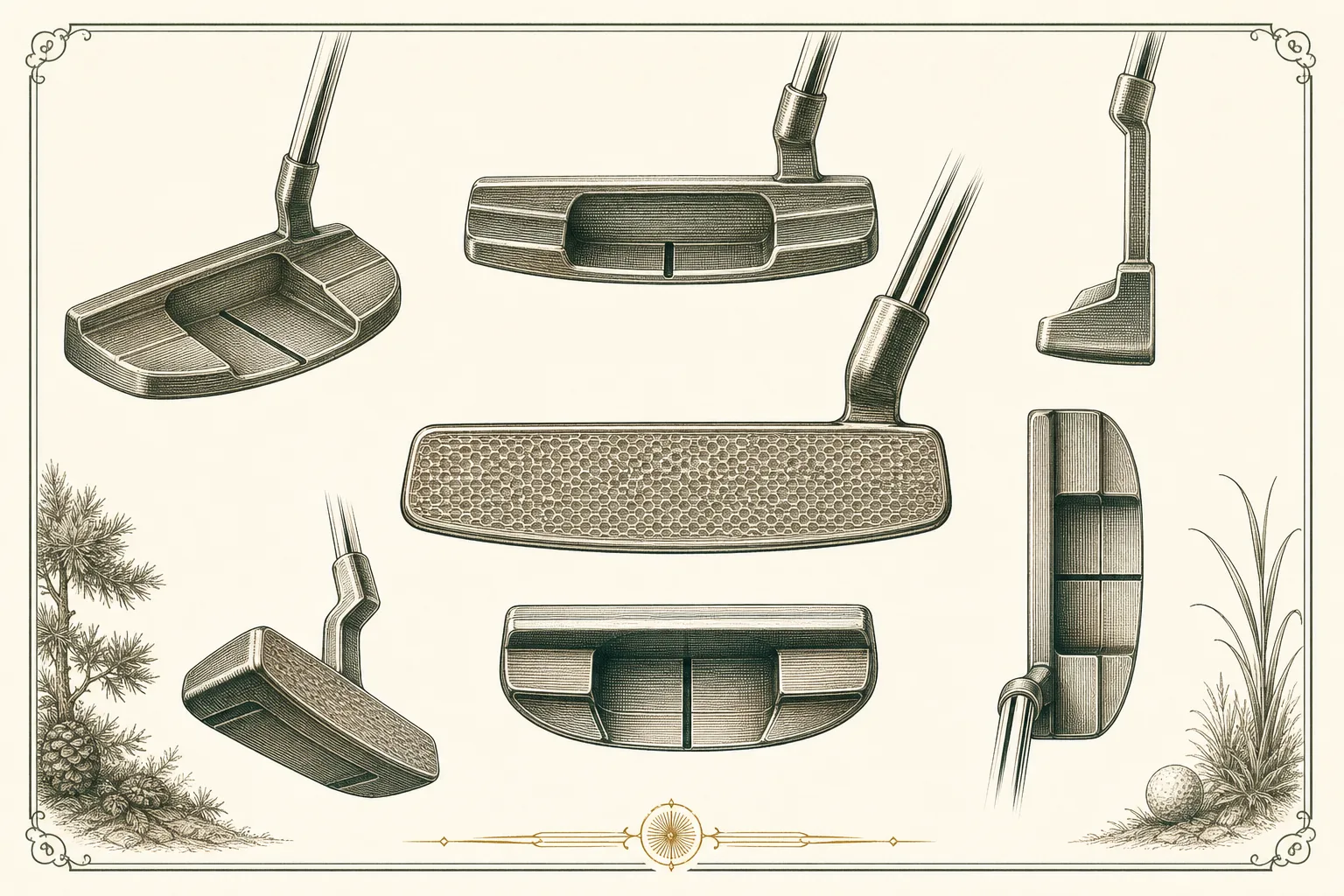
“A multi-material high-MOI mallet available in center-shaft and crank-neck options, tour-proven around 2016. Face-balanced builds suit a straight stroke; crank-neck adds a touch of toe hang for a mild arc.”
Inovai 3.0 is the most heavily reviewed early Inovai, sold as a 2016–2017 model per period Amazon and retailer listings. Its 'fang' head shape uses a soft 6061 aluminum face and a stainless-steel rear 'wing' weight pulled low and rearward for what Bettinardi called the 'perfect head weight,' milled with the brand's F.I.T. (Feel-Impact-Technology) face that removes roughly 55% of material to soften feel. GolfWRX and National Club Golfer both flagged it as the most divisive-looking putter in Bettinardi's then-current line — 'the wackiest design' — while praising its alignment aids and distance control; reviewers split on the face feel itself, with some calling it the softest metal-faced putter they'd rolled and others finding it dead and rubbery in the hands.
Genuinely notable rather than a cult classic: it drew independent reviews from GolfWRX, National Club Golfer, Today's Golfer and Plugged In Golf, and its striking, divisive fang shape got real trade-press attention as a design statement. But reviewer reception on the face feel was mixed, not uniformly glowing, and there is no evidence of players actively hunting it down years later.
A player who wants maximum forgiveness and doesn't mind a bold, alignment-heavy, love-it-or-hate-it look — reviewers were explicit that appearance would 'divide opinion.' A golfer who wants a soft, traditional milled-face feel above all else should be aware reviews split on whether the F.I.T. aluminum face feels premium-soft or artificially dead; try before buying.
Part of the mid-2010s wave of Bettinardi mallets alongside Inovai 2.0, competing against the era's TaylorMade Spider and Odyssey O-Works mallets for the high-MOI buyer. It was followed by Inovai 5.0, which reviewers noted rounded off the fangs and toned down the design.
High-MOI mallet by design: the rearward stainless wing weight and fang-shape perimeter mass are explicitly built to resist twisting on off-center hits, and reviewers specifically credit it with strong distance control and stability. Consistent with the rest of the high-MOI Inovai family.
Calibrated across the whole catalog — a tour blade scores low here on purpose; it means control, not ease.
Realistic 2026 private-party pricing for a clean example runs roughly $90–$150, reflecting a nearly decade-old mallet that never developed premium resale demand; counterbalance and less common shaft configurations trend toward the higher end.
Reading is one thing — hitting is another. Book a bay and see the numbers for yourself before you buy anywhere.
“A multi-material high-MOI mallet available in center-shaft and crank-neck options, tour-proven around 2016. Face-balanced builds suit a straight stroke; crank-neck adds a touch of toe hang for a mild arc.”
Inovai 3.0 is the most heavily reviewed early Inovai, sold as a 2016–2017 model per period Amazon and retailer listings. Its 'fang' head shape uses a soft 6061 aluminum face and a stainless-steel rear 'wing' weight pulled low and rearward for what Bettinardi called the 'perfect head weight,' milled with the brand's F.I.T. (Feel-Impact-Technology) face that removes roughly 55% of material to soften feel. GolfWRX and National Club Golfer both flagged it as the most divisive-looking putter in Bettinardi's then-current line — 'the wackiest design' — while praising its alignment aids and distance control; reviewers split on the face feel itself, with some calling it the softest metal-faced putter they'd rolled and others finding it dead and rubbery in the hands.
Genuinely notable rather than a cult classic: it drew independent reviews from GolfWRX, National Club Golfer, Today's Golfer and Plugged In Golf, and its striking, divisive fang shape got real trade-press attention as a design statement. But reviewer reception on the face feel was mixed, not uniformly glowing, and there is no evidence of players actively hunting it down years later.
A player who wants maximum forgiveness and doesn't mind a bold, alignment-heavy, love-it-or-hate-it look — reviewers were explicit that appearance would 'divide opinion.' A golfer who wants a soft, traditional milled-face feel above all else should be aware reviews split on whether the F.I.T. aluminum face feels premium-soft or artificially dead; try before buying.
Part of the mid-2010s wave of Bettinardi mallets alongside Inovai 2.0, competing against the era's TaylorMade Spider and Odyssey O-Works mallets for the high-MOI buyer. It was followed by Inovai 5.0, which reviewers noted rounded off the fangs and toned down the design.
High-MOI mallet by design: the rearward stainless wing weight and fang-shape perimeter mass are explicitly built to resist twisting on off-center hits, and reviewers specifically credit it with strong distance control and stability. Consistent with the rest of the high-MOI Inovai family.
Calibrated across the whole catalog — a tour blade scores low here on purpose; it means control, not ease.
Realistic 2026 private-party pricing for a clean example runs roughly $90–$150, reflecting a nearly decade-old mallet that never developed premium resale demand; counterbalance and less common shaft configurations trend toward the higher end.
Reading is one thing — hitting is another. Book a bay and see the numbers for yourself before you buy anywhere.