“A true forged muscleback built for Tour staff who wanted a real blade - rung-4 rare air with the highest readiness bar in the bag. Only earns a slot with an elite center-strike rate and tight dispersion; otherwise it steals distance and joy.”
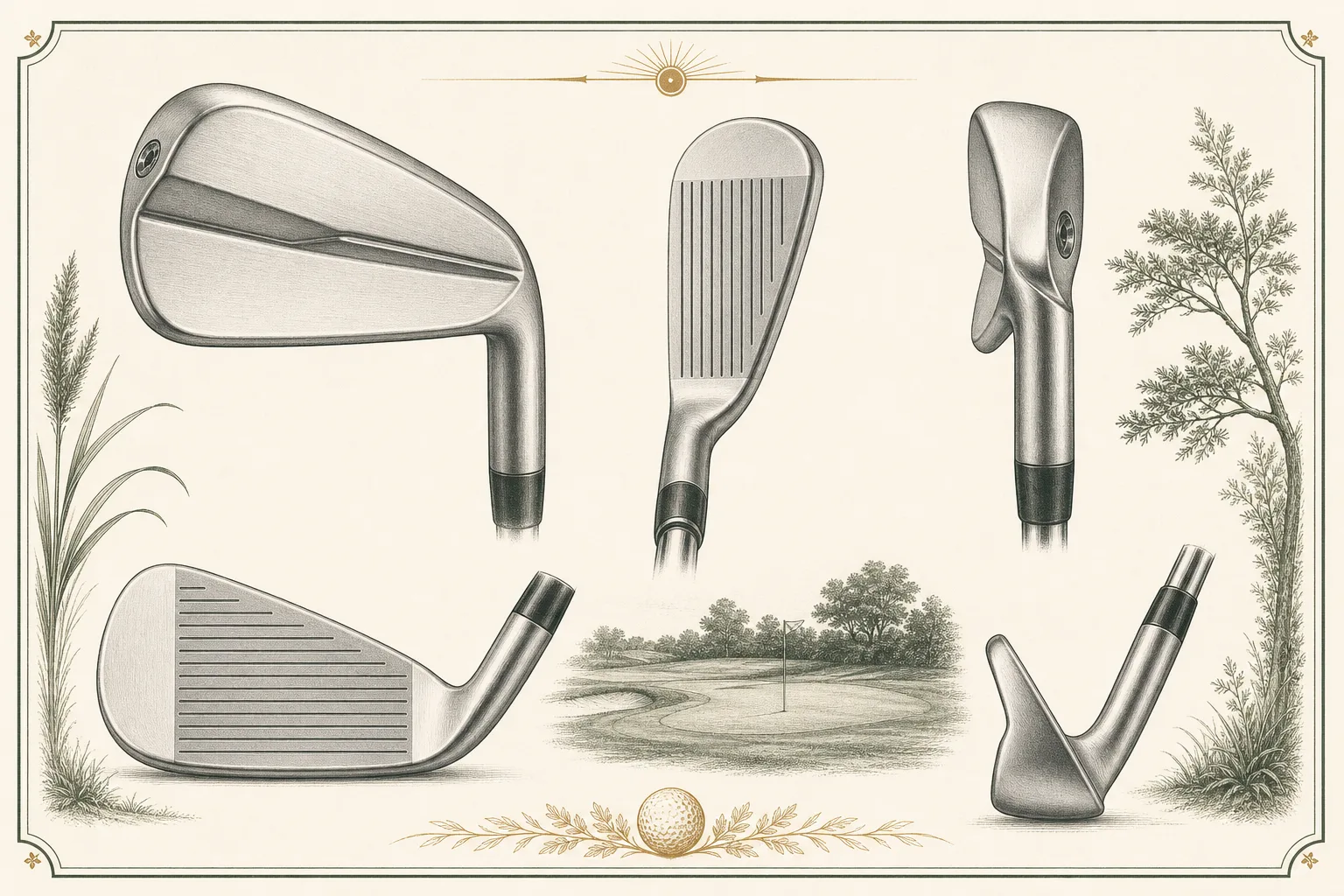
Unveiled May 2019, the Blueprint was Ping's return to a true one-piece forged muscleback blade, built explicitly to a request from its Tour staff who wanted a proper players' blade rather than a cavity. Each head is forged from a single billet of 8620 carbon steel through a four-stage forging process, with a thin topline, narrow sole and virtually no offset. Ping added tungsten weights in the toe and hosel to claw back a little stability without compromising the blade shape, and every face and groove is CNC-milled for consistency. It is unapologetically an elite-player tool - Ping itself frames it as an iron for scratch handicaps and below - offering the workability and shot-shaping control that only a compact blade delivers.
Its standing comes from being Ping's first genuine forged blade in years and a Tour-driven design, gamed by elite ball-strikers and reviewed as a benchmark modern muscleback by Plugged In Golf, Today's Golfer and National Club Golfer. But a sub-scratch-only blade sells in tiny numbers and commands respect rather than mass reverence or scarcity pricing, so it is notable, not a cult classic or icon.
Strictly for elite ball-strikers - scratch handicap and below - with the speed and consistency to flight and shape shots on command. The payoff is total workability and feedback. Anyone above a low single-digit handicap should not consider it; the i210 or i59 offer players-iron feel with meaningful forgiveness, and the G-series is far kinder still.
At launch it competed with the Titleist 620 MB, Mizuno MP-20 MB, TaylorMade P730 and Srixon Z-Forged blades of 2019. Within Ping's line it sits below the iBlade/i210 as the pure-blade halo, and was succeeded by the Blueprint S (2023 hollow-ish players cavity) and Blueprint T (compact blade), which split the concept into two heads.
This is a muscleback blade - among the least forgiving irons made. The thin topline, narrow sole, minimal offset and small effective sweet spot punish toe, heel and thin strikes with real distance and directional loss. The tungsten toe and hosel weighting adds a sliver of stability versus a classic blade, which is why it earns a 3 rather than a 2, but it demands a repeatable, center-face strike and offers no help to anyone who does not have one.
Calibrated across the whole catalog — a tour blade scores low here on purpose; it means control, not ease.
A clean forged blade set trades roughly $500-850 private-party in 2026 (set MSRP was in the ~$1,400-1,600 range). It holds value moderately well because forged blades attract a dedicated buyer, but the tiny target audience limits liquidity. Carbon-steel heads show wear and light rust that hurt value; bent lofts/lies from prior fitting and worn grooves narrow the already-small pool of qualified buyers.
The Legends Rack
The beloved players' cavity and Ping's pure blade — the Blueprint being the rare Ping that better players describe as pretty. Who'll love it: Ping loyalists who ball-strike.
Who it suitsBetter players
Reading is one thing — hitting is another. Book a bay and see the numbers for yourself before you buy anywhere.
“A true forged muscleback built for Tour staff who wanted a real blade - rung-4 rare air with the highest readiness bar in the bag. Only earns a slot with an elite center-strike rate and tight dispersion; otherwise it steals distance and joy.”
Unveiled May 2019, the Blueprint was Ping's return to a true one-piece forged muscleback blade, built explicitly to a request from its Tour staff who wanted a proper players' blade rather than a cavity. Each head is forged from a single billet of 8620 carbon steel through a four-stage forging process, with a thin topline, narrow sole and virtually no offset. Ping added tungsten weights in the toe and hosel to claw back a little stability without compromising the blade shape, and every face and groove is CNC-milled for consistency. It is unapologetically an elite-player tool - Ping itself frames it as an iron for scratch handicaps and below - offering the workability and shot-shaping control that only a compact blade delivers.
Its standing comes from being Ping's first genuine forged blade in years and a Tour-driven design, gamed by elite ball-strikers and reviewed as a benchmark modern muscleback by Plugged In Golf, Today's Golfer and National Club Golfer. But a sub-scratch-only blade sells in tiny numbers and commands respect rather than mass reverence or scarcity pricing, so it is notable, not a cult classic or icon.
Strictly for elite ball-strikers - scratch handicap and below - with the speed and consistency to flight and shape shots on command. The payoff is total workability and feedback. Anyone above a low single-digit handicap should not consider it; the i210 or i59 offer players-iron feel with meaningful forgiveness, and the G-series is far kinder still.
At launch it competed with the Titleist 620 MB, Mizuno MP-20 MB, TaylorMade P730 and Srixon Z-Forged blades of 2019. Within Ping's line it sits below the iBlade/i210 as the pure-blade halo, and was succeeded by the Blueprint S (2023 hollow-ish players cavity) and Blueprint T (compact blade), which split the concept into two heads.
This is a muscleback blade - among the least forgiving irons made. The thin topline, narrow sole, minimal offset and small effective sweet spot punish toe, heel and thin strikes with real distance and directional loss. The tungsten toe and hosel weighting adds a sliver of stability versus a classic blade, which is why it earns a 3 rather than a 2, but it demands a repeatable, center-face strike and offers no help to anyone who does not have one.
Calibrated across the whole catalog — a tour blade scores low here on purpose; it means control, not ease.
A clean forged blade set trades roughly $500-850 private-party in 2026 (set MSRP was in the ~$1,400-1,600 range). It holds value moderately well because forged blades attract a dedicated buyer, but the tiny target audience limits liquidity. Carbon-steel heads show wear and light rust that hurt value; bent lofts/lies from prior fitting and worn grooves narrow the already-small pool of qualified buyers.
The Legends Rack
The beloved players' cavity and Ping's pure blade — the Blueprint being the rare Ping that better players describe as pretty. Who'll love it: Ping loyalists who ball-strike.
Who it suitsBetter players
Reading is one thing — hitting is another. Book a bay and see the numbers for yourself before you buy anywhere.