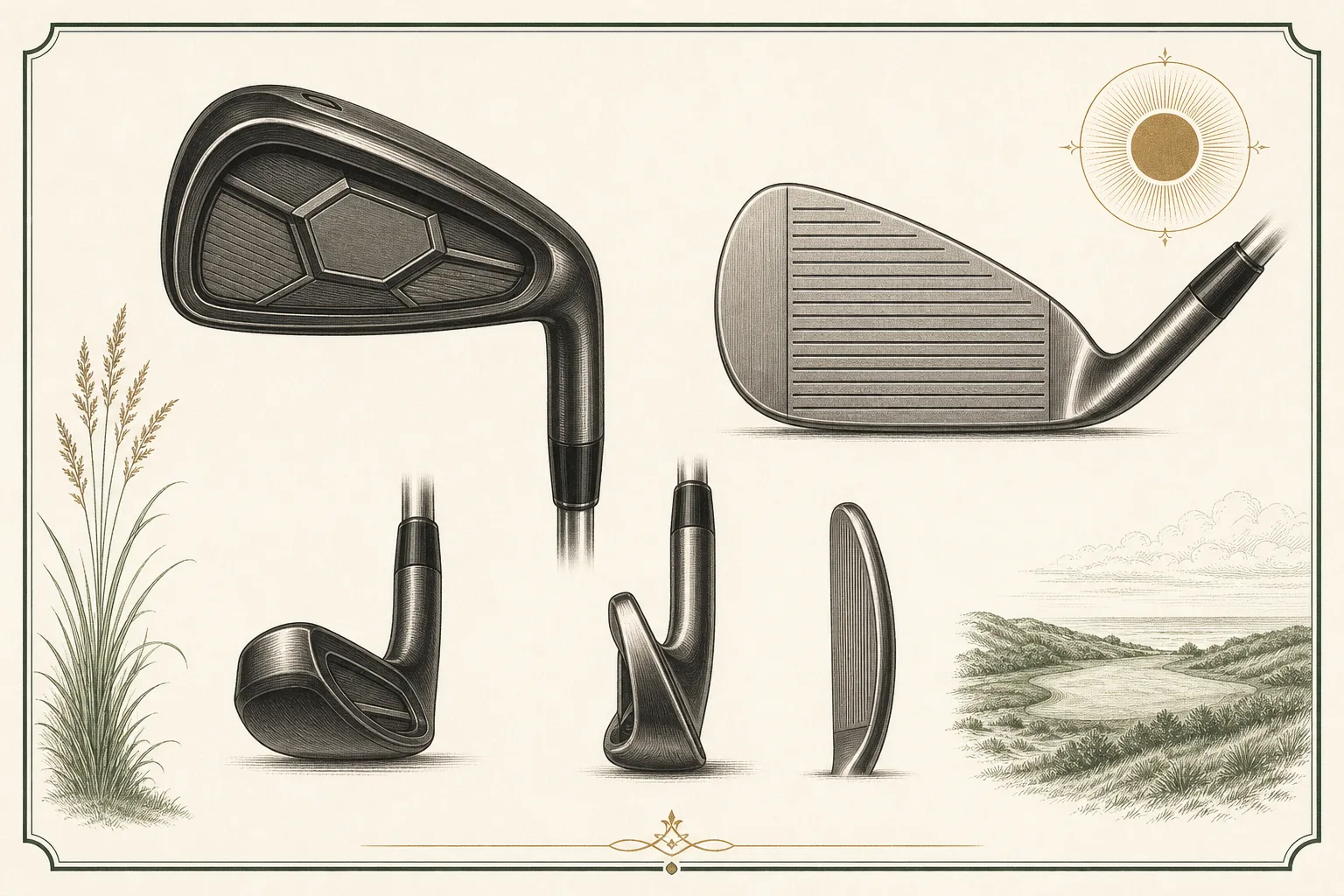
“Compact forged cavity back in a black finish, the tour end of Adams' iron range. A players-cavity rung for accomplished ball-strikers who prefer shaping over hybrid help.”
Adams' bid for credibility with better players during its late-2000s tour push. Where the mainstream Idea line was all about hybrids and forgiveness, the Idea Pro Black CB (the first, sometimes called CB1) was a forged 8620 carbon-steel cavity-back with classic lines, minimal offset, and a milled cavity and grooves cut to the 2010 USGA groove spec. The heads wear Adams' signature nickel-chromium black PVD finish, a look that became a small signature of the Pro Black era. It was engineered to bridge Adams' tour offerings and its game-improvement bread-and-butter: a soft-feeling, workable players' cavity that low-to-mid handicaps could shape while still getting a touch of cavity-back help. It arrived alongside a genuine Adams tour presence and quietly earned a reputation as a lot of forged iron for the money.
Underrated and cheap relative to its quality. Adams was never a prestige irons brand, so a well-made forged 8620 players' cavity from the company flies under the radar and posts strong user ratings (golfreview scores in the 4.4-4.8 range across the Pro Black CB family) while trading for a fraction of a comparable Mizuno or Titleist. Feel-focused buyers who know the line seek it out; the wider market overlooks it. That gap between quality and reputation is the definition of a sleeper, not a cult.
For low-to-mid handicaps (roughly 0-12) with consistent ball-striking who want forged feel, workability, and a clean address look at a value price. Lofts (4=24 through PW=46) are traditional, so it flies shorter and higher-spinning than a modern strong-lofted set. Higher handicaps chasing forgiveness or distance should look at the mainstream Idea or CB2 instead.
Launched 2010 into the first wave of clubs cut to the new 2010 conforming-groove rule, competing against players' cavities like the Mizuno MP-52/MX-300, Titleist AP2/CB, and Ping i15. It anchored Adams' 'Pro' identity during the brand's most credible tour period. It was followed by the slightly more forgiving CB2 (2011) and CB3 (2012). A modern equivalent is any current forged players-cavity such as a Mizuno Pro 245 or Titleist T150, with today's stronger lofts.
Forgiving only for its class. This is a compact forged players' cavity with a thin topline, little offset, and a modest sweet spot; the milled cavity and perimeter weighting give it a bit more stability than a muscle-back, but thin and toe strikes lose distance and feel. A 5 means 'about as forgiving as a true players' cavity gets,' not 'easy to hit.' It demands a repeatable center-face strike and rewards it with soft feel and shot control.
Calibrated across the whole catalog — a tour blade scores low here on purpose; it means control, not ease.
A value standout: realistic 2026 private-party price for a clean 4-PW/GW set is roughly $120-250 depending on shaft and wear, well under a comparable Mizuno or Titleist of the same vintage, which is exactly why feel-seekers hunt them. Reconditioned-retail and trade-in figures can run higher and overstate private-party value. Premium or rare shafts and mint condition push the top of the range.
Reading is one thing — hitting is another. Book a bay and see the numbers for yourself before you buy anywhere.
“Compact forged cavity back in a black finish, the tour end of Adams' iron range. A players-cavity rung for accomplished ball-strikers who prefer shaping over hybrid help.”
Adams' bid for credibility with better players during its late-2000s tour push. Where the mainstream Idea line was all about hybrids and forgiveness, the Idea Pro Black CB (the first, sometimes called CB1) was a forged 8620 carbon-steel cavity-back with classic lines, minimal offset, and a milled cavity and grooves cut to the 2010 USGA groove spec. The heads wear Adams' signature nickel-chromium black PVD finish, a look that became a small signature of the Pro Black era. It was engineered to bridge Adams' tour offerings and its game-improvement bread-and-butter: a soft-feeling, workable players' cavity that low-to-mid handicaps could shape while still getting a touch of cavity-back help. It arrived alongside a genuine Adams tour presence and quietly earned a reputation as a lot of forged iron for the money.
Underrated and cheap relative to its quality. Adams was never a prestige irons brand, so a well-made forged 8620 players' cavity from the company flies under the radar and posts strong user ratings (golfreview scores in the 4.4-4.8 range across the Pro Black CB family) while trading for a fraction of a comparable Mizuno or Titleist. Feel-focused buyers who know the line seek it out; the wider market overlooks it. That gap between quality and reputation is the definition of a sleeper, not a cult.
For low-to-mid handicaps (roughly 0-12) with consistent ball-striking who want forged feel, workability, and a clean address look at a value price. Lofts (4=24 through PW=46) are traditional, so it flies shorter and higher-spinning than a modern strong-lofted set. Higher handicaps chasing forgiveness or distance should look at the mainstream Idea or CB2 instead.
Launched 2010 into the first wave of clubs cut to the new 2010 conforming-groove rule, competing against players' cavities like the Mizuno MP-52/MX-300, Titleist AP2/CB, and Ping i15. It anchored Adams' 'Pro' identity during the brand's most credible tour period. It was followed by the slightly more forgiving CB2 (2011) and CB3 (2012). A modern equivalent is any current forged players-cavity such as a Mizuno Pro 245 or Titleist T150, with today's stronger lofts.
Forgiving only for its class. This is a compact forged players' cavity with a thin topline, little offset, and a modest sweet spot; the milled cavity and perimeter weighting give it a bit more stability than a muscle-back, but thin and toe strikes lose distance and feel. A 5 means 'about as forgiving as a true players' cavity gets,' not 'easy to hit.' It demands a repeatable center-face strike and rewards it with soft feel and shot control.
Calibrated across the whole catalog — a tour blade scores low here on purpose; it means control, not ease.
A value standout: realistic 2026 private-party price for a clean 4-PW/GW set is roughly $120-250 depending on shaft and wear, well under a comparable Mizuno or Titleist of the same vintage, which is exactly why feel-seekers hunt them. Reconditioned-retail and trade-in figures can run higher and overstate private-party value. Premium or rare shafts and mint condition push the top of the range.
Reading is one thing — hitting is another. Book a bay and see the numbers for yourself before you buy anywhere.