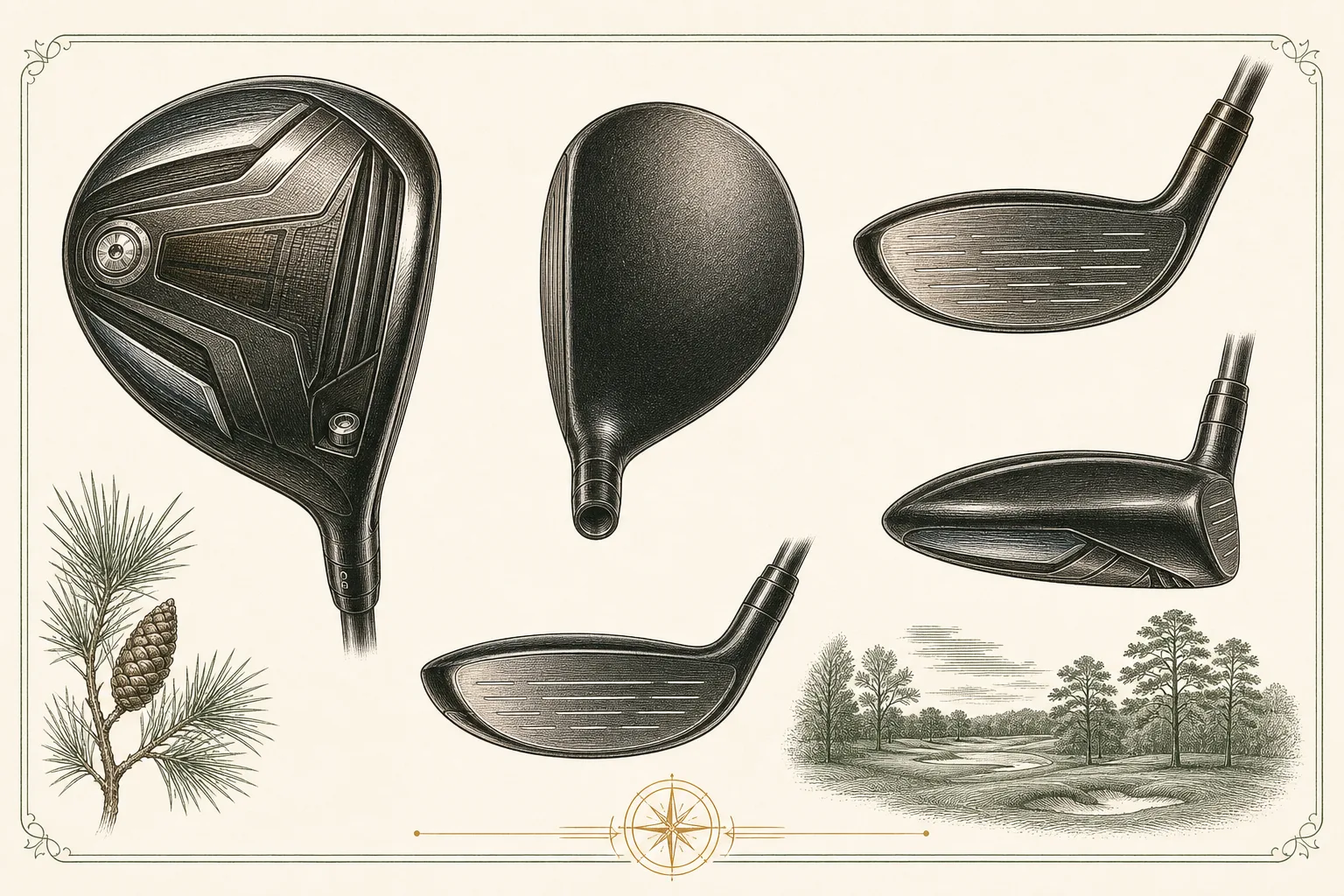
“Fast titanium-faced fairway - a versatile rung-2 wood off the tee or deck. Forgiveness here carries no penalty.”
Released alongside the ST190 driver in January 2019, the ST190 fairway used a deeper HT1770 maraging-steel face designed to flex more like a driver face than a typical fairway wood, chasing more ball speed across the whole face. A composite crown freed roughly 4g of weight to move lower in the head, combining with the deeper face to produce a lower-spin flight than earlier Mizuno fairways. Reviewers called it Mizuno's best-performing fairway wood to that point, praising easy launch, low spin, and speeds on par with the well-reviewed ST190 driver. It shipped in black rather than Mizuno's customary blue, and a higher-end ST190 TS version with a bonded hosel and firmer feel sold alongside the standard adjustable-hosel model.
It rode the same wave of strong, independently-corroborated reviews as its driver sibling (2nd Swing, Women & Golf, MyGolfSpy, GolfWRX all covered it positively at launch) and was genuinely regarded as a step up for Mizuno's fairway-wood line, but it did not generate lasting forum demand or collector interest — it was a well-reviewed product of its two-year cycle, then quietly replaced.
Golfers who already like the low-spin, mid-launch character of the ST190 driver and want a fairway wood built on the same philosophy — solid contact rewarded with real ball speed and a workable fade bias. Higher handicappers who mis-hit fairway woods frequently and need maximum forgiveness may prefer a wider, more perimeter-weighted competitor.
Launched into the same January 2019 metalwood cycle as the ST190 driver, competing with TaylorMade's M5/M6, Callaway's Epic Flash, and Titleist's TS2/TS3 fairway woods. It replaced the ST180 fairway and was itself replaced by the ST200 fairway a year later, continuing Mizuno's steady annual refresh of the maraging-face/composite-crown formula.
The deeper maraging face and lower CG from the composite crown were built to widen the ball-speed-preserving zone of the face and make launch easier, and reviewers confirmed easy launch and solid speed as headline traits. It is tuned more toward speed and a lower spin window than toward maximum forgiveness on the mis-hit extremes — a fairway wood for a golfer who makes reasonably center-face contact and wants distance, not the widest possible margin for error.
Calibrated across the whole catalog — a tour blade scores low here on purpose; it means control, not ease.
A 6-7 year old commodity fairway wood by 2026: realistic private-party value on eBay/SidelineSwap runs roughly $50-90 depending on shaft and hosel wear, with reconditioned-retail listings priced somewhat above that range. It carries no collector premium beyond being a still well-regarded, playable used fairway wood.
Reading is one thing — hitting is another. Book a bay and see the numbers for yourself before you buy anywhere.
“Fast titanium-faced fairway - a versatile rung-2 wood off the tee or deck. Forgiveness here carries no penalty.”
Released alongside the ST190 driver in January 2019, the ST190 fairway used a deeper HT1770 maraging-steel face designed to flex more like a driver face than a typical fairway wood, chasing more ball speed across the whole face. A composite crown freed roughly 4g of weight to move lower in the head, combining with the deeper face to produce a lower-spin flight than earlier Mizuno fairways. Reviewers called it Mizuno's best-performing fairway wood to that point, praising easy launch, low spin, and speeds on par with the well-reviewed ST190 driver. It shipped in black rather than Mizuno's customary blue, and a higher-end ST190 TS version with a bonded hosel and firmer feel sold alongside the standard adjustable-hosel model.
It rode the same wave of strong, independently-corroborated reviews as its driver sibling (2nd Swing, Women & Golf, MyGolfSpy, GolfWRX all covered it positively at launch) and was genuinely regarded as a step up for Mizuno's fairway-wood line, but it did not generate lasting forum demand or collector interest — it was a well-reviewed product of its two-year cycle, then quietly replaced.
Golfers who already like the low-spin, mid-launch character of the ST190 driver and want a fairway wood built on the same philosophy — solid contact rewarded with real ball speed and a workable fade bias. Higher handicappers who mis-hit fairway woods frequently and need maximum forgiveness may prefer a wider, more perimeter-weighted competitor.
Launched into the same January 2019 metalwood cycle as the ST190 driver, competing with TaylorMade's M5/M6, Callaway's Epic Flash, and Titleist's TS2/TS3 fairway woods. It replaced the ST180 fairway and was itself replaced by the ST200 fairway a year later, continuing Mizuno's steady annual refresh of the maraging-face/composite-crown formula.
The deeper maraging face and lower CG from the composite crown were built to widen the ball-speed-preserving zone of the face and make launch easier, and reviewers confirmed easy launch and solid speed as headline traits. It is tuned more toward speed and a lower spin window than toward maximum forgiveness on the mis-hit extremes — a fairway wood for a golfer who makes reasonably center-face contact and wants distance, not the widest possible margin for error.
Calibrated across the whole catalog — a tour blade scores low here on purpose; it means control, not ease.
A 6-7 year old commodity fairway wood by 2026: realistic private-party value on eBay/SidelineSwap runs roughly $50-90 depending on shaft and hosel wear, with reconditioned-retail listings priced somewhat above that range. It carries no collector premium beyond being a still well-regarded, playable used fairway wood.
Reading is one thing — hitting is another. Book a bay and see the numbers for yourself before you buy anywhere.