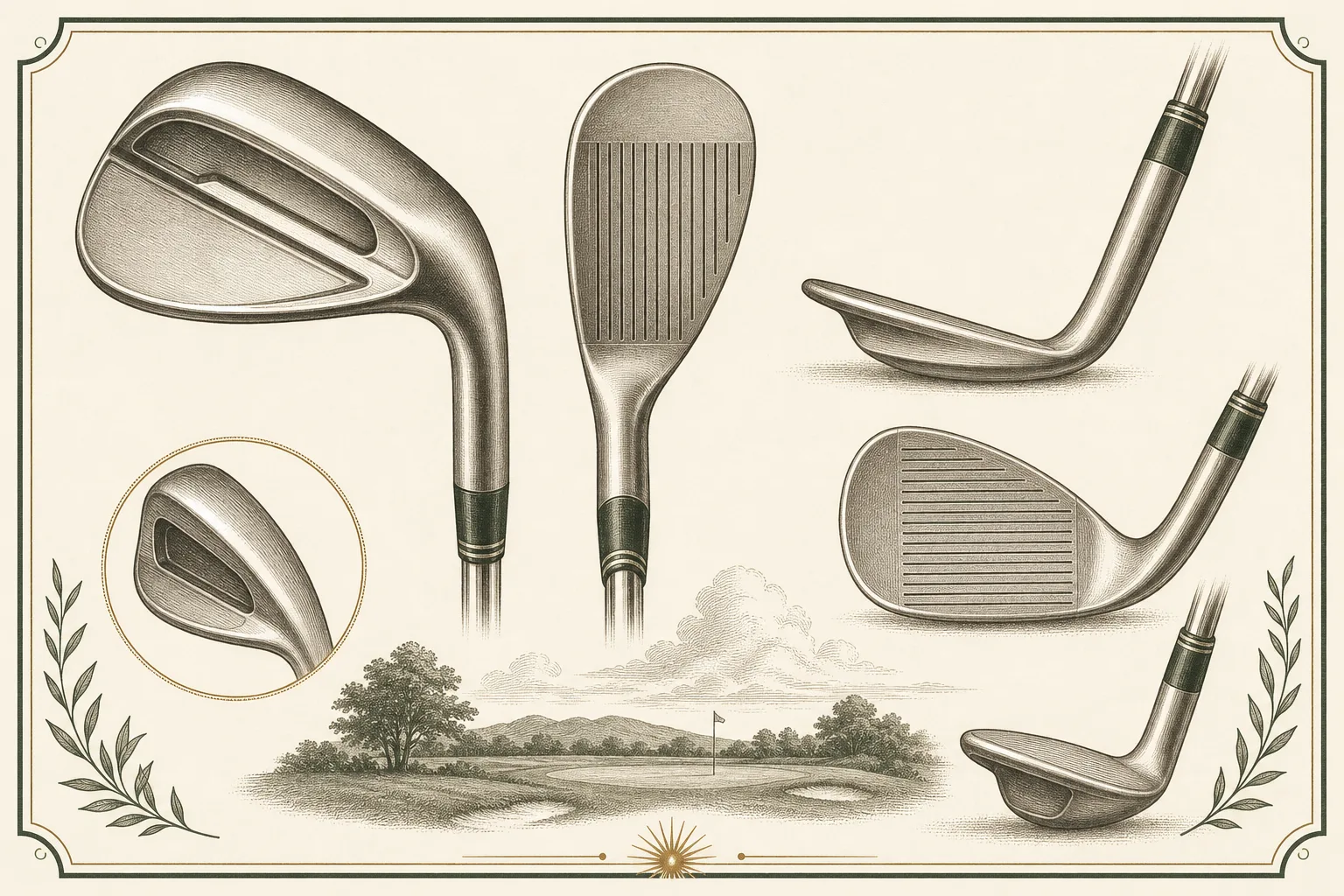
“The CG14 was a tour-proven players/tour milled wedge whose shape underpinned the later CG16, with Zip grooves and multiple bounce/grind options. Classic Cleveland short-game feel. Bargain-bin used with old grooves.”
The CG14 (2009) introduced Cleveland's Zip Grooves — grooves CNC-milled to maximum-conforming dimensions with a larger groove volume than prior Cleveland wedges, designed to channel more debris away from the strike zone so spin stayed consistent even from imperfect lies. Cleveland deliberately rounded the groove edges rather than chasing the absolute sharpest possible edge, prioritizing consistent spin across a range of lies and less ball-cover wear over outright maximum bite — making 'Zip' something of a misnomer by the engineers' own admission. It paired the new grooves with Gelback vibration-dampening material in the cavity for feel, and its tour-proven shape directly underpinned the CG16 that followed two years later.
Historically notable rather than cult-followed: it was the first Cleveland wedge to carry Zip Grooves and its shape carried forward into the well-regarded CG16, giving it real lineage significance, but it was quickly overshadowed within its own product family by the CG15 (2010) — marketed and remembered as the definitive 'last of the square grooves' wedge before the 2011 USGA groove-rule change. The CG14 is a stepping-stone model, not a destination one.
Better players and short-game-focused golfers of its era who wanted tour-shape wedges with maximum-legal groove spin. Today, its square grooves are pre-2010-rule and non-conforming for USGA/R&A tournament play, so it fits casual and recreational rounds rather than sanctioned competition; a golfer needing tournament-legal grooves should choose a current Cleveland RTX-generation wedge instead.
Launched in 2009 as Cleveland introduced Zip Grooves industry-wide, one generation ahead of the 2011 USGA groove-configuration rule that outlawed the aggressive square/U-groove designs of this era in conforming tournament play. Its shape fed directly into the CG16 (2011) once grooves had to change again for rule compliance. A modern equivalent in role is Cleveland's current RTX ZipCore tour wedge.
A players/tour-milled wedge shape rather than a wide-sole game-improvement wedge — its forgiveness comes mainly from the deep, debris-channeling Zip Grooves preserving spin consistency across lies, not from a forgiving head shape. Scored modestly above a pure blade-style wedge but well below a true GI wedge like the CBX line; it rewards a decent strike more than it rescues a poor one.
Calibrated across the whole catalog — a tour blade scores low here on purpose; it means control, not ease.
Because its square grooves are outdated for tournament play and it was overshadowed by the CG15 the following year, used pricing is low: single wedges typically sell privately for roughly $20-40 in 2026, reflecting genuinely bargain-bin demand rather than any collector premium — consistent with the catalog's own 'E' used-price band for this model.
Reading is one thing — hitting is another. Book a bay and see the numbers for yourself before you buy anywhere.
“The CG14 was a tour-proven players/tour milled wedge whose shape underpinned the later CG16, with Zip grooves and multiple bounce/grind options. Classic Cleveland short-game feel. Bargain-bin used with old grooves.”
The CG14 (2009) introduced Cleveland's Zip Grooves — grooves CNC-milled to maximum-conforming dimensions with a larger groove volume than prior Cleveland wedges, designed to channel more debris away from the strike zone so spin stayed consistent even from imperfect lies. Cleveland deliberately rounded the groove edges rather than chasing the absolute sharpest possible edge, prioritizing consistent spin across a range of lies and less ball-cover wear over outright maximum bite — making 'Zip' something of a misnomer by the engineers' own admission. It paired the new grooves with Gelback vibration-dampening material in the cavity for feel, and its tour-proven shape directly underpinned the CG16 that followed two years later.
Historically notable rather than cult-followed: it was the first Cleveland wedge to carry Zip Grooves and its shape carried forward into the well-regarded CG16, giving it real lineage significance, but it was quickly overshadowed within its own product family by the CG15 (2010) — marketed and remembered as the definitive 'last of the square grooves' wedge before the 2011 USGA groove-rule change. The CG14 is a stepping-stone model, not a destination one.
Better players and short-game-focused golfers of its era who wanted tour-shape wedges with maximum-legal groove spin. Today, its square grooves are pre-2010-rule and non-conforming for USGA/R&A tournament play, so it fits casual and recreational rounds rather than sanctioned competition; a golfer needing tournament-legal grooves should choose a current Cleveland RTX-generation wedge instead.
Launched in 2009 as Cleveland introduced Zip Grooves industry-wide, one generation ahead of the 2011 USGA groove-configuration rule that outlawed the aggressive square/U-groove designs of this era in conforming tournament play. Its shape fed directly into the CG16 (2011) once grooves had to change again for rule compliance. A modern equivalent in role is Cleveland's current RTX ZipCore tour wedge.
A players/tour-milled wedge shape rather than a wide-sole game-improvement wedge — its forgiveness comes mainly from the deep, debris-channeling Zip Grooves preserving spin consistency across lies, not from a forgiving head shape. Scored modestly above a pure blade-style wedge but well below a true GI wedge like the CBX line; it rewards a decent strike more than it rescues a poor one.
Calibrated across the whole catalog — a tour blade scores low here on purpose; it means control, not ease.
Because its square grooves are outdated for tournament play and it was overshadowed by the CG15 the following year, used pricing is low: single wedges typically sell privately for roughly $20-40 in 2026, reflecting genuinely bargain-bin demand rather than any collector premium — consistent with the catalog's own 'E' used-price band for this model.
Reading is one thing — hitting is another. Book a bay and see the numbers for yourself before you buy anywhere.