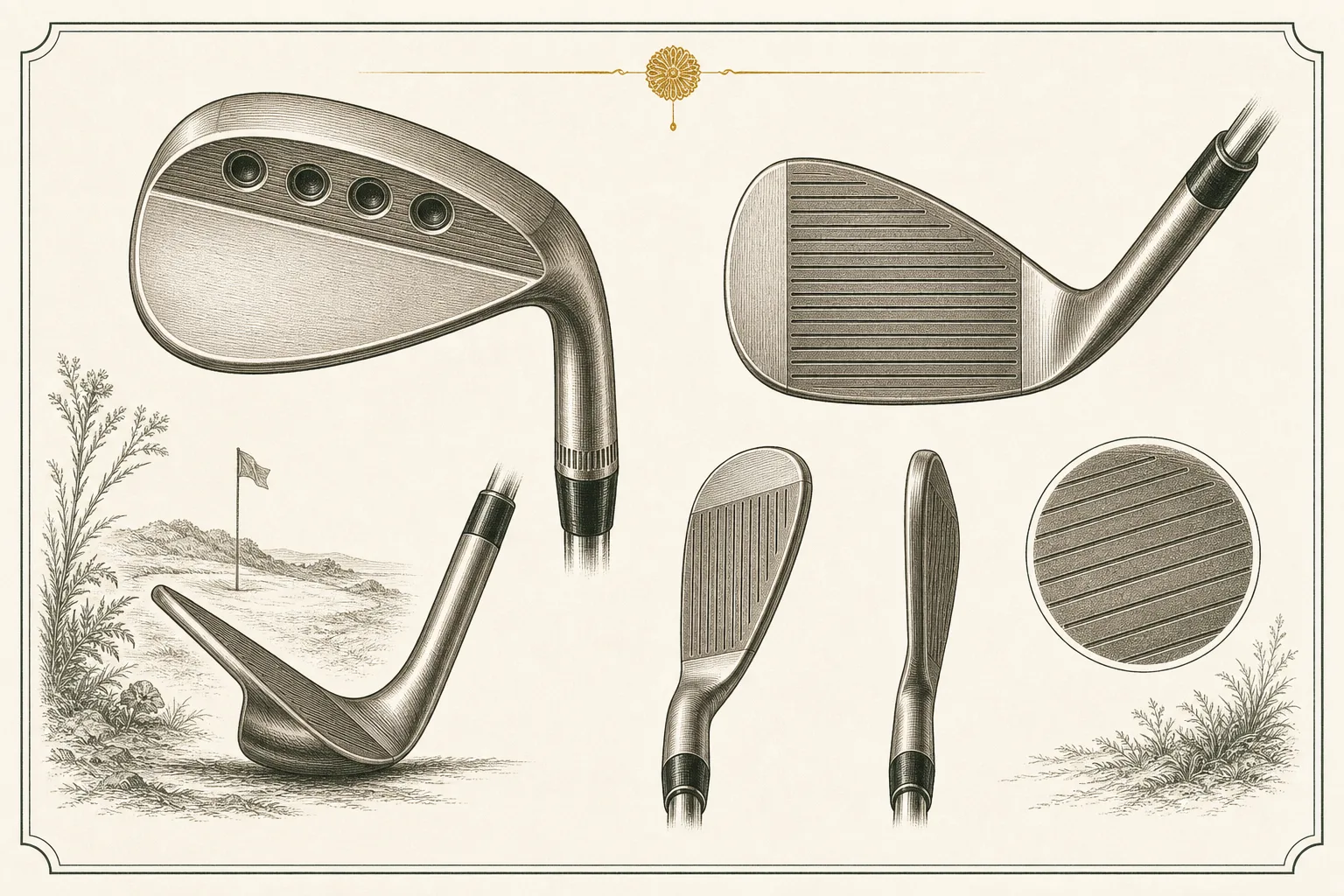
The original Mack Daddy Forged wedge, introduced around 2011, was Callaway's first wedge to carry the name that would become its signature short-game franchise for the next decade-plus. It was a compact, soft-carbon-steel forged head aimed at better players, distinguished mainly by its groove pattern — grooves that Callaway itself would later use as the internal baseline for durability and spin testing when developing the sharper, 39%-larger grooves of the Mack Daddy 2. It was less a technological leap than the foundation the whole Mack Daddy/JAWS lineage was built on.
Notable chiefly as the origin point of a long-running, well-regarded Callaway wedge franchise rather than for its own standalone reputation — Callaway's later marketing materials reference the 2011 Forged wedge's grooves as a benchmark, but independent contemporary reviews of this specific first-generation model are thin compared to the Mack Daddy 2 onward, which is itself telling: it was a solid, unremarkable forged wedge that set up a much more celebrated successor.
A fit, in its day, for low-to-mid handicap players wanting a soft-forged feel and Tour-style shaping. Today it is functionally obsolete next to its own descendants: the Mack Daddy 2 through 4 and JAWS lines offer meaningfully more spin from the same or lower price on the used market, so there is little reason for a 2026 buyer to seek out this specific first-generation model over a newer Mack Daddy.
Competed in the early-2010s players'-wedge market against Titleist's Vokey SM5/SM6 lineage and Cleveland's CG/RTX wedges. It was directly replaced by the Mack Daddy 2 in 2013, which explicitly marketed itself against this model's grooves as the improvement benchmark — an unusually direct generational comparison for a wedge line.
A traditional compact forged wedge shape with minimal offset and a thin topline aimed at better ball-strikers, not a forgiveness-first design. Its grooves were tour-legal and effective on clean strikes, but off-center or thin contact behaves like any blade-style forged wedge of its era — with noticeably less spin retention than the larger, sharper grooves Callaway introduced two years later on the Mack Daddy 2.
Calibrated across the whole catalog — a tour blade scores low here on purpose; it means control, not ease.
Scarce on today's used market compared to later Mack Daddy generations since most sellers/retailers have cycled inventory toward the 2, 3, and 4; where listed, expect low prices in the $30-$60 range typical of a 10+ year old forged wedge, similar to or below current Mack Daddy 2/3 used pricing.
Reading is one thing — hitting is another. Book a bay and see the numbers for yourself before you buy anywhere.
The original Mack Daddy Forged wedge, introduced around 2011, was Callaway's first wedge to carry the name that would become its signature short-game franchise for the next decade-plus. It was a compact, soft-carbon-steel forged head aimed at better players, distinguished mainly by its groove pattern — grooves that Callaway itself would later use as the internal baseline for durability and spin testing when developing the sharper, 39%-larger grooves of the Mack Daddy 2. It was less a technological leap than the foundation the whole Mack Daddy/JAWS lineage was built on.
Notable chiefly as the origin point of a long-running, well-regarded Callaway wedge franchise rather than for its own standalone reputation — Callaway's later marketing materials reference the 2011 Forged wedge's grooves as a benchmark, but independent contemporary reviews of this specific first-generation model are thin compared to the Mack Daddy 2 onward, which is itself telling: it was a solid, unremarkable forged wedge that set up a much more celebrated successor.
A fit, in its day, for low-to-mid handicap players wanting a soft-forged feel and Tour-style shaping. Today it is functionally obsolete next to its own descendants: the Mack Daddy 2 through 4 and JAWS lines offer meaningfully more spin from the same or lower price on the used market, so there is little reason for a 2026 buyer to seek out this specific first-generation model over a newer Mack Daddy.
Competed in the early-2010s players'-wedge market against Titleist's Vokey SM5/SM6 lineage and Cleveland's CG/RTX wedges. It was directly replaced by the Mack Daddy 2 in 2013, which explicitly marketed itself against this model's grooves as the improvement benchmark — an unusually direct generational comparison for a wedge line.
A traditional compact forged wedge shape with minimal offset and a thin topline aimed at better ball-strikers, not a forgiveness-first design. Its grooves were tour-legal and effective on clean strikes, but off-center or thin contact behaves like any blade-style forged wedge of its era — with noticeably less spin retention than the larger, sharper grooves Callaway introduced two years later on the Mack Daddy 2.
Calibrated across the whole catalog — a tour blade scores low here on purpose; it means control, not ease.
Scarce on today's used market compared to later Mack Daddy generations since most sellers/retailers have cycled inventory toward the 2, 3, and 4; where listed, expect low prices in the $30-$60 range typical of a 10+ year old forged wedge, similar to or below current Mack Daddy 2/3 used pricing.
Reading is one thing — hitting is another. Book a bay and see the numbers for yourself before you buy anywhere.