“Progressive CG and the brushed-copper finish era. Steel-dominant identity club; a fitting fit here lasts years, so the engine treats a replacement request with the wedge friction multiplier.”
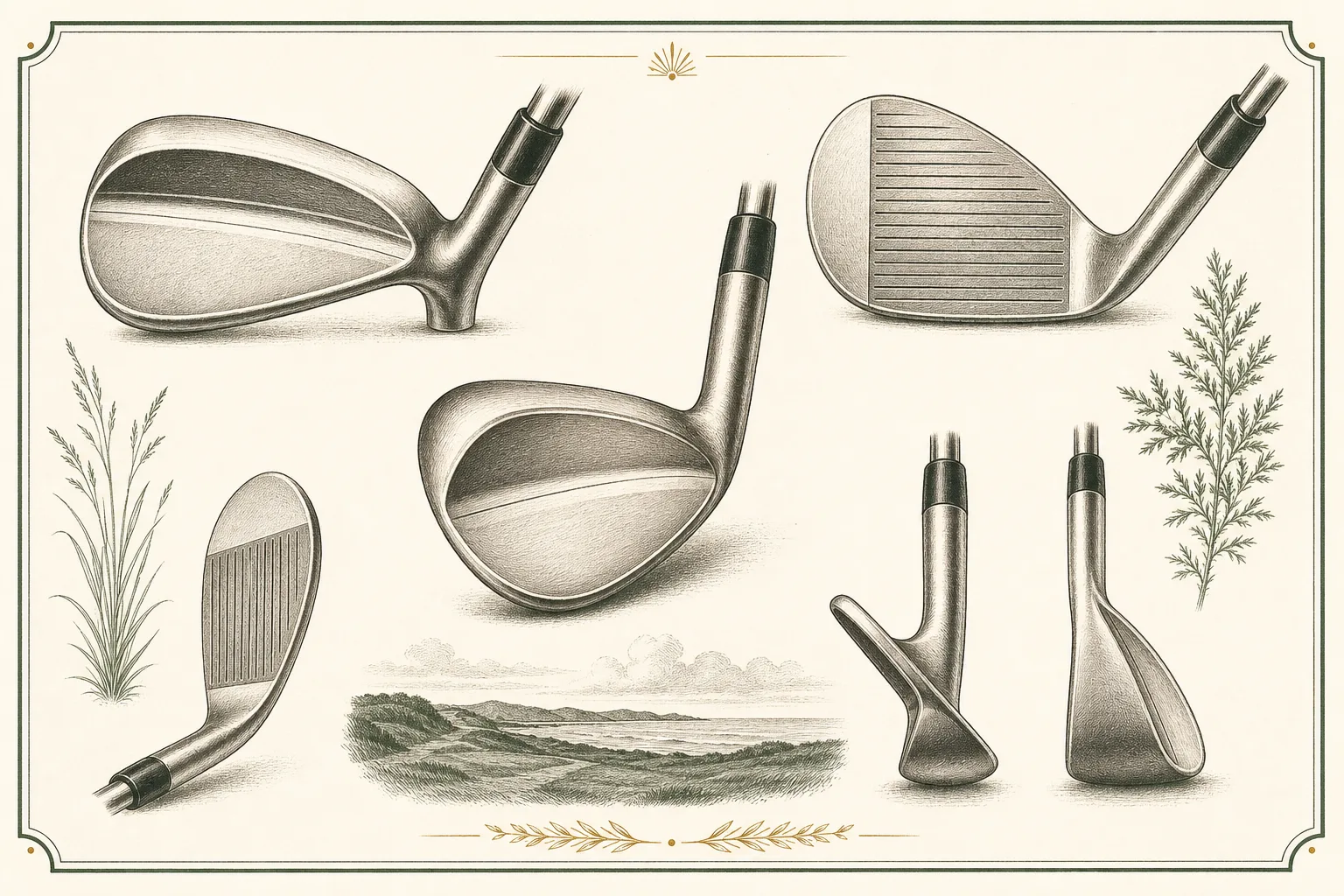
Announced January 26, 2016 at the PGA Merchandise Show and in stores by March 11, the SM6 was the first ground-up geometry change to Vokey wedges in years rather than a re-stamp of the prior model. It introduced progressive center-of-gravity tuning aligned to each loft's typical impact point - low CG in the 46-52 degree range, mid CG in 54-56, higher CG in 58-62 - plus new TX4 Spin Milled grooves with a parallel face texture claimed to add roughly 200 rpm of spin on average over the SM5. Five sole grinds (L, M, S, F, K) were all in play on tour simultaneously at launch, sold in Tour Chrome, Steel Gray and Jet Black finishes for $149.
No independent forum mythology or scarcity value - it is simply the standard tour and consumer wedge of its generation, fully superseded by the SM7 within two years. Notable for being Vokey's first real geometry overhaul in a long run of incremental releases, not for cult reverence.
Low-to-mid handicap players and dedicated short-game specialists who get properly fit into a specific grind and bounce; a golfer who chronically digs or chunks without being fit into the K or M grind will not find it forgiving.
Sits between the SM5 (2014) and SM7 (2018) in Vokey's numbered lineage; competed against Cleveland's RTX-3, Callaway's Mack Daddy 4, and the Ping Glide line of the same period.
The five-grind matrix (full-sole K/S/F versus heel-toe-relief L/M) lets a fitter dial in turf interaction, and progressive CG smooths feel across lofts, but this remains a compact-headed players wedge with a thin top line - it rewards center-face contact and does not approach game-improvement forgiveness.
Calibrated across the whole catalog — a tour blade scores low here on purpose; it means control, not ease.
Individual wedges (Vokeys are almost always bought/sold singly, not as sets) commonly run $40-65 each in 2026 at 10 years old; still a popular cheap practice/beater wedge given the strong original tour pedigree.
Reading is one thing — hitting is another. Book a bay and see the numbers for yourself before you buy anywhere.
“Progressive CG and the brushed-copper finish era. Steel-dominant identity club; a fitting fit here lasts years, so the engine treats a replacement request with the wedge friction multiplier.”
Announced January 26, 2016 at the PGA Merchandise Show and in stores by March 11, the SM6 was the first ground-up geometry change to Vokey wedges in years rather than a re-stamp of the prior model. It introduced progressive center-of-gravity tuning aligned to each loft's typical impact point - low CG in the 46-52 degree range, mid CG in 54-56, higher CG in 58-62 - plus new TX4 Spin Milled grooves with a parallel face texture claimed to add roughly 200 rpm of spin on average over the SM5. Five sole grinds (L, M, S, F, K) were all in play on tour simultaneously at launch, sold in Tour Chrome, Steel Gray and Jet Black finishes for $149.
No independent forum mythology or scarcity value - it is simply the standard tour and consumer wedge of its generation, fully superseded by the SM7 within two years. Notable for being Vokey's first real geometry overhaul in a long run of incremental releases, not for cult reverence.
Low-to-mid handicap players and dedicated short-game specialists who get properly fit into a specific grind and bounce; a golfer who chronically digs or chunks without being fit into the K or M grind will not find it forgiving.
Sits between the SM5 (2014) and SM7 (2018) in Vokey's numbered lineage; competed against Cleveland's RTX-3, Callaway's Mack Daddy 4, and the Ping Glide line of the same period.
The five-grind matrix (full-sole K/S/F versus heel-toe-relief L/M) lets a fitter dial in turf interaction, and progressive CG smooths feel across lofts, but this remains a compact-headed players wedge with a thin top line - it rewards center-face contact and does not approach game-improvement forgiveness.
Calibrated across the whole catalog — a tour blade scores low here on purpose; it means control, not ease.
Individual wedges (Vokeys are almost always bought/sold singly, not as sets) commonly run $40-65 each in 2026 at 10 years old; still a popular cheap practice/beater wedge given the strong original tour pedigree.
Reading is one thing — hitting is another. Book a bay and see the numbers for yourself before you buy anywhere.