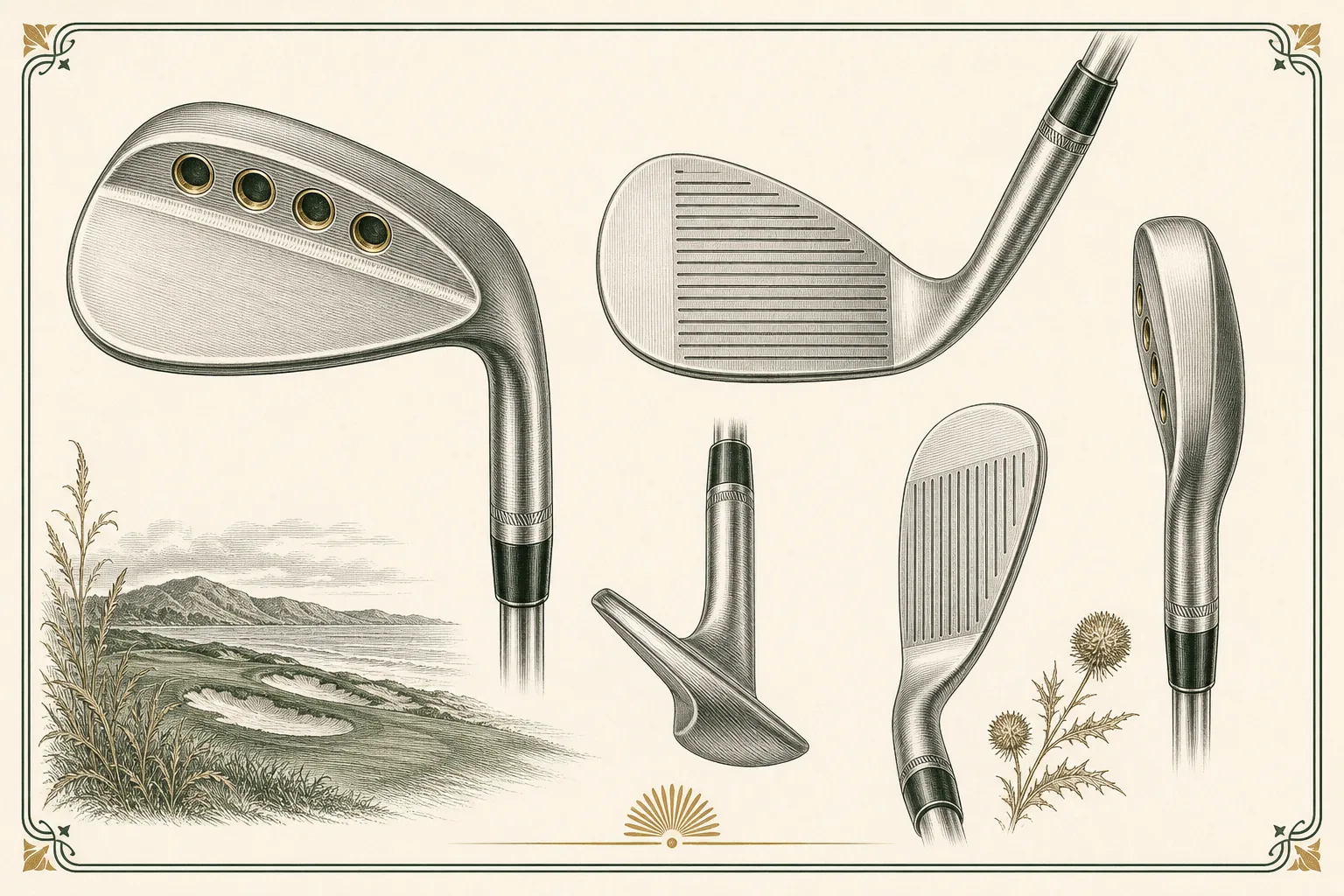
“Roger Cleveland's grooved-in tour wedge with multiple grinds. Steel-dominant identity club; plentiful used.”
The Mack Daddy 2 was Roger Cleveland's follow-up tour wedge for Callaway, built around grooves cut 39% larger than the previous generation plus a micro-groove texture etched between the main grooves to pre-rough the face and add friction at impact. It came in multiple sole grinds (including a dedicated tour/S grind and a wider W grind) so fitters could match bounce and turf interaction to a player's attack angle and typical lies, continuing the full-loft-run approach (46 through 64 degrees) that let a player build a cohesive wedge set from pitching wedge to lob. Reviewers consistently flagged the spin as the story: full shots and even short pitches came off noticeably 'hot' with backspin, requiring some acclimation, and the effect was most dramatic out of the rough where the extra groove volume grabbed grass and moisture better than its predecessor.
It earned real tour credibility rather than internet mythology: Phil Mickelson carried four Mack Daddy 2 wedges at once during this era, and reviewers at the time called it one of the best-looking and best-spinning wedges Callaway had released since the original X-Forged wedge line. But it was a standard two-year product-cycle wedge superseded by the MD3 in 2016 with no lasting scarcity or forum-reverence narrative attached — solid and tour-proven, not mythologized.
Better ball-strikers and low-to-mid handicaps who want maximum spin control and grind options to match their attack angle and typical turf conditions. A high handicapper who chunks or blades wedges regularly will get more forgiveness (at some cost in spin and feel) from a cavity-back GI wedge like Callaway's own later Mack Daddy CB.
Released in 2014 into a wedge market where the USGA's 2010 groove-conformity rule had already reset every manufacturer to a common groove-volume ceiling, so the real battleground was micro-texture and grind variety rather than raw groove size — the MD2's 39%-larger grooves and micro-groove finish were Callaway's answer within that ceiling. It was replaced by the Mack Daddy 3 (Milled) in 2016, which pushed the groove story further with Progressive Groove Optimization.
A compact, tour-style forged wedge head with a fairly narrow sole by modern game-improvement standards; its whole design brief is spin and shot-shaping control around the green, not forgiveness on mis-hit distance or full-swing off-center strikes. Scored at the low end appropriate to a players'/tour wedge category, not because it is a poor club.
Calibrated across the whole catalog — a tour blade scores low here on purpose; it means control, not ease.
Individual used wedges typically sell for roughly $30-$60 on eBay in 2026 depending on loft, grind and grooove wear (grooves matter a lot on a wedge's playability, and a decade-old MD2 is often past its sharpest spin). A matched 2-3 wedge combo commonly runs $80-$150. It is not a collectible; groove condition, not scarcity, drives price.
Reading is one thing — hitting is another. Book a bay and see the numbers for yourself before you buy anywhere.
“Roger Cleveland's grooved-in tour wedge with multiple grinds. Steel-dominant identity club; plentiful used.”
The Mack Daddy 2 was Roger Cleveland's follow-up tour wedge for Callaway, built around grooves cut 39% larger than the previous generation plus a micro-groove texture etched between the main grooves to pre-rough the face and add friction at impact. It came in multiple sole grinds (including a dedicated tour/S grind and a wider W grind) so fitters could match bounce and turf interaction to a player's attack angle and typical lies, continuing the full-loft-run approach (46 through 64 degrees) that let a player build a cohesive wedge set from pitching wedge to lob. Reviewers consistently flagged the spin as the story: full shots and even short pitches came off noticeably 'hot' with backspin, requiring some acclimation, and the effect was most dramatic out of the rough where the extra groove volume grabbed grass and moisture better than its predecessor.
It earned real tour credibility rather than internet mythology: Phil Mickelson carried four Mack Daddy 2 wedges at once during this era, and reviewers at the time called it one of the best-looking and best-spinning wedges Callaway had released since the original X-Forged wedge line. But it was a standard two-year product-cycle wedge superseded by the MD3 in 2016 with no lasting scarcity or forum-reverence narrative attached — solid and tour-proven, not mythologized.
Better ball-strikers and low-to-mid handicaps who want maximum spin control and grind options to match their attack angle and typical turf conditions. A high handicapper who chunks or blades wedges regularly will get more forgiveness (at some cost in spin and feel) from a cavity-back GI wedge like Callaway's own later Mack Daddy CB.
Released in 2014 into a wedge market where the USGA's 2010 groove-conformity rule had already reset every manufacturer to a common groove-volume ceiling, so the real battleground was micro-texture and grind variety rather than raw groove size — the MD2's 39%-larger grooves and micro-groove finish were Callaway's answer within that ceiling. It was replaced by the Mack Daddy 3 (Milled) in 2016, which pushed the groove story further with Progressive Groove Optimization.
A compact, tour-style forged wedge head with a fairly narrow sole by modern game-improvement standards; its whole design brief is spin and shot-shaping control around the green, not forgiveness on mis-hit distance or full-swing off-center strikes. Scored at the low end appropriate to a players'/tour wedge category, not because it is a poor club.
Calibrated across the whole catalog — a tour blade scores low here on purpose; it means control, not ease.
Individual used wedges typically sell for roughly $30-$60 on eBay in 2026 depending on loft, grind and grooove wear (grooves matter a lot on a wedge's playability, and a decade-old MD2 is often past its sharpest spin). A matched 2-3 wedge combo commonly runs $80-$150. It is not a collectible; groove condition, not scarcity, drives price.
Reading is one thing — hitting is another. Book a bay and see the numbers for yourself before you buy anywhere.