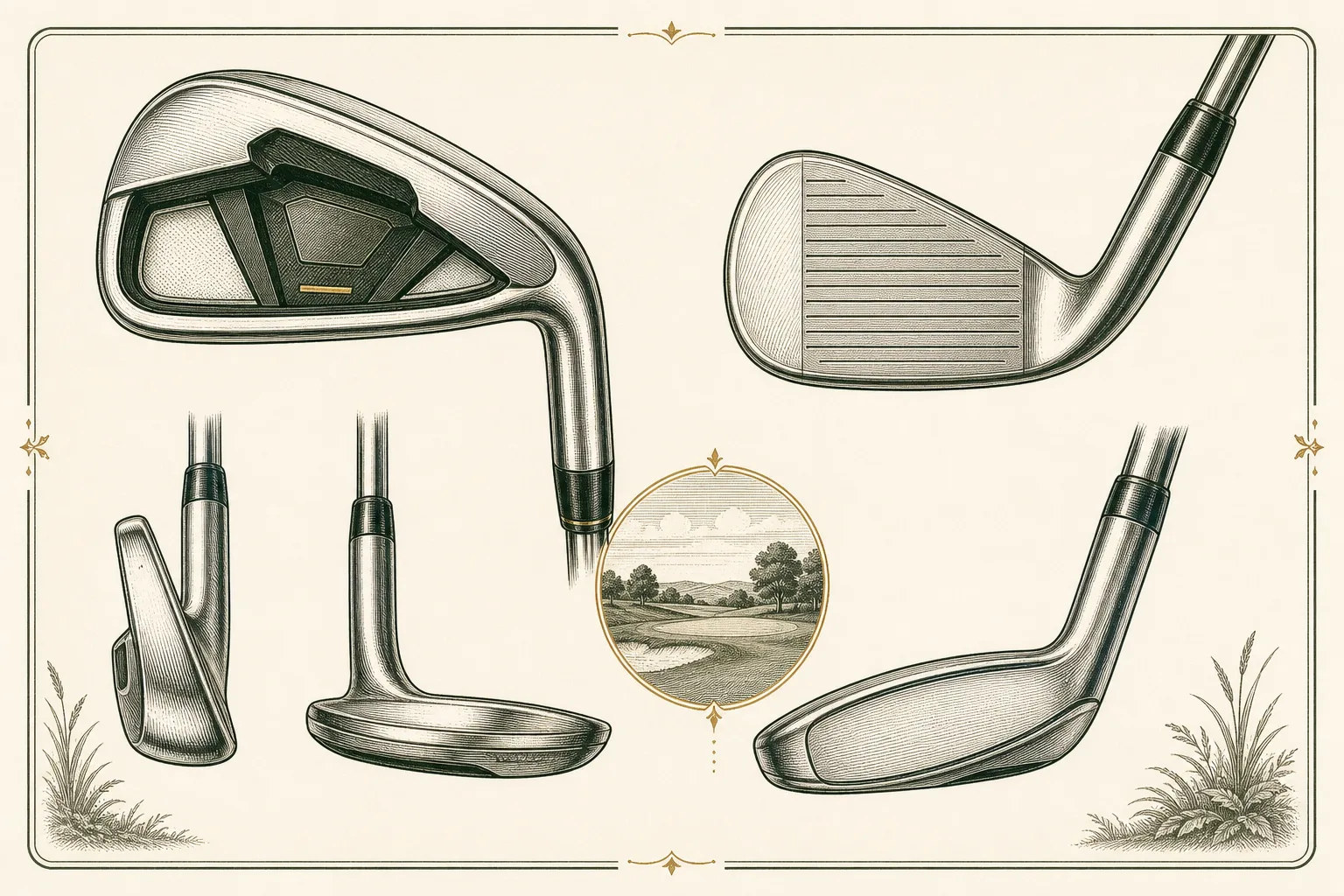
“The flagship GI Rogue ST: an AI-designed 450 high-strength face and heavy tungsten weighting for speed plus forgiveness, with a strong 27-degree 7-iron. An excellent all-around mid-handicap choice.”
The Rogue ST MAX (2022) was Callaway's volume distance iron and the flagship of a four-model family (Pro, MAX, MAX OS, MAX OS Lite). Its headline was a new high-strength 450 steel AI-designed Face Cup — a material Callaway said had never been used in a golf face — capable of flexing nearly as much as a titanium driver face (a ~0.825 COR against the 0.830 driver limit). Behind it sat 62 grams of high-density tungsten, about 260% more than the Mavrik it replaced, to push the CG low and deep for high, stable launch; urethane microspheres run up to the 6th groove for feel. Callaway's own numbers claimed roughly +1.5 mph ball speed and +4.2 yards of carry over Mavrik. A fast, forgiving, strong-lofted iron for the mainstream distance buyer.
Notable rather than cult: the 450-steel AI face was a genuine material first for an iron, the Rogue ST family was a strong seller and awards contender in 2022, and it drew wide well-reviewed coverage (Golfalot, Today's Golfer, Plugged In Golf). Its standing rests on engineering and market success, not scarcity — it is a mass-market club, honestly.
The MAX targets mid-handicappers (roughly 8-18) with moderate-to-above swing speed wanting speed, forgiveness and all-around performance in a not-oversized head. Slower swingers or higher handicaps should step to MAX OS/OS Lite for more launch and forgiveness; better players wanting a cleaner, more workable shape want the Rogue ST Pro. Not for feel purists who dislike strong lofts and low spin.
Launched against TaylorMade Stealth irons, Ping G425, Titleist T300 and Cobra LTDx in the 2022 distance market. It replaced the Mavrik (2020) and was succeeded by the Paradym/Paradym X (2023) and later the Apex Ai lines. A modern equivalent is the Callaway Paradym X or Ping G430.
Very forgiving in the game-improvement-distance class. 62g of tungsten (260% more than Mavrik) drives a low, deep, stable CG so toe/heel strikes hold line, and the 450 AI Face Cup preserves ball speed across the face; reviewers noted dispersion that didn't leak offline. The MAX OS and OS Lite are even more forgiving (larger, weaker-lofted, lighter). The trade-offs are the usual strong-loft distance-iron ones: a lower, lower-spinning flight and minimal workability. An 8 puts the MAX squarely in GI-distance territory, a notch below the max-game-improvement Big Bertha.
Calibrated across the whole catalog — a tour blade scores low here on purpose; it means control, not ease.
Realistic 2026 private-party value for a complete steel 4-PW set is roughly $450-650 (original MSRP ~$999), being only a few years old and still popular; graphite and premium shafts push the top. Certified reconditioned-retail (Callaway Pre-Owned, 2nd Swing) runs higher — frequently $600-800 — reflecting grading, warranty and store margin. Depreciation is moderate for now given its recency and strong reputation; expect it to soften as newer Callaway distance irons cycle in.
Reading is one thing — hitting is another. Book a bay and see the numbers for yourself before you buy anywhere.
“The flagship GI Rogue ST: an AI-designed 450 high-strength face and heavy tungsten weighting for speed plus forgiveness, with a strong 27-degree 7-iron. An excellent all-around mid-handicap choice.”
The Rogue ST MAX (2022) was Callaway's volume distance iron and the flagship of a four-model family (Pro, MAX, MAX OS, MAX OS Lite). Its headline was a new high-strength 450 steel AI-designed Face Cup — a material Callaway said had never been used in a golf face — capable of flexing nearly as much as a titanium driver face (a ~0.825 COR against the 0.830 driver limit). Behind it sat 62 grams of high-density tungsten, about 260% more than the Mavrik it replaced, to push the CG low and deep for high, stable launch; urethane microspheres run up to the 6th groove for feel. Callaway's own numbers claimed roughly +1.5 mph ball speed and +4.2 yards of carry over Mavrik. A fast, forgiving, strong-lofted iron for the mainstream distance buyer.
Notable rather than cult: the 450-steel AI face was a genuine material first for an iron, the Rogue ST family was a strong seller and awards contender in 2022, and it drew wide well-reviewed coverage (Golfalot, Today's Golfer, Plugged In Golf). Its standing rests on engineering and market success, not scarcity — it is a mass-market club, honestly.
The MAX targets mid-handicappers (roughly 8-18) with moderate-to-above swing speed wanting speed, forgiveness and all-around performance in a not-oversized head. Slower swingers or higher handicaps should step to MAX OS/OS Lite for more launch and forgiveness; better players wanting a cleaner, more workable shape want the Rogue ST Pro. Not for feel purists who dislike strong lofts and low spin.
Launched against TaylorMade Stealth irons, Ping G425, Titleist T300 and Cobra LTDx in the 2022 distance market. It replaced the Mavrik (2020) and was succeeded by the Paradym/Paradym X (2023) and later the Apex Ai lines. A modern equivalent is the Callaway Paradym X or Ping G430.
Very forgiving in the game-improvement-distance class. 62g of tungsten (260% more than Mavrik) drives a low, deep, stable CG so toe/heel strikes hold line, and the 450 AI Face Cup preserves ball speed across the face; reviewers noted dispersion that didn't leak offline. The MAX OS and OS Lite are even more forgiving (larger, weaker-lofted, lighter). The trade-offs are the usual strong-loft distance-iron ones: a lower, lower-spinning flight and minimal workability. An 8 puts the MAX squarely in GI-distance territory, a notch below the max-game-improvement Big Bertha.
Calibrated across the whole catalog — a tour blade scores low here on purpose; it means control, not ease.
Realistic 2026 private-party value for a complete steel 4-PW set is roughly $450-650 (original MSRP ~$999), being only a few years old and still popular; graphite and premium shafts push the top. Certified reconditioned-retail (Callaway Pre-Owned, 2nd Swing) runs higher — frequently $600-800 — reflecting grading, warranty and store margin. Depreciation is moderate for now given its recency and strong reputation; expect it to soften as newer Callaway distance irons cycle in.
Reading is one thing — hitting is another. Book a bay and see the numbers for yourself before you buy anywhere.