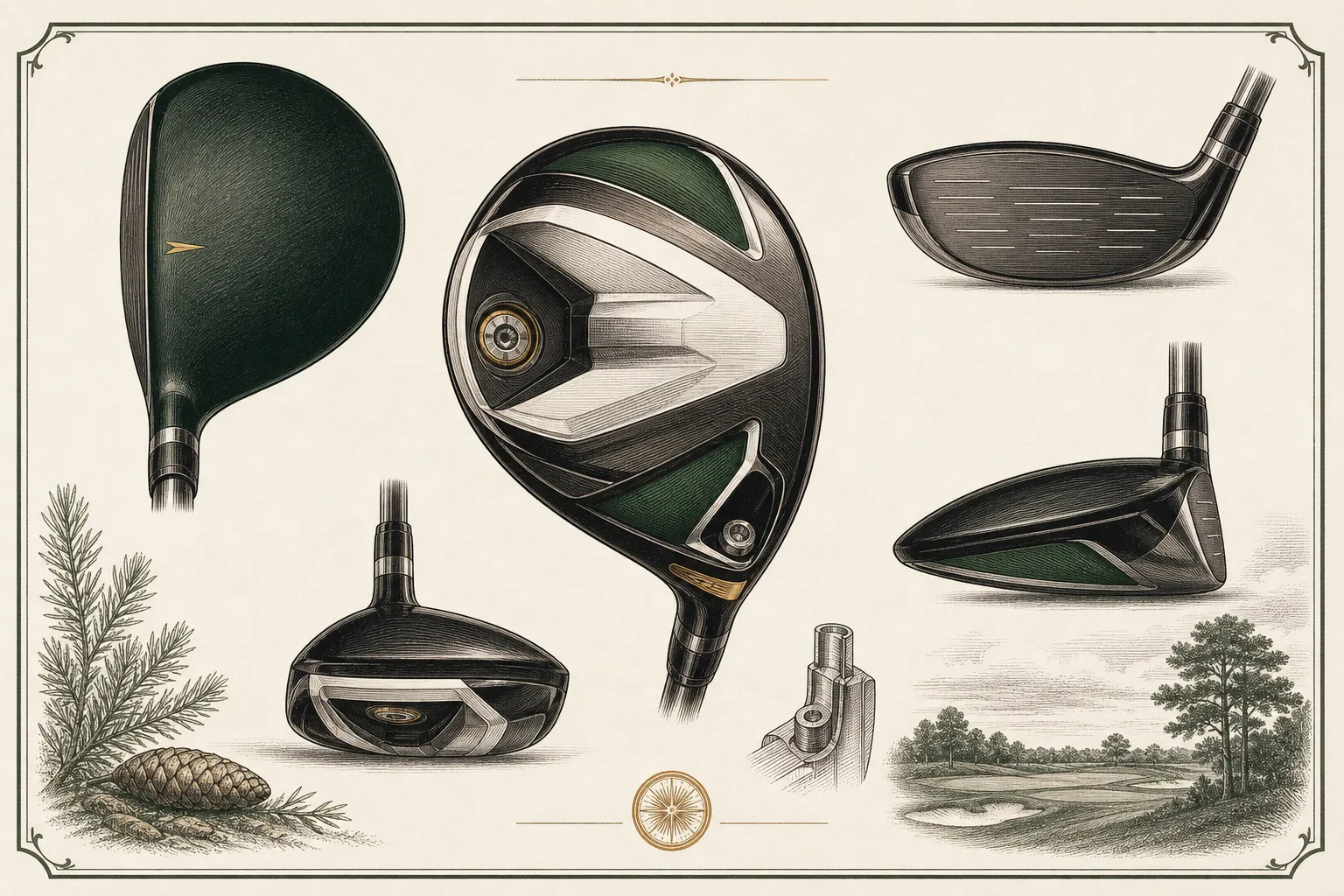
“The red cavity-crown fairway with an adjustable hosel. Set loft to the carry gap you actually need to fill.”
The retail VR_S Covert fairway wood shared its NexCOR face and rear high-speed cavity design - weight redistributed from the back of the head into the heel and toe to raise MOI - with the flashier Covert Tour fairway that launched the same season, but it shipped as a simpler, smaller-headed, fixed-loft club rather than the adjustable model. Where the Tour version used Nike's FlexLoft system to let a fitter change loft and face angle independently across a five-degree range, the standard Covert fairway came with a glued, non-adjustable hosel in 3-wood and 5-wood lofts and a stock Mitsubishi Diamana Kura Kage shaft - a shallower-faced, higher-launching head aimed at players who struggle to get a fairway wood airborne rather than at better players wanting to dial in trajectory.
It sold as the mass-market half of a two-tier release, overshadowed at the time by the adjustable Tour version and by attention around Nike's new McIlroy sponsorship; it never built any following of its own and is essentially unknown outside the used-club market today.
Higher handicappers and slower swing speeds who need help launching a fairway wood and do not need to fine-tune loft or face angle; a better player who wants to dial in ball flight should pay the modest premium for the adjustable Covert Tour version instead.
Launched alongside the VR_S Covert driver and irons as Nike introduced its 2013 Rory McIlroy-era product cycle, priced under the adjustable Tour model at roughly $199-230 retail; Nike replaced the whole Covert fairway family with the Covert 2.0 line about a year later.
The shallower face and higher-launching profile genuinely help a slower swinger or higher handicapper get the ball airborne compared with the lower-spin Tour head, and the heel-toe weighting adds real stability on off-center hits, but the fixed loft removes any ability to fine-tune trajectory that the Tour buyer got for a similar retail price.
Calibrated across the whole catalog — a tour blade scores low here on purpose; it means control, not ease.
Heavily discounted today: used examples commonly sell for well under $100, with some listings as low as $45-50, on 2nd Swing and similar sites in 2026, reflecting both its age and its position as the budget option even when new.
Reading is one thing — hitting is another. Book a bay and see the numbers for yourself before you buy anywhere.
“The red cavity-crown fairway with an adjustable hosel. Set loft to the carry gap you actually need to fill.”
The retail VR_S Covert fairway wood shared its NexCOR face and rear high-speed cavity design - weight redistributed from the back of the head into the heel and toe to raise MOI - with the flashier Covert Tour fairway that launched the same season, but it shipped as a simpler, smaller-headed, fixed-loft club rather than the adjustable model. Where the Tour version used Nike's FlexLoft system to let a fitter change loft and face angle independently across a five-degree range, the standard Covert fairway came with a glued, non-adjustable hosel in 3-wood and 5-wood lofts and a stock Mitsubishi Diamana Kura Kage shaft - a shallower-faced, higher-launching head aimed at players who struggle to get a fairway wood airborne rather than at better players wanting to dial in trajectory.
It sold as the mass-market half of a two-tier release, overshadowed at the time by the adjustable Tour version and by attention around Nike's new McIlroy sponsorship; it never built any following of its own and is essentially unknown outside the used-club market today.
Higher handicappers and slower swing speeds who need help launching a fairway wood and do not need to fine-tune loft or face angle; a better player who wants to dial in ball flight should pay the modest premium for the adjustable Covert Tour version instead.
Launched alongside the VR_S Covert driver and irons as Nike introduced its 2013 Rory McIlroy-era product cycle, priced under the adjustable Tour model at roughly $199-230 retail; Nike replaced the whole Covert fairway family with the Covert 2.0 line about a year later.
The shallower face and higher-launching profile genuinely help a slower swinger or higher handicapper get the ball airborne compared with the lower-spin Tour head, and the heel-toe weighting adds real stability on off-center hits, but the fixed loft removes any ability to fine-tune trajectory that the Tour buyer got for a similar retail price.
Calibrated across the whole catalog — a tour blade scores low here on purpose; it means control, not ease.
Heavily discounted today: used examples commonly sell for well under $100, with some listings as low as $45-50, on 2nd Swing and similar sites in 2026, reflecting both its age and its position as the budget option even when new.
Reading is one thing — hitting is another. Book a bay and see the numbers for yourself before you buy anywhere.