“Two adjustable weights and low spin for the faster player. Great head, but only if your speed and strike justify rung 3.”
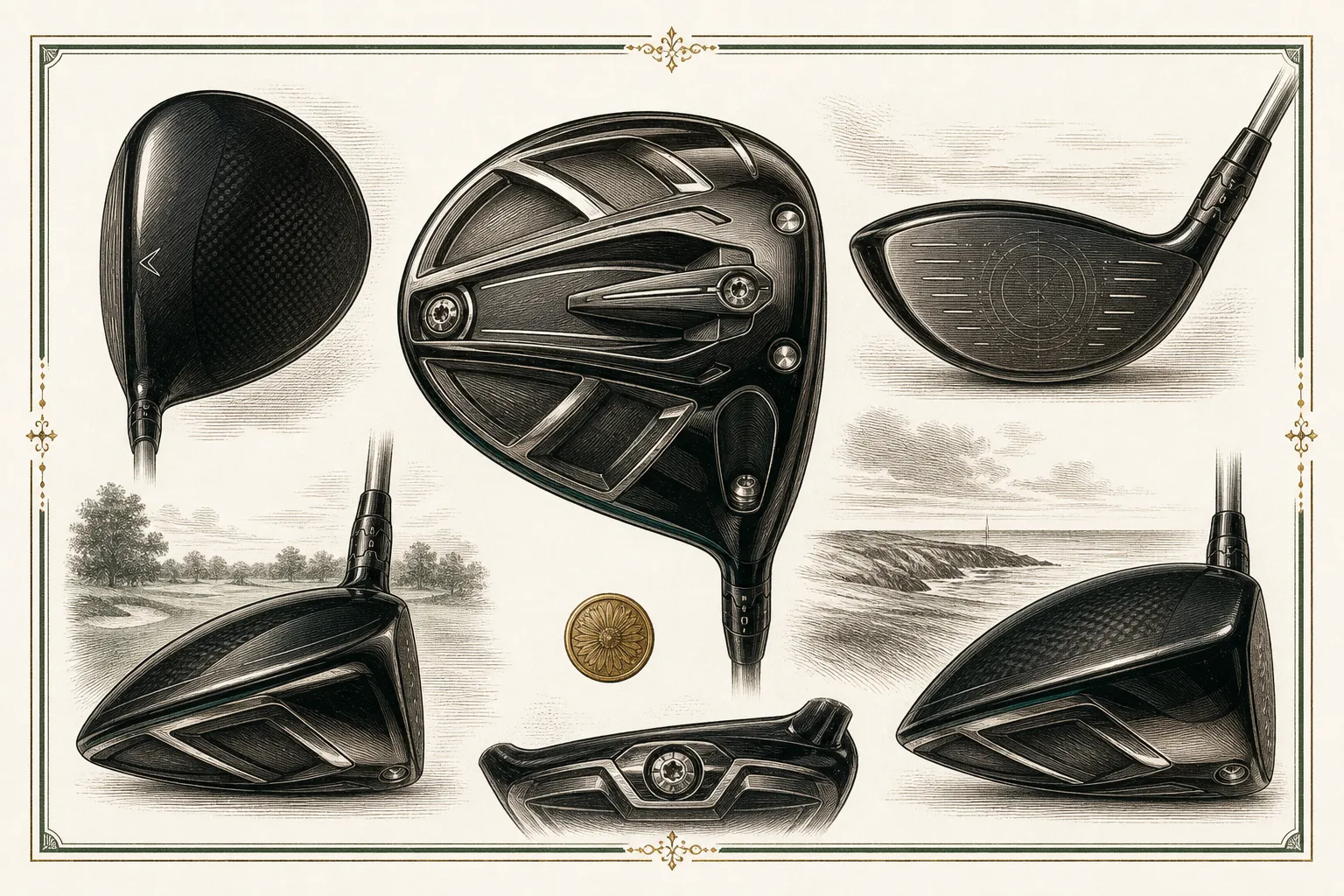
Callaway's 2018 Rogue driver carried Jailbreak - the internal titanium-bar bracing that debuted in the 2017 Epic - into a second generation, and Sub Zero was the low-spin variant built for faster, better ball-strikers. Two fixed weight ports accept interchangeable 2g/14g weights, letting a fitter bias CG forward for lower spin or back for more forgiveness. A Triaxial Carbon Crown frees weight for MOI while the Jailbreak bars, reshaped into a lighter hourglass and shrunk about 25% versus Epic's, let the face flex more under load for ball speed. Reviewers (Golf.com ClubTest, Plugged In Golf, Golfstead) consistently flagged it as low-spinning to the point that slower or steeper swingers would balloon shots short, marking it as the tour-leaning half of the Rogue driver family rather than the volume seller.
No dedicated cult around Sub Zero specifically - it's a well-reviewed niche tool inside the broader Rogue/Jailbreak generation that bridged Epic (2017) and Epic Flash (2019). Its low-spin remit narrowed its buyer pool to better players and faster swingers by design, and it's discussed as a solid fitting option in equipment reviews rather than revered on forums the way the original Jailbreak launch (Epic) or a true icon like the Ping Eye 2 is.
Faster-swinging, better ball-strikers who already produce enough spin and need to bring it down for distance and a flatter window - exactly the player the 2018 reviews (Golfstead, Plugged In Golf) pointed it at. A slower-swinging or steeper-attack golfer who needs help getting the ball airborne should take the standard Rogue or Rogue Draw instead; Sub Zero will punish them with low, weak flight.
Part of Callaway's three-way 2018 driver split (Rogue, Rogue Draw, Rogue Sub Zero), competing that year with TaylorMade's M3/M4 twist face drivers and Ping's G400 LST. It sat between the original Epic Sub Zero (2017) and the next Jailbreak refinement in Epic Flash Sub Zero (2019). A modern equivalent in Callaway's own line is the Paradym/Ai Smoke Triple Diamond LS.
Deliberately less forgiving than the standard 2018 Rogue driver it sat beside: the low-spin remit concentrates CG for a more penetrating flight rather than max launch and stability, and the two-weight system is a spin/launch tuning tool, not a forgiveness one. It still carries Jailbreak and a 460cc Triaxial Carbon Crown for real off-center ball speed retention versus a pure players' head, landing it mid-pack rather than at the bottom of the forgiveness scale.
Calibrated across the whole catalog — a tour blade scores low here on purpose; it means control, not ease.
2nd Swing's graded store listings run about $219-$250 for clean examples in 2026; realistic private-party prices on eBay/SidelineSwap for an ungraded head-only or full driver typically land lower, roughly $100-$180 depending on shaft and condition. It is common and unremarkable on the used market - a solid fitting-cart option, not a collectible.
Reading is one thing — hitting is another. Book a bay and see the numbers for yourself before you buy anywhere.
“Two adjustable weights and low spin for the faster player. Great head, but only if your speed and strike justify rung 3.”
Callaway's 2018 Rogue driver carried Jailbreak - the internal titanium-bar bracing that debuted in the 2017 Epic - into a second generation, and Sub Zero was the low-spin variant built for faster, better ball-strikers. Two fixed weight ports accept interchangeable 2g/14g weights, letting a fitter bias CG forward for lower spin or back for more forgiveness. A Triaxial Carbon Crown frees weight for MOI while the Jailbreak bars, reshaped into a lighter hourglass and shrunk about 25% versus Epic's, let the face flex more under load for ball speed. Reviewers (Golf.com ClubTest, Plugged In Golf, Golfstead) consistently flagged it as low-spinning to the point that slower or steeper swingers would balloon shots short, marking it as the tour-leaning half of the Rogue driver family rather than the volume seller.
No dedicated cult around Sub Zero specifically - it's a well-reviewed niche tool inside the broader Rogue/Jailbreak generation that bridged Epic (2017) and Epic Flash (2019). Its low-spin remit narrowed its buyer pool to better players and faster swingers by design, and it's discussed as a solid fitting option in equipment reviews rather than revered on forums the way the original Jailbreak launch (Epic) or a true icon like the Ping Eye 2 is.
Faster-swinging, better ball-strikers who already produce enough spin and need to bring it down for distance and a flatter window - exactly the player the 2018 reviews (Golfstead, Plugged In Golf) pointed it at. A slower-swinging or steeper-attack golfer who needs help getting the ball airborne should take the standard Rogue or Rogue Draw instead; Sub Zero will punish them with low, weak flight.
Part of Callaway's three-way 2018 driver split (Rogue, Rogue Draw, Rogue Sub Zero), competing that year with TaylorMade's M3/M4 twist face drivers and Ping's G400 LST. It sat between the original Epic Sub Zero (2017) and the next Jailbreak refinement in Epic Flash Sub Zero (2019). A modern equivalent in Callaway's own line is the Paradym/Ai Smoke Triple Diamond LS.
Deliberately less forgiving than the standard 2018 Rogue driver it sat beside: the low-spin remit concentrates CG for a more penetrating flight rather than max launch and stability, and the two-weight system is a spin/launch tuning tool, not a forgiveness one. It still carries Jailbreak and a 460cc Triaxial Carbon Crown for real off-center ball speed retention versus a pure players' head, landing it mid-pack rather than at the bottom of the forgiveness scale.
Calibrated across the whole catalog — a tour blade scores low here on purpose; it means control, not ease.
2nd Swing's graded store listings run about $219-$250 for clean examples in 2026; realistic private-party prices on eBay/SidelineSwap for an ungraded head-only or full driver typically land lower, roughly $100-$180 depending on shaft and condition. It is common and unremarkable on the used market - a solid fitting-cart option, not a collectible.
Reading is one thing — hitting is another. Book a bay and see the numbers for yourself before you buy anywhere.