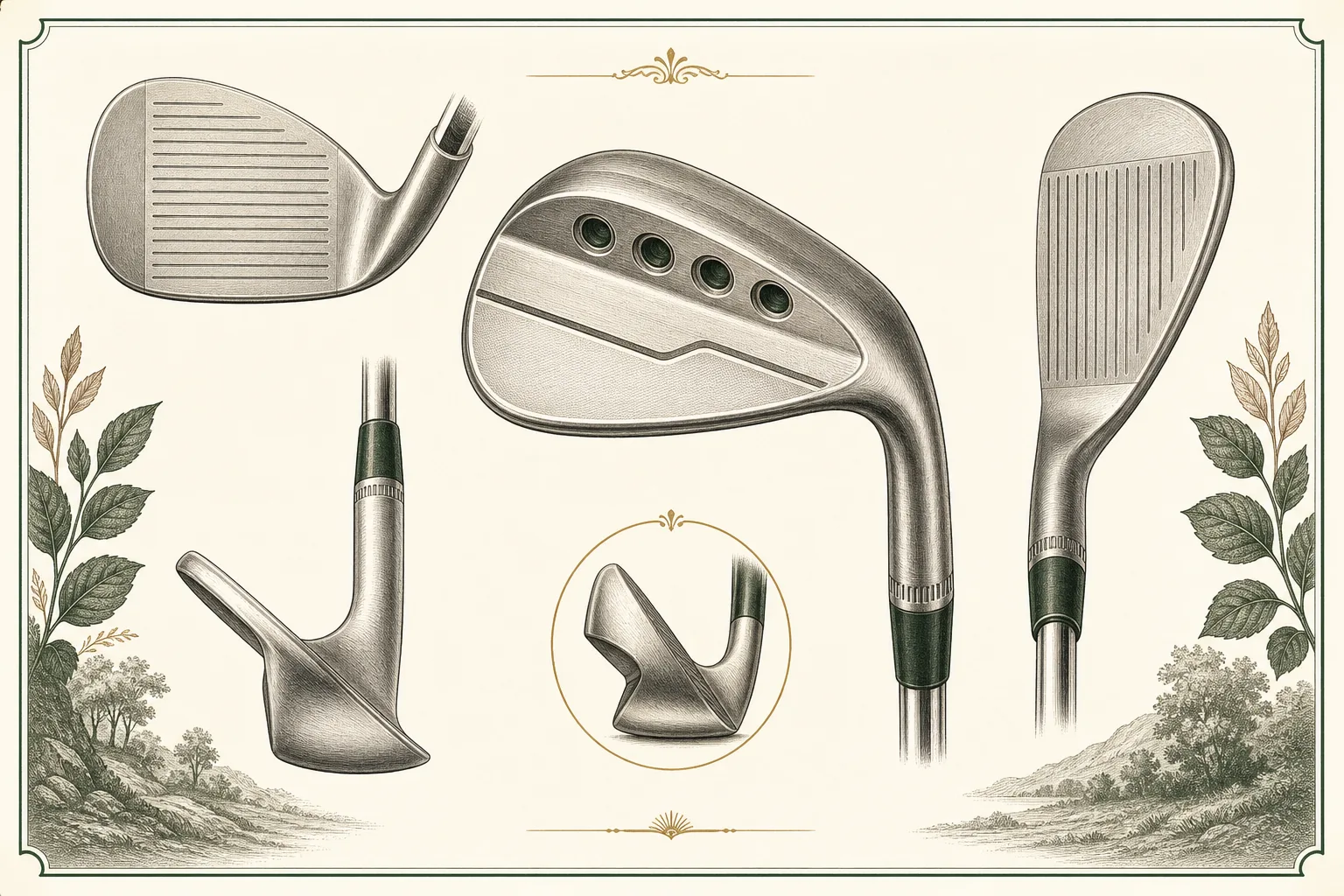
“Aggressive JAWS grooves with a 37-degree groove-in-groove. Steel-dominant players' wedge; a common current-bag choice.”
The fifth generation of Roger Cleveland's Mack Daddy line, launched September 2019 as 'JAWS MD5' — the point where Callaway leaned fully into groove aggression as the wedge's identity. The headline change was a sharper groove-wall angle (37 degrees, versus roughly 5 in the MD4) plus 'groove-in-groove' technology: micro-ridges milled between the main grooves add extra contact points across the face to bite the ball on partial and open-face shots. Cast from 8620 mild carbon steel with tour-shaped, progressively sized heads, it shipped in five sole grinds (S, C, W, X, and a low-bounce option) across lofts from 46 to 64 degrees, positioned as a spin-max tour wedge rather than a forgiveness club.
A well-regarded, high-volume tour wedge that reviewers (Plugged In Golf, Today's Golfer, Golfalot) consistently rated among the grippiest of its generation, and it saw wide PGA Tour play — but it is a mainstream OEM wedge on a two-year refresh cycle, not a scarce or reverently hunted object. It was superseded by JAWS Raw in 2022 and is now simply a strong used-market value, so 'notable' rather than cult.
Low-to-mid handicaps and better ball-strikers who open the face, hit varied trajectories, and want maximum greenside spin and grind choice. Grind selection matters: S-grind for neutral/steep-ish attack, C/X for shot-shapers who open it, W for steeper diggers, low-bounce for firm turf. A higher handicap wanting easy, get-it-close chipping is better served by the sibling CB cavity wedge.
Launched into the 2019-2020 spin-wedge arms race against Titleist Vokey SM8, TaylorMade MG2/Hi-Toe, and Cleveland's own RTX 4 — all chasing groove sharpness within the USGA's conforming limits. It followed the MD4 (2017) and was itself replaced by JAWS Raw (2022), which took the same groove geometry and removed the face plating to push spin further. The modern equivalent in Callaway's line is the JAWS Raw / Opus series.
Scored as a players' tour-milled wedge, not a game-improvement club: compact tour head, thin-to-moderate topline, and grind-dependent sole mean it rewards clean strike and shot-making over mishit protection. The aggressive grooves add spin, not forgiveness. A 4 reflects that it is more playable than a pure blade wedge but well below a cavity-back or GI wedge — the buyer trades forgiveness for spin and versatility around the greens.
Calibrated across the whole catalog — a tour blade scores low here on purpose; it means control, not ease.
Realistic 2026 private-party value is roughly $50-95 for a clean single wedge (eBay/SidelineSwap), driven down by grip and groove wear since grooves are the whole point of the club. Reconditioned-retail listings (Callaway Golf Pre-Owned, 2nd Swing, Golf Avenue) run higher — commonly $80-130 graded/warrantied — which overstates what a private seller actually gets. Worn grooves should knock 30-40% off; specialty grinds (X, low-bounce) in clean shape hold value best.
Reading is one thing — hitting is another. Book a bay and see the numbers for yourself before you buy anywhere.
“Aggressive JAWS grooves with a 37-degree groove-in-groove. Steel-dominant players' wedge; a common current-bag choice.”
The fifth generation of Roger Cleveland's Mack Daddy line, launched September 2019 as 'JAWS MD5' — the point where Callaway leaned fully into groove aggression as the wedge's identity. The headline change was a sharper groove-wall angle (37 degrees, versus roughly 5 in the MD4) plus 'groove-in-groove' technology: micro-ridges milled between the main grooves add extra contact points across the face to bite the ball on partial and open-face shots. Cast from 8620 mild carbon steel with tour-shaped, progressively sized heads, it shipped in five sole grinds (S, C, W, X, and a low-bounce option) across lofts from 46 to 64 degrees, positioned as a spin-max tour wedge rather than a forgiveness club.
A well-regarded, high-volume tour wedge that reviewers (Plugged In Golf, Today's Golfer, Golfalot) consistently rated among the grippiest of its generation, and it saw wide PGA Tour play — but it is a mainstream OEM wedge on a two-year refresh cycle, not a scarce or reverently hunted object. It was superseded by JAWS Raw in 2022 and is now simply a strong used-market value, so 'notable' rather than cult.
Low-to-mid handicaps and better ball-strikers who open the face, hit varied trajectories, and want maximum greenside spin and grind choice. Grind selection matters: S-grind for neutral/steep-ish attack, C/X for shot-shapers who open it, W for steeper diggers, low-bounce for firm turf. A higher handicap wanting easy, get-it-close chipping is better served by the sibling CB cavity wedge.
Launched into the 2019-2020 spin-wedge arms race against Titleist Vokey SM8, TaylorMade MG2/Hi-Toe, and Cleveland's own RTX 4 — all chasing groove sharpness within the USGA's conforming limits. It followed the MD4 (2017) and was itself replaced by JAWS Raw (2022), which took the same groove geometry and removed the face plating to push spin further. The modern equivalent in Callaway's line is the JAWS Raw / Opus series.
Scored as a players' tour-milled wedge, not a game-improvement club: compact tour head, thin-to-moderate topline, and grind-dependent sole mean it rewards clean strike and shot-making over mishit protection. The aggressive grooves add spin, not forgiveness. A 4 reflects that it is more playable than a pure blade wedge but well below a cavity-back or GI wedge — the buyer trades forgiveness for spin and versatility around the greens.
Calibrated across the whole catalog — a tour blade scores low here on purpose; it means control, not ease.
Realistic 2026 private-party value is roughly $50-95 for a clean single wedge (eBay/SidelineSwap), driven down by grip and groove wear since grooves are the whole point of the club. Reconditioned-retail listings (Callaway Golf Pre-Owned, 2nd Swing, Golf Avenue) run higher — commonly $80-130 graded/warrantied — which overstates what a private seller actually gets. Worn grooves should knock 30-40% off; specialty grinds (X, low-bounce) in clean shape hold value best.
Reading is one thing — hitting is another. Book a bay and see the numbers for yourself before you buy anywhere.