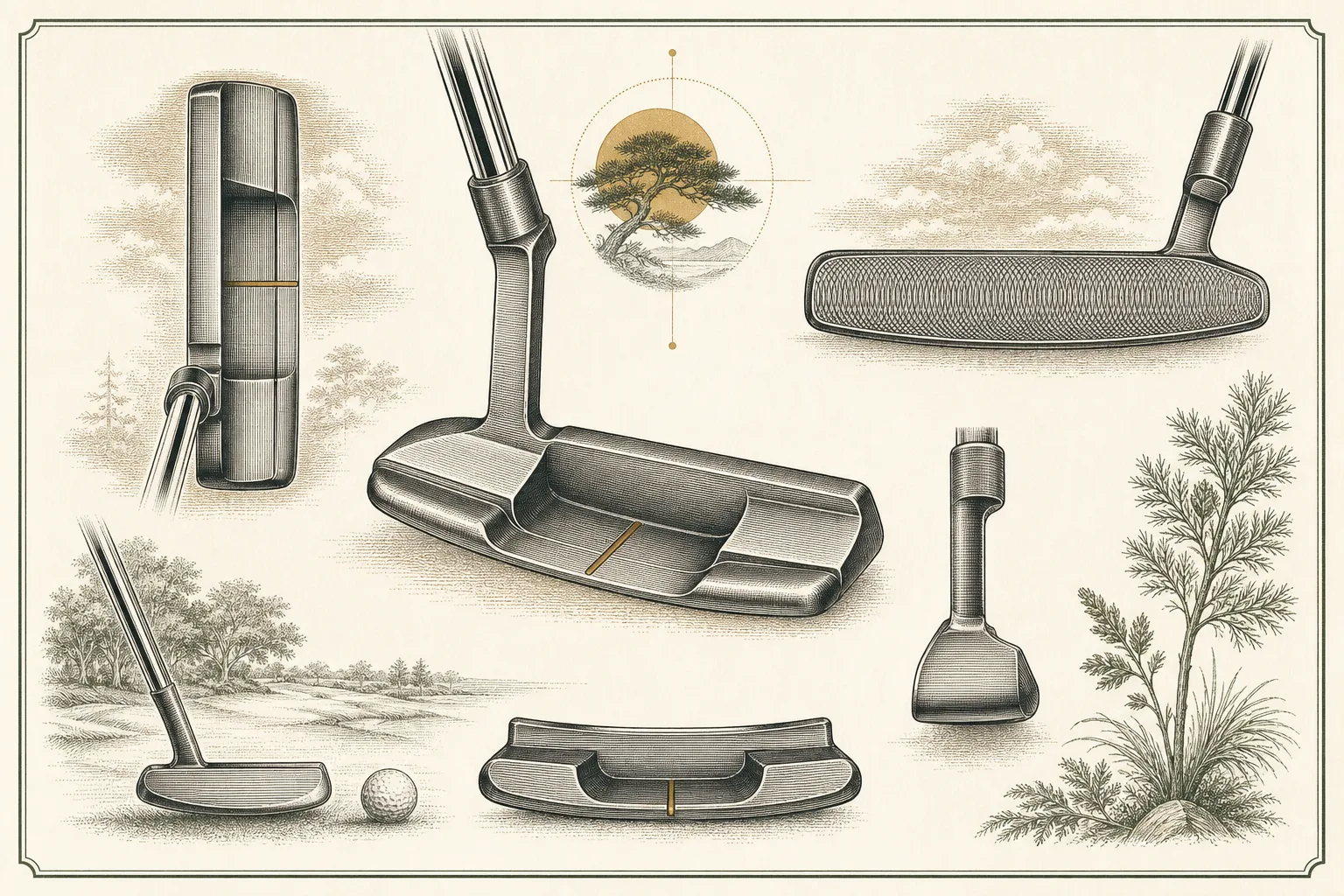
“A 370g forged blade putter that runs through the same forging as Miura's irons, with a milled face that turns skid into a true roll. The heavier of the KM-005/006 pair, ideal for firmer greens and a smoother stroke.”
The heavier twin of Miura's KM forged blade pair, a 370-gram toe-hang putter run through the same Himeji forging and milling process as the company's irons. Where the KM-005 is the lighter 350g head for touch and slower greens, the KM-006's extra 20 grams suits firmer, faster surfaces and a smoother, more pendulum-like stroke. It carries the identical milled mild-steel face that turns skid into a true roll, the same 3-degree loft, 70-degree lie and roughly 4:30 toe hang, and the same satin oil-chromed finish. It is the choice within the pair for the player who wants a little more head mass steadying the stroke.
Like its KM-005 sibling, a boutique forged blade that stays under the radar next to the big American milled-putter brands while drawing strong praise from specialists (ABC7's club reviews and PutterZone-tier coverage highlight its feel). Low volume plus Miura's iron-forging pedigree make it a connoisseur's sleeper, valued by those who seek it out rather than a widely-recognized cult piece.
Thinly traded like the KM-005, handled mostly by boutique and tour-stock putter dealers. Realistic private-party value in 2026 is roughly $175-375 depending on condition and finish, with clean examples and rare specs (LH, black boron) at the top of the range. Reconditioned/boutique retail runs above private-party; original retail was ~$400.
For the feel-based putter on firmer, faster greens who wants a touch more head mass to smooth the stroke; the arc'd-stroke better player is the natural buyer. The lighter KM-005 is the pick for slower greens and a more touch-driven stroke. A player wanting a face-balanced mallet or maximum mishit forgiveness should look elsewhere.
Part of Miura's Series 1957 putter program (reviewed from around 2010 into the mid-2010s), at the premium forged-blade tier against Scotty Cameron Newport, Bettinardi BB, and boutique Japanese milled putters. Within Miura it is the heavier of the KM-005/006 toe-hang pair, later joined by heads such as the KM-008. A modern equivalent is a Miura KM-008 or a forged Bettinardi/Cameron blade in a heavier build.
Scored on the putter axis: a compact toe-hang forged blade, low-forgiveness relative to a mallet, with no MOI aids beyond the milled face. The 20g heavier head (370g vs the KM-005's 350g) adds a little stroke stability and helps on firmer greens, but off-center putts are not stabilized like a high-MOI mallet. A 4 matches the KM-005, reflecting a traditional feel blade with a slight steadiness edge from the added mass.
Calibrated across the whole catalog — a tour blade scores low here on purpose; it means control, not ease.
Reading is one thing — hitting is another. Book a bay and see the numbers for yourself before you buy anywhere.