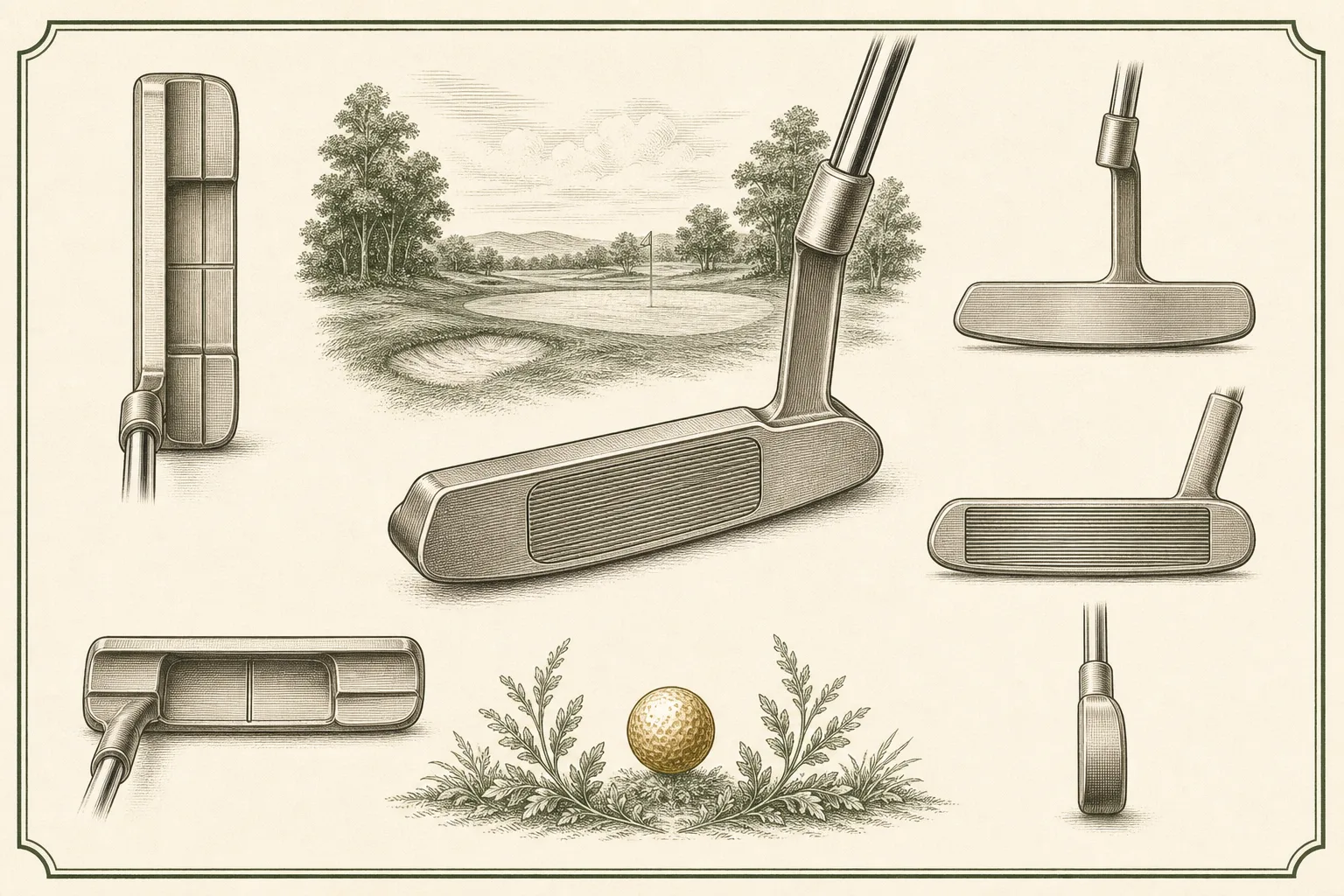
“The lighter of the KM forged blade pair, better suited to slower greens and a more feel-based stroke. Same Himeji forging and milled face as its heavier KM-006 sibling.”
Miura extending its lifelong pursuit of the perfect iron into the putter category, forged in Himeji from mild steel and milled to the same ultra-smooth, tight-tolerance standard as its irons. The KM-005 is the lighter of a two-head pair, a 350-gram toe-hang blade (its sibling KM-006 runs 370g) with a milled face that reviewers say converts skid into a true roll and delivers vivid, clicky-yet-not-hard audio feedback. Standard loft is 3 degrees and lie 70 degrees, with the toe hanging around 4:30, and the head wears a satin oil-chromed finish. It is a putter built the way Miura builds irons: quietly, for feel above all.
A boutique forged blade putter that flies under the radar next to Scotty Cameron and Bettinardi, yet earns lavish praise from the specialists who find it (PutterZone calls the feel phenomenal and praises its poise and audio feedback). Low production and Miura-forging pedigree make it a connoisseur's sleeper rather than a mass-recognized or heavily-hunted piece, so a genuine feel-first hidden gem more than a cult icon.
Thinly traded because so few were sold; boutique and used-putter dealers (including tour-stock specialists) handle most sales. Realistic private-party value in 2026 is roughly $150-350 depending on condition, finish wear and headcover, with clean examples and rarer specs (left-hand, black boron) commanding the top end. As with all Miura, reconditioned/boutique retail runs above private-party; original retail was ~$380.
For the feel-based putter, typically a better player with a slight-arc stroke who values roll quality and audio/tactile feedback over maximum forgiveness. Its 350g lighter head suits slower greens and a touch-based stroke; the heavier KM-006 is the pick for firmer, faster greens. A player who wants a stable face-balanced mallet or maximum mishit help should look elsewhere.
Part of Miura's Series 1957 putter program (the KM/DG line reviewed from around 2010 onward and carried into the mid-2010s), competing at the premium forged-blade tier with Scotty Cameron Newport, Bettinardi BB series, and boutique Japanese milled putters. Within Miura the KM-005/006 are the toe-hang blade pair, later joined by heads like the KM-008. A modern equivalent is a Miura KM-008 or a forged Bettinardi blade.
Scored on the putter axis: this is a compact toe-hang forged blade with a small head and no perimeter/heel-toe MOI aids beyond the milled face, so it is low-forgiveness relative to a mallet or high-MOI blade and rewards a consistent arc'd stroke. The milled face helps start the ball rolling truly, which aids distance control, but off-center putts are not stabilized the way a modern mallet stabilizes them. A 4 reflects a traditional feel-oriented blade, not an insert mallet.
Calibrated across the whole catalog — a tour blade scores low here on purpose; it means control, not ease.
Reading is one thing — hitting is another. Book a bay and see the numbers for yourself before you buy anywhere.