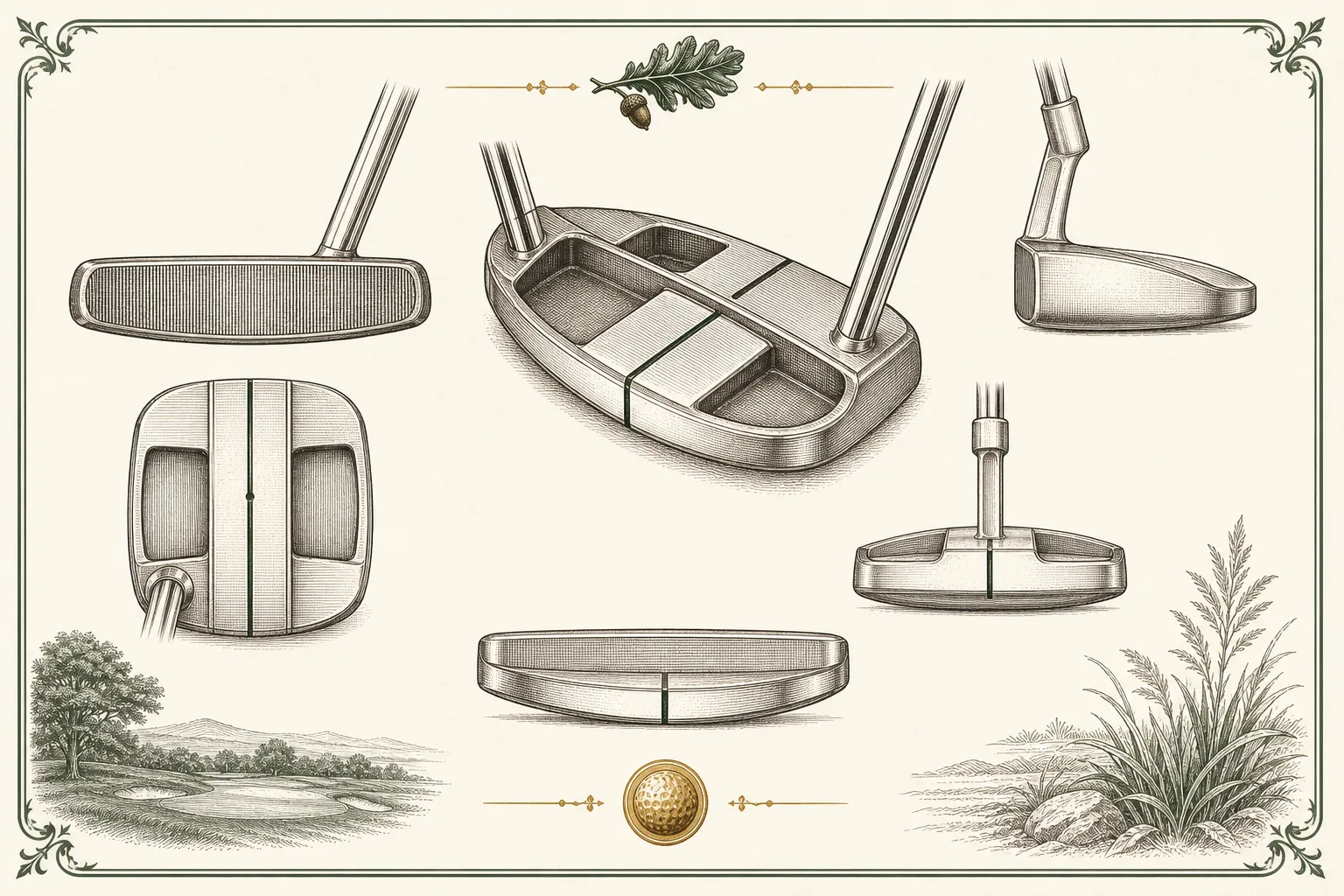
“The A-Series are classic Anser-style blades on the back-weighted, counterbalanced Heavy Putter chassis. Toe hang fits an arced stroke while the added mass smooths tempo. Milled aluminum-and-steel build.”
The A-Series is the original head shape of Boccieri Golf's Heavy Putter — a classic Anser-style, toe-hang blade built on the patented 'Back Weighting System' Steve Boccieri developed after realizing extra head mass alone made golfers' wrists break down. Instead he moved a counterweight to the grip's butt end, raising the balance point roughly 75% higher than a conventional putter so the stroke is driven by the shoulders, not the hands. The A1, the first production model, launched around 2006-2007 (golfbluebook's earliest listing is 2007) at roughly $230 retail with adjustable tip weights and a Weight Management System for tuning feel. It's the shape purists gravitated to inside the line — a familiar blade silhouette carrying an unfamiliar weighting idea.
The Heavy Putter line as a whole is the quiet ancestor of a mainstream category: counterbalanced putters (SuperStroke CounterCore, Odyssey Ten, Bettinardi's counterbalance models) are now standard equipment, and industry retrospectives explicitly trace that lineage back to Boccieri's Heavy Putter, launched in 2005. Tour wins accumulated across the PGA, European, Champions, Nationwide, Asian and Canadian tours through the late 2000s. But the A-Series blade itself never built forum-collector demand the way a Scotty Cameron does — it's respected as a pioneer, not chased as an object.
Players with an arced stroke who like a traditional blade look and toe hang, and who struggle with handsy, inconsistent tempo under pressure — the extra grip-end weight is specifically aimed at quieting the small muscles. Not a fit for a face-balanced, straight-back-straight-through putter or anyone who wants a large forgiving mallet; the classic blade shape here still rewards a centered strike.
Launched into a mid-2000s putter market still dominated by conventional-weight blades and mallets from Scotty Cameron, Odyssey and Ping; counterbalancing was a novelty concept, not yet a category. The A-Series' descendants are everywhere today — most major manufacturers now sell a counterbalanced option — making this an early, largely unbranded version of what became standard putter engineering fifteen years later.
A traditional Anser-style blade head shape carries a smaller, less forgiving sweet spot than a mallet, and the A-Series' MOI is at the low end of the Heavy Putter range even with the counterweighted grip. The back-weighting system helps stroke consistency (tempo forgiveness), but it does not meaningfully widen the face's tolerance for off-center strikes the way a high-MOI mallet like the H-Series does — this is a stroke-mechanics aid on a classic-shape head, not a mis-hit rescue putter.
Calibrated across the whole catalog — a tour blade scores low here on purpose; it means control, not ease.
A niche, discontinued design with limited resale infrastructure: clean A-Series heads typically trade for $25-45 privately in 2026 (well under the ~$230 original retail), since demand is confined to golfers specifically seeking a counterbalanced blade rather than the broader putter market.
Reading is one thing — hitting is another. Book a bay and see the numbers for yourself before you buy anywhere.