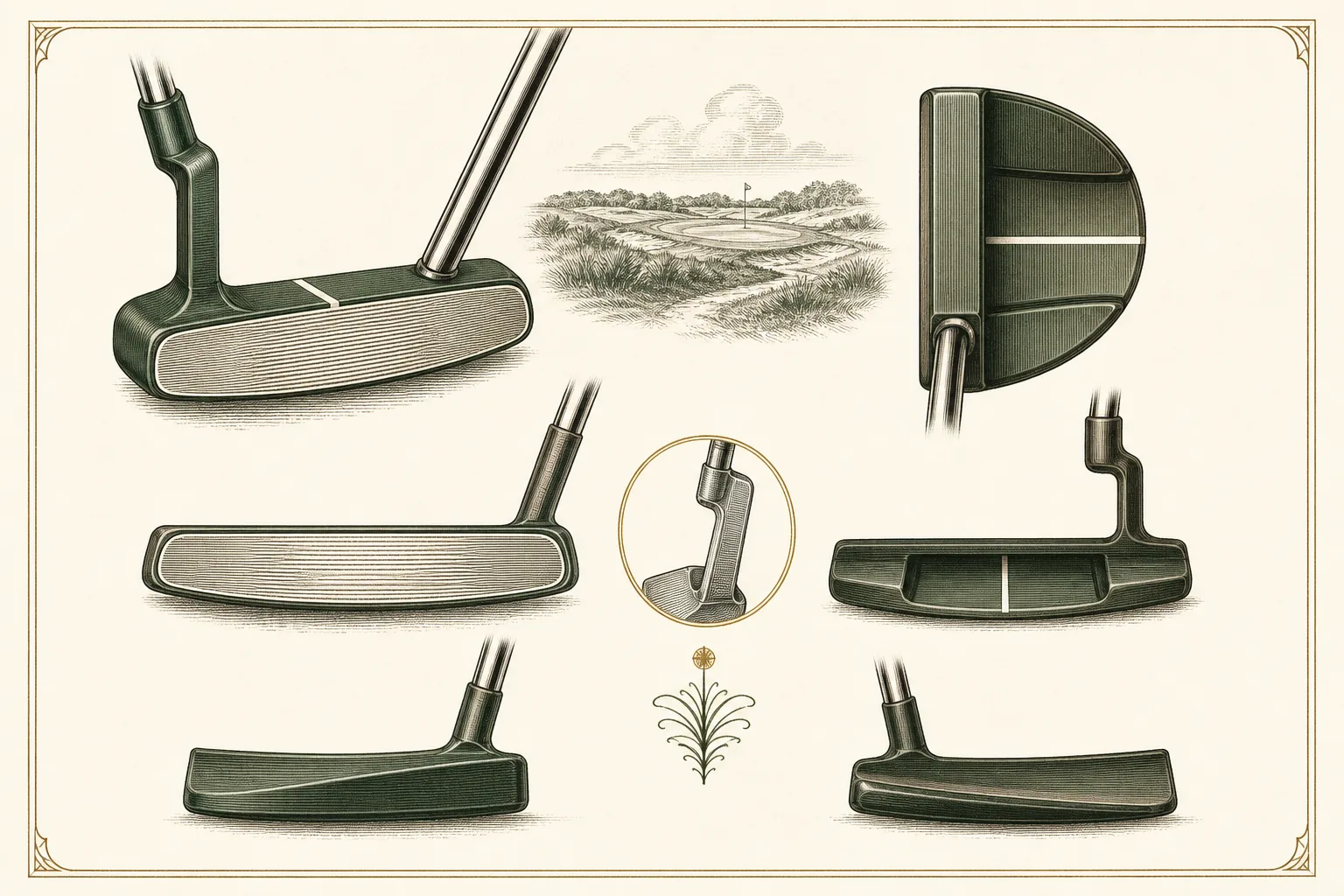
“The original tour blade that introduced Axis1's perfectly balanced, torque-free technology to competitive play. Its heel counterweight keeps CG on the face center in line with the shaft, self-squaring the face for any stroke.”
The Axis1 Tour was the tour-aimed blade in a lineup that grew out of Luis Pedraza's original 2009 'Eagle' putter -- the first design built around his patented Perfect Balance/torque-free concept, which won Sports Illustrated's 'Best in Show' at the 2009 PGA Show. Where a conventional blade hangs toe-down when balanced on a finger (revealing torque that twists the face open on the backstroke and shut through impact), the Tour's heel counterweight pulls its center of gravity onto the shaft axis so the toe points straight up at 12 o'clock -- the putter theoretically resists twisting regardless of stroke type. It gave Axis1, until then mostly a mail-order/infomercial-adjacent novelty brand, its first putter shaped like something a traditionalist would actually carry.
Axis1's balance claim is real and independently testable (any putter can be finger-balanced to check for toe-hang), and it drew genuine enthusiast attention on GolfWRX and specialist review sites for changing how the putter behaves through the stroke -- but it never broke into mainstream awareness the way the later Rose model did once Justin Rose signed on, and it is largely overshadowed today by Axis1's more famous later putters.
Golfers who fight an inconsistent face angle through the stroke (habitual pushes/pulls from an open or shut face) and who prefer a traditional blade look over Axis1's more visually unusual mallets. Less useful for a golfer who already controls face angle well and wants the standard finger/distance feedback of a conventional blade.
Released into a putter market still dominated by traditional Scotty Cameron/Odyssey blades and mallets; Axis1's zero-torque pitch predates the current wave of high-MOI 'wing' mallets (Odyssey's Ten, TaylorMade's Spider) that chase forgiveness through weight distribution rather than eliminating torque outright -- two different engineering answers to the same 'keep the face square' problem.
The torque-free design's real benefit is stroke consistency (resisting face rotation), not a larger sweet spot -- reviewers note mis-hits are still hard to feel because the balance masks the usual off-center feedback, so distance control on a heel/toe miss is decent but not dramatically more forgiving than a standard heel-shafted blade of similar size.
Calibrated across the whole catalog — a tour blade scores low here on purpose; it means control, not ease.
Inexpensive on the used market given the brand's niche following -- a used Axis1 Tour typically sells for $60-$120 privately (eBay/2nd Swing), reflecting steady but modest demand from golfers specifically seeking the torque-free design rather than any collector premium.
Reading is one thing — hitting is another. Book a bay and see the numbers for yourself before you buy anywhere.
“The original tour blade that introduced Axis1's perfectly balanced, torque-free technology to competitive play. Its heel counterweight keeps CG on the face center in line with the shaft, self-squaring the face for any stroke.”
The Axis1 Tour was the tour-aimed blade in a lineup that grew out of Luis Pedraza's original 2009 'Eagle' putter -- the first design built around his patented Perfect Balance/torque-free concept, which won Sports Illustrated's 'Best in Show' at the 2009 PGA Show. Where a conventional blade hangs toe-down when balanced on a finger (revealing torque that twists the face open on the backstroke and shut through impact), the Tour's heel counterweight pulls its center of gravity onto the shaft axis so the toe points straight up at 12 o'clock -- the putter theoretically resists twisting regardless of stroke type. It gave Axis1, until then mostly a mail-order/infomercial-adjacent novelty brand, its first putter shaped like something a traditionalist would actually carry.
Axis1's balance claim is real and independently testable (any putter can be finger-balanced to check for toe-hang), and it drew genuine enthusiast attention on GolfWRX and specialist review sites for changing how the putter behaves through the stroke -- but it never broke into mainstream awareness the way the later Rose model did once Justin Rose signed on, and it is largely overshadowed today by Axis1's more famous later putters.
Golfers who fight an inconsistent face angle through the stroke (habitual pushes/pulls from an open or shut face) and who prefer a traditional blade look over Axis1's more visually unusual mallets. Less useful for a golfer who already controls face angle well and wants the standard finger/distance feedback of a conventional blade.
Released into a putter market still dominated by traditional Scotty Cameron/Odyssey blades and mallets; Axis1's zero-torque pitch predates the current wave of high-MOI 'wing' mallets (Odyssey's Ten, TaylorMade's Spider) that chase forgiveness through weight distribution rather than eliminating torque outright -- two different engineering answers to the same 'keep the face square' problem.
The torque-free design's real benefit is stroke consistency (resisting face rotation), not a larger sweet spot -- reviewers note mis-hits are still hard to feel because the balance masks the usual off-center feedback, so distance control on a heel/toe miss is decent but not dramatically more forgiving than a standard heel-shafted blade of similar size.
Calibrated across the whole catalog — a tour blade scores low here on purpose; it means control, not ease.
Inexpensive on the used market given the brand's niche following -- a used Axis1 Tour typically sells for $60-$120 privately (eBay/2nd Swing), reflecting steady but modest demand from golfers specifically seeking the torque-free design rather than any collector premium.
Reading is one thing — hitting is another. Book a bay and see the numbers for yourself before you buy anywhere.