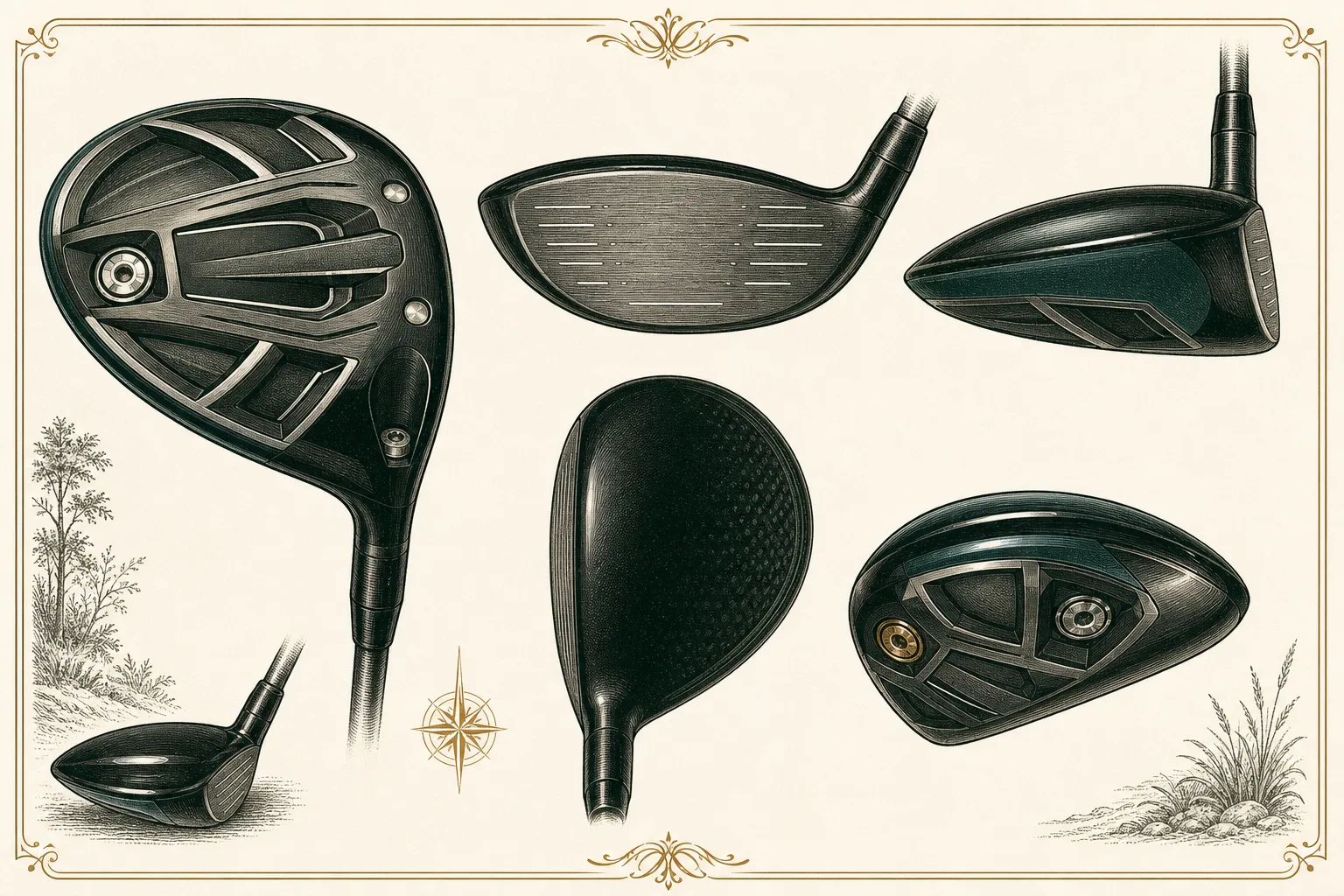
“The forward weight-screw position (vs. the standard Rogue's rear screw) is a real spin-lowering feature for a fast, low-spin strike — wasted weight-tuning on a moderate-speed swing.”
The 2018 Rogue Sub Zero fairway wood took the standard Rogue fairway's tech -- Jailbreak, 360 Face Cup, triaxial carbon crown, Boeing-designed Speed Step aerodynamics -- and moved its 2g weight screw from the standard rear position to the front of the sole, pushing the CG forward specifically to kill spin for faster, better-ball-striking players. Testing showed spin rates staying under 3000rpm even on fades, and dropping below 2500rpm on a solid draw, numbers well below the standard Rogue fairway aimed at higher-handicap golfers. It came in 13.5, 15 and 18-degree lofts with a wide range of 60-80g aftermarket-grade shaft options (Aldila Synergy, Project X EvenFlow, HZRDUS Yellow), reflecting its better-player target market.
A well-executed but unremarkable low-spin fairway wood release -- one of two 2018 Rogue fairway shapes (standard and Sub Zero) refreshed the following year and replaced by Callaway's Epic Flash/Epic family. No scarcity, no forum mythology, just a solid better-player tool from its era that is now simply an old, cheap fairway wood.
Lower-handicap, faster-swinging players who need to flatten trajectory and reduce spin off the tee or from the fairway, particularly into wind. Higher-handicap or slower-swinging players get more forgiveness and easier launch from the standard 2018 Rogue fairway wood built with a rear weight screw for the opposite goal.
Released alongside the standard 2018 Rogue fairway wood, aligned with the broader 'standard vs Sub Zero' pairing Callaway used across its driver and fairway lines that generation (echoed later by the Rogue ST Max vs Max LS split in 2022); replaced by the Epic Flash Sub Zero fairway the following year.
Reviewers were explicit that the Sub Zero's forgiveness, while 'good,' does not match the standard Rogue fairway sold alongside it -- the forward-CG weight-screw position that kills spin for a low-handicap player also shrinks the effective sweet spot and raises the mis-hit penalty compared to the rear-weighted standard model.
Calibrated across the whole catalog — a tour blade scores low here on purpose; it means control, not ease.
2nd Swing reconditioned-retail pricing runs roughly $58-$227 depending on loft, shaft and condition against an original ~$300 MSRP; realistic eBay private-party pricing for a clean head in 2026 is typically $40-$80, reflecting two full Callaway fairway-wood generations of depreciation.
Reading is one thing — hitting is another. Book a bay and see the numbers for yourself before you buy anywhere.