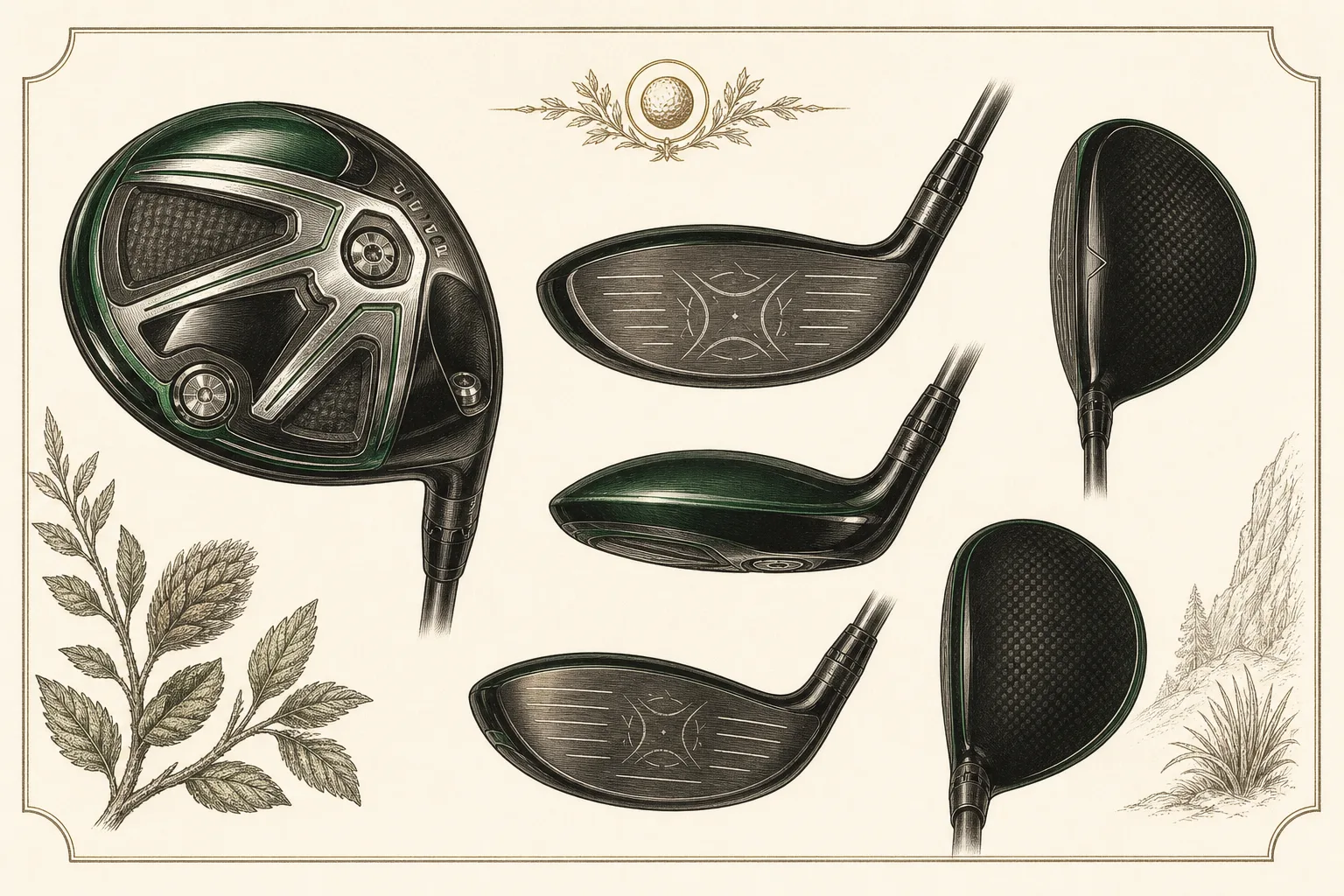
“Low-spin Epic fairway for the fast player who wants a flatter, penetrating flight. Fit to speed only.”
The Epic Sub Zero fairway paired Jailbreak technology with a Triaxial Carbon crown to bring the low-spin driver's design brief into a fairway wood: a lighter crown moved mass low for a flatter, more piercing flight than the standard Epic fairway, aimed at faster players wanting to keep spin down off both the deck and the tee. It launched with Phil Mickelson putting it in play at the 2017 CareerBuilder Challenge alongside the Epic driver, giving Callaway a tour-proof point almost immediately. Reviewers found it long and workable but noted the tradeoff plainly — independent testing found roughly a 38-yard total-distance drop-off between center and off-center strikes, a real forgiveness cost for the low-spin performance.
A well-regarded, tour-validated fairway wood in its year, but it never developed cult status — it was one generation in Callaway's annual fairway wood refresh, replaced by the Epic Flash Sub Zero two years later, and today it's simply a decent used low-spin fairway with no scarcity or forum mythology attached.
Suited to faster-swing, lower-handicap players who spin a standard fairway wood too high and need a flatter, more penetrating ball flight off the tee or deck. Mid-to-high handicappers or slower swingers should avoid it — the same design that flattens flight for a strong player will launch too low and cost distance for someone who needs help getting the ball airborne.
Released alongside the Epic Sub Zero driver in 2017, competing with TaylorMade's M1/M2 and Titleist's 917F fairway woods aimed at better players; succeeded by the Epic Flash Sub Zero fairway (2019) and later the GBB Epic Sub Zero fairway of the 2020 relaunch. A modern equivalent is the Callaway Paradym Triple Diamond fairway.
Deliberately gives up forgiveness for spin control and flight window: the low, forward CG and lighter carbon crown that keep spin down also shrink the margin for error, and the roughly 38-yard center-to-mishit distance gap documented in reviews is a real, measured tradeoff rather than a generic caveat — this sits well below a standard game-improvement fairway wood on forgiveness.
Calibrated across the whole catalog — a tour blade scores low here on purpose; it means control, not ease.
Realistic 2026 private-party price is roughly $60-$120 for a complete club with headcover on eBay/SidelineSwap, in line with other 2017-era fairway woods now several generations removed from Callaway's current line.
Reading is one thing — hitting is another. Book a bay and see the numbers for yourself before you buy anywhere.