“First Mizuno wedge in 1025 Boron, with Quad Cut Grooves and the widest loft/bounce/grind ladder of the T-series for tight fitting. Steel-dominant players' wedge; a soft, precise identity club and the oldest of this family.”
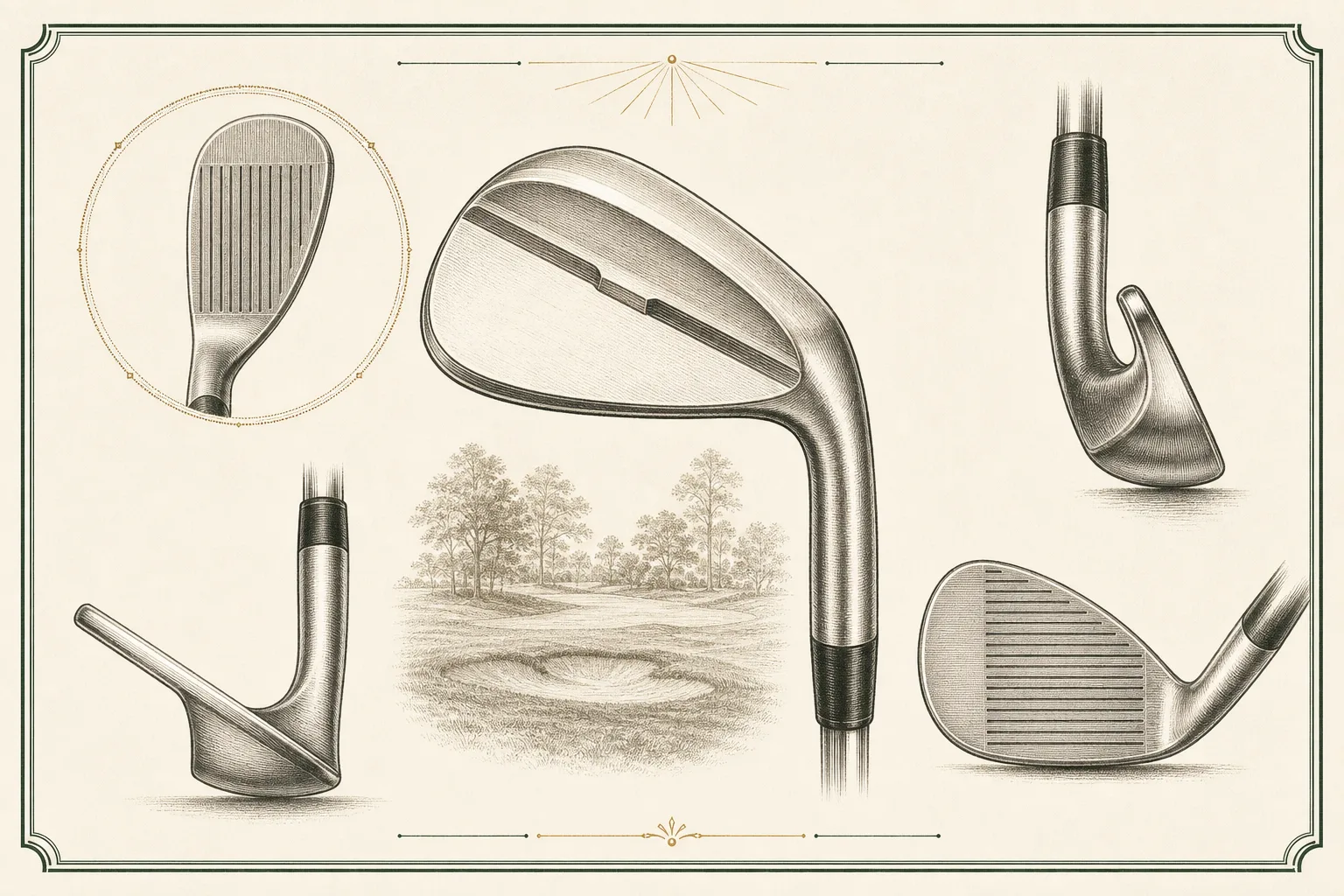
The T7 (2016) is remembered as Mizuno's boron wedge — the first time the company Grain Flow Forged its wedges from 1025 Boron steel rather than plain mild carbon steel. Adding boron let Mizuno forge a stronger head and, crucially, mill deeper, more durable grooves via a new ultra-high-speed CNC process: the boron-hardened faces hold sharp Quad Cut grooves that maintain spin longer than softer forged wedges. The T7 also used loft-specific groove geometry — 45– to 53-degree wedges got deeper, narrower grooves to maximize spin on full and partial shots, while the 54– to 62-degree scoring wedges got wider, shallower grooves — and a sole that narrows and loses bounce as loft climbs, with more aggressive grinds in the high-loft heads. Mizuno offered an industry-leading 87 loft/bounce combinations. It came in White Satin and a distinctive Blue ION finish, and reviewers consistently praised the soft, solid feel and heavy check, even on short chips, that the boron-forged head delivered.
The T7 is well-regarded and remembered as the standout boron-forged Mizuno wedge with strong contemporary reviews (Golf Monthly, Golfalot, GolfWRX, Today's Golfer) and a genuine technical hook, which lifts it above an anonymous commodity. But wedges churn fast, it was superseded by the T20/T22/T24 lines, and it has no scarcity, tour-legend or collector premium. 'Notable' is honest: a respected, distinctive forged wedge, not a cult piece.
Mid-to-low handicaps and better players who want a soft, forged tour-milled wedge with durable, high-spin boron grooves and a fit-able sole (DB fit: any). The loft-specific grooves and 87 loft/bounce/grind combinations make it fit a wide range of players and turf if properly matched. A high-handicap wanting a wide, forgiving cavity-back wedge or maximum bounce-out-of-the-box ease is better served by a game-improvement wedge; the T7 rewards technique.
Launched 2016 (in market through roughly 2019) against the Titleist Vokey SM6/SM7, Cleveland RTX-3, Callaway Mack Daddy 4 and TaylorMade Milled Grind. Its boron-forged, deep-milled-groove pitch was Mizuno's answer to the spin-and-durability arms race of the mid-2010s. It preceded Mizuno's T20/T22/T24 wedge generations, which continued the loft-specific-groove and multi-grind approach.
Wedges are strike-and-grind dependent rather than MOI-driven, so this rates it among wedges. The T7 is a compact, forged tour-milled wedge with clean, traditional shaping and no cavity or perimeter-weighted forgiveness aids — it rewards clean contact and precise strike. Its help comes from fit rather than mishit rescue: 87 loft/bounce combinations and grind options let a fitter match sole/bounce to the player and turf, which is the practical 'forgiveness' a wedge offers. A 4 reflects a players' forged wedge — modestly more playable than a bare blade iron but far from a game-improvement head.
Calibrated across the whole catalog — a tour blade scores low here on purpose; it means control, not ease.
Plentiful, cheap used supply; a decade-old single wedge with no premium. Mizuno's trade-in data cited about $50 per wedge on trade-in; realistic 2026 private-party single-wedge prices are roughly $40–$90 depending on grind, finish and groove wear, against ~$150 new. Groove wear is the key value killer for any used wedge — boron slows it but doesn't stop it; Blue ION examples in clean condition and rarer grinds sit at the top. It is worth what it can still spin, not a collectible.
Reading is one thing — hitting is another. Book a bay and see the numbers for yourself before you buy anywhere.
“First Mizuno wedge in 1025 Boron, with Quad Cut Grooves and the widest loft/bounce/grind ladder of the T-series for tight fitting. Steel-dominant players' wedge; a soft, precise identity club and the oldest of this family.”
The T7 (2016) is remembered as Mizuno's boron wedge — the first time the company Grain Flow Forged its wedges from 1025 Boron steel rather than plain mild carbon steel. Adding boron let Mizuno forge a stronger head and, crucially, mill deeper, more durable grooves via a new ultra-high-speed CNC process: the boron-hardened faces hold sharp Quad Cut grooves that maintain spin longer than softer forged wedges. The T7 also used loft-specific groove geometry — 45– to 53-degree wedges got deeper, narrower grooves to maximize spin on full and partial shots, while the 54– to 62-degree scoring wedges got wider, shallower grooves — and a sole that narrows and loses bounce as loft climbs, with more aggressive grinds in the high-loft heads. Mizuno offered an industry-leading 87 loft/bounce combinations. It came in White Satin and a distinctive Blue ION finish, and reviewers consistently praised the soft, solid feel and heavy check, even on short chips, that the boron-forged head delivered.
The T7 is well-regarded and remembered as the standout boron-forged Mizuno wedge with strong contemporary reviews (Golf Monthly, Golfalot, GolfWRX, Today's Golfer) and a genuine technical hook, which lifts it above an anonymous commodity. But wedges churn fast, it was superseded by the T20/T22/T24 lines, and it has no scarcity, tour-legend or collector premium. 'Notable' is honest: a respected, distinctive forged wedge, not a cult piece.
Mid-to-low handicaps and better players who want a soft, forged tour-milled wedge with durable, high-spin boron grooves and a fit-able sole (DB fit: any). The loft-specific grooves and 87 loft/bounce/grind combinations make it fit a wide range of players and turf if properly matched. A high-handicap wanting a wide, forgiving cavity-back wedge or maximum bounce-out-of-the-box ease is better served by a game-improvement wedge; the T7 rewards technique.
Launched 2016 (in market through roughly 2019) against the Titleist Vokey SM6/SM7, Cleveland RTX-3, Callaway Mack Daddy 4 and TaylorMade Milled Grind. Its boron-forged, deep-milled-groove pitch was Mizuno's answer to the spin-and-durability arms race of the mid-2010s. It preceded Mizuno's T20/T22/T24 wedge generations, which continued the loft-specific-groove and multi-grind approach.
Wedges are strike-and-grind dependent rather than MOI-driven, so this rates it among wedges. The T7 is a compact, forged tour-milled wedge with clean, traditional shaping and no cavity or perimeter-weighted forgiveness aids — it rewards clean contact and precise strike. Its help comes from fit rather than mishit rescue: 87 loft/bounce combinations and grind options let a fitter match sole/bounce to the player and turf, which is the practical 'forgiveness' a wedge offers. A 4 reflects a players' forged wedge — modestly more playable than a bare blade iron but far from a game-improvement head.
Calibrated across the whole catalog — a tour blade scores low here on purpose; it means control, not ease.
Plentiful, cheap used supply; a decade-old single wedge with no premium. Mizuno's trade-in data cited about $50 per wedge on trade-in; realistic 2026 private-party single-wedge prices are roughly $40–$90 depending on grind, finish and groove wear, against ~$150 new. Groove wear is the key value killer for any used wedge — boron slows it but doesn't stop it; Blue ION examples in clean condition and rarer grinds sit at the top. It is worth what it can still spin, not a collectible.
Reading is one thing — hitting is another. Book a bay and see the numbers for yourself before you buy anywhere.