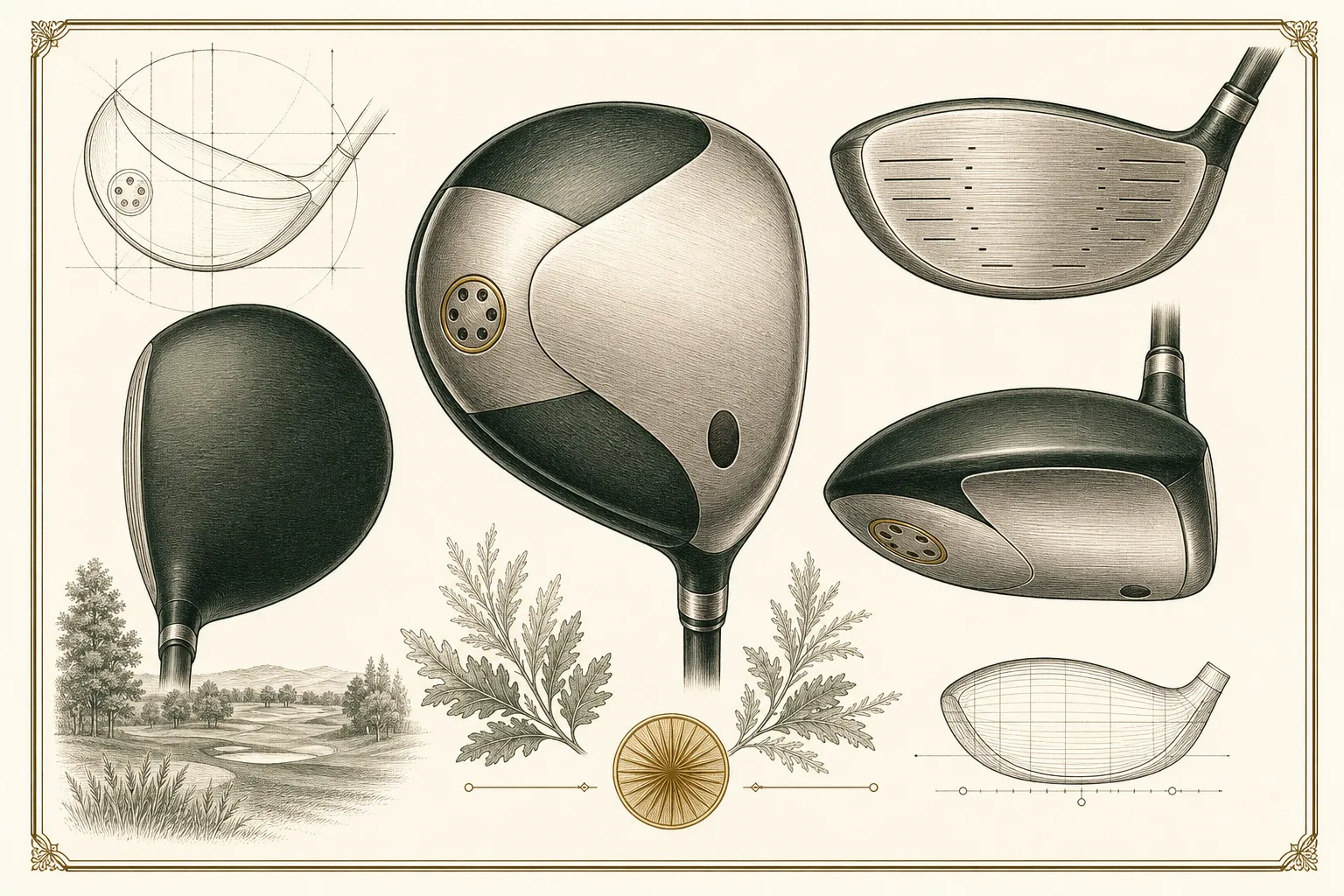
“The 380cc GBB II grown to 415cc for more MOI. A perfectly honest mid-2000s Ti driver; a modern head out-launches it easily.”
Launched in 2004, the GBB II 415 was Callaway's push to the ceiling of driver head size before the USGA locked the limit at 460cc. Callaway's own press materials billed it as the largest driver the company had ever brought to market, using the extra 35cc over the standard Great Big Bertha II (380cc) purely to raise Moment of Inertia rather than to chase a gimmick. The clubface used a new thinner, stronger titanium construction for a bigger effective hitting area, and it came paired with the 45-inch GBB System 60 graphite shaft (with a dedicated 44-inch Gems 50 ladies shaft). It sat at the top of the Great Big Bertha II family, one generation removed from the original 1990s Big Bertha that built Callaway's driver reputation, and it sold well as a mainstream flagship rather than a specialty tour product.
No dedicated forum cult or scarcity value has developed around it, but it holds a genuine historical footnote: it was Callaway's largest-ever clubhead at the moment the industry was racing toward the 460cc ceiling, and it carried strong user ratings (4.2/5 across 26 reviews on golfreview.com) as a mainstream bestseller in its own era.
A fine, cheap gamer today for a high-handicap or nostalgic recreational player who wants an easy-swinging, forgiving stick and does not care about modern ball speeds; the 45-inch stock shaft and light System 60 flex suit moderate swing speeds. Anyone chasing current distance numbers should look at a modern 460cc driver instead — 20+ years of face and shaft technology have made this club meaningfully shorter by comparison.
It competed directly with TaylorMade's R500/R580 series and Titleist's 983/905 drivers in the mid-2000s size arms race, and it was itself superseded within Callaway's own line by the X460 (2006, see companion record) once the USGA settled on 460cc as the hard limit. A modern equivalent is any current Callaway Paradym/Ai Smoke driver — same forgiveness-first philosophy, vastly more refined execution.
A 415cc head with the extra volume specifically engineered into MOI rather than shape, so off-center hits lose noticeably less ball speed and spin consistency than the smaller-headed drivers it replaced. It is not a modern max-MOI head, but for 2004 it was among the most forgiving shapes Callaway sold, at the direct cost of a slightly larger, less workable look at address.
Calibrated across the whole catalog — a tour blade scores low here on purpose; it means control, not ease.
Callaway Golf Pre-Owned and 2nd Swing have cycled this model in and out of stock at graded/reconditioned prices historically in the $80-$150 range; realistic private-party/eBay pricing for a clean example with its stock shaft runs roughly $40-$90 in 2026, reflecting its age and the two decades of driver technology since. It is not a collectible — value is purely functional.
Reading is one thing — hitting is another. Book a bay and see the numbers for yourself before you buy anywhere.
“The 380cc GBB II grown to 415cc for more MOI. A perfectly honest mid-2000s Ti driver; a modern head out-launches it easily.”
Launched in 2004, the GBB II 415 was Callaway's push to the ceiling of driver head size before the USGA locked the limit at 460cc. Callaway's own press materials billed it as the largest driver the company had ever brought to market, using the extra 35cc over the standard Great Big Bertha II (380cc) purely to raise Moment of Inertia rather than to chase a gimmick. The clubface used a new thinner, stronger titanium construction for a bigger effective hitting area, and it came paired with the 45-inch GBB System 60 graphite shaft (with a dedicated 44-inch Gems 50 ladies shaft). It sat at the top of the Great Big Bertha II family, one generation removed from the original 1990s Big Bertha that built Callaway's driver reputation, and it sold well as a mainstream flagship rather than a specialty tour product.
No dedicated forum cult or scarcity value has developed around it, but it holds a genuine historical footnote: it was Callaway's largest-ever clubhead at the moment the industry was racing toward the 460cc ceiling, and it carried strong user ratings (4.2/5 across 26 reviews on golfreview.com) as a mainstream bestseller in its own era.
A fine, cheap gamer today for a high-handicap or nostalgic recreational player who wants an easy-swinging, forgiving stick and does not care about modern ball speeds; the 45-inch stock shaft and light System 60 flex suit moderate swing speeds. Anyone chasing current distance numbers should look at a modern 460cc driver instead — 20+ years of face and shaft technology have made this club meaningfully shorter by comparison.
It competed directly with TaylorMade's R500/R580 series and Titleist's 983/905 drivers in the mid-2000s size arms race, and it was itself superseded within Callaway's own line by the X460 (2006, see companion record) once the USGA settled on 460cc as the hard limit. A modern equivalent is any current Callaway Paradym/Ai Smoke driver — same forgiveness-first philosophy, vastly more refined execution.
A 415cc head with the extra volume specifically engineered into MOI rather than shape, so off-center hits lose noticeably less ball speed and spin consistency than the smaller-headed drivers it replaced. It is not a modern max-MOI head, but for 2004 it was among the most forgiving shapes Callaway sold, at the direct cost of a slightly larger, less workable look at address.
Calibrated across the whole catalog — a tour blade scores low here on purpose; it means control, not ease.
Callaway Golf Pre-Owned and 2nd Swing have cycled this model in and out of stock at graded/reconditioned prices historically in the $80-$150 range; realistic private-party/eBay pricing for a clean example with its stock shaft runs roughly $40-$90 in 2026, reflecting its age and the two decades of driver technology since. It is not a collectible — value is purely functional.
Reading is one thing — hitting is another. Book a bay and see the numbers for yourself before you buy anywhere.