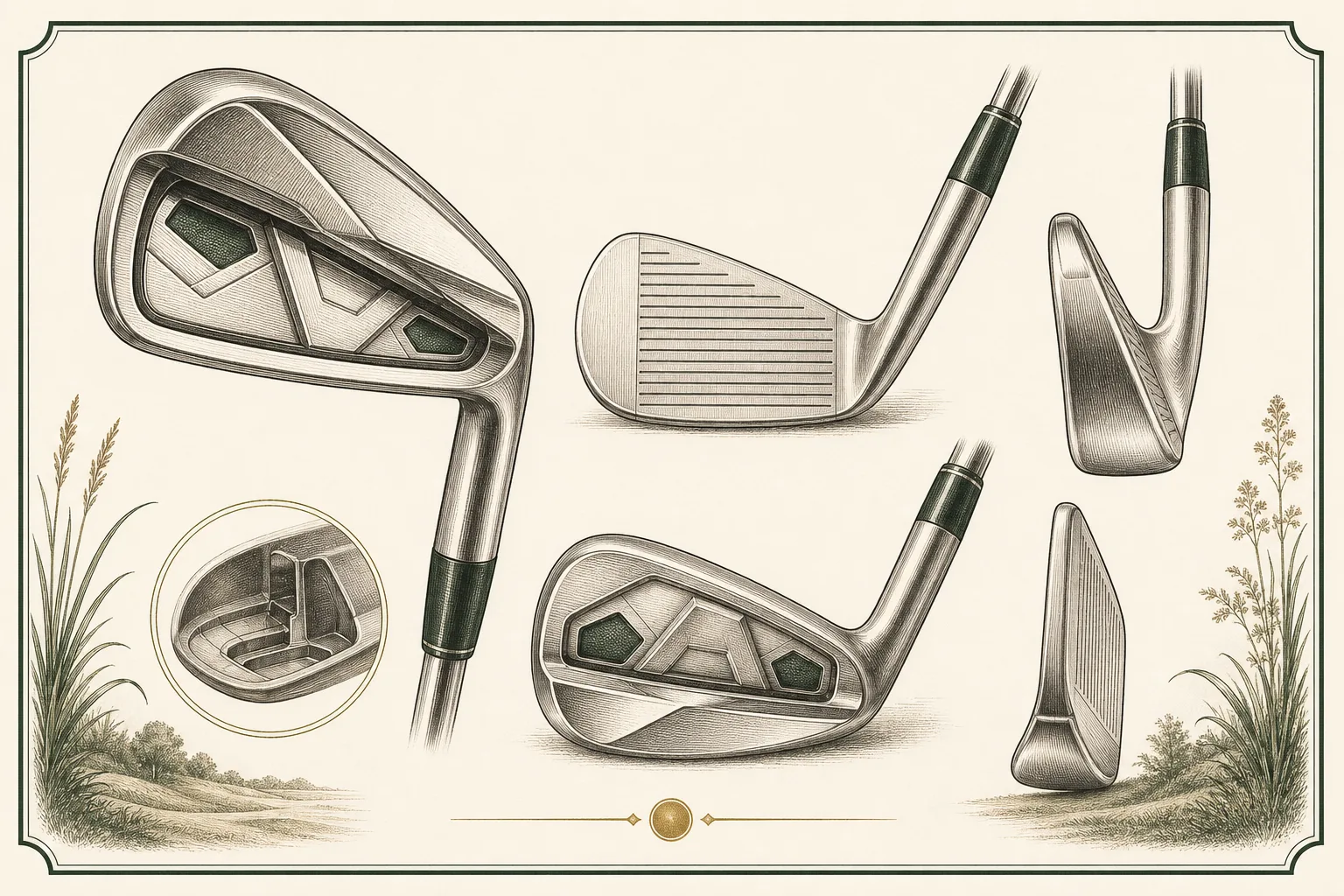
“A rung-2 forged set with a longer, thinner head and a visible dual pocket for higher launch and forgiveness. The most playable of the J15 family for mid-handicaps. Strong used value if you want forged feel with help.”
The J15 DPF was the most forgiving model in Bridgestone's J15 forged family, built from premium forged carbon steel with visible cavities flanking a central muscle section — Bridgestone marketed this as a dual-pocket design meant to shift discretionary weight to the perimeter for a higher moment of inertia. Compared to its DF and CB siblings it used a longer, thinner-topline head and noticeably stronger lofts, aiming squarely at players who wanted more forgiveness and launch without stepping all the way into a game-improvement iron. Reviewers found it delivered real ball-speed and forgiveness gains over the other J15 models but felt a little 'dead' at impact next to the softer-feeling DF, a common trade-off when weight gets moved away from the center of the face.
It did its job well for the buyer chasing forgiveness within the forged J15 range, but it generated no lasting enthusiast reputation — golf media covered it as one competent entry in a four-model refresh, and it was retired on Bridgestone's normal iron cycle with nothing distinguishing it beyond 'the forgiving one in this particular family.'
Best for a mid-handicap player who wants forged feel and a fairly compact look but needs real help on off-center strikes, especially in the longer irons where the stronger lofts and dual-pocket design add both distance and margin for error. A skilled ball-striker who prefers pure feedback should choose the DF or CB in the same family instead.
Released in the same 2015 J15 wave as the CB and DF, sitting in the market alongside forgiving-but-forged competitors like Mizuno's JPX-850 Forged and Callaway's Apex CF16 — irons built for players who wanted forged feel without giving up all the forgiveness of a cast game-improvement head.
The most forgiving of the four J15 forged models thanks to its visible dual-pocket cavity design and longer, perimeter-weighted head, and reviewers confirmed mis-hits from other forged irons felt straighter and carried further with this one — but it is still a forged, players-oriented head rather than a true cast game-improvement design, so it tops out in the middle of the forgiveness scale rather than at the game-improvement end.
Calibrated across the whole catalog — a tour blade scores low here on purpose; it means control, not ease.
Ten-plus years old and from a brand with modest resale pull in the US, a clean used 4-PW/5-PW steel set realistically brings roughly $150–$250 private-party in 2026 — genuinely useful forged forgiveness for the money, but it is not a set collectors chase.
Reading is one thing — hitting is another. Book a bay and see the numbers for yourself before you buy anywhere.
“A rung-2 forged set with a longer, thinner head and a visible dual pocket for higher launch and forgiveness. The most playable of the J15 family for mid-handicaps. Strong used value if you want forged feel with help.”
The J15 DPF was the most forgiving model in Bridgestone's J15 forged family, built from premium forged carbon steel with visible cavities flanking a central muscle section — Bridgestone marketed this as a dual-pocket design meant to shift discretionary weight to the perimeter for a higher moment of inertia. Compared to its DF and CB siblings it used a longer, thinner-topline head and noticeably stronger lofts, aiming squarely at players who wanted more forgiveness and launch without stepping all the way into a game-improvement iron. Reviewers found it delivered real ball-speed and forgiveness gains over the other J15 models but felt a little 'dead' at impact next to the softer-feeling DF, a common trade-off when weight gets moved away from the center of the face.
It did its job well for the buyer chasing forgiveness within the forged J15 range, but it generated no lasting enthusiast reputation — golf media covered it as one competent entry in a four-model refresh, and it was retired on Bridgestone's normal iron cycle with nothing distinguishing it beyond 'the forgiving one in this particular family.'
Best for a mid-handicap player who wants forged feel and a fairly compact look but needs real help on off-center strikes, especially in the longer irons where the stronger lofts and dual-pocket design add both distance and margin for error. A skilled ball-striker who prefers pure feedback should choose the DF or CB in the same family instead.
Released in the same 2015 J15 wave as the CB and DF, sitting in the market alongside forgiving-but-forged competitors like Mizuno's JPX-850 Forged and Callaway's Apex CF16 — irons built for players who wanted forged feel without giving up all the forgiveness of a cast game-improvement head.
The most forgiving of the four J15 forged models thanks to its visible dual-pocket cavity design and longer, perimeter-weighted head, and reviewers confirmed mis-hits from other forged irons felt straighter and carried further with this one — but it is still a forged, players-oriented head rather than a true cast game-improvement design, so it tops out in the middle of the forgiveness scale rather than at the game-improvement end.
Calibrated across the whole catalog — a tour blade scores low here on purpose; it means control, not ease.
Ten-plus years old and from a brand with modest resale pull in the US, a clean used 4-PW/5-PW steel set realistically brings roughly $150–$250 private-party in 2026 — genuinely useful forged forgiveness for the money, but it is not a set collectors chase.
Reading is one thing — hitting is another. Book a bay and see the numbers for yourself before you buy anywhere.