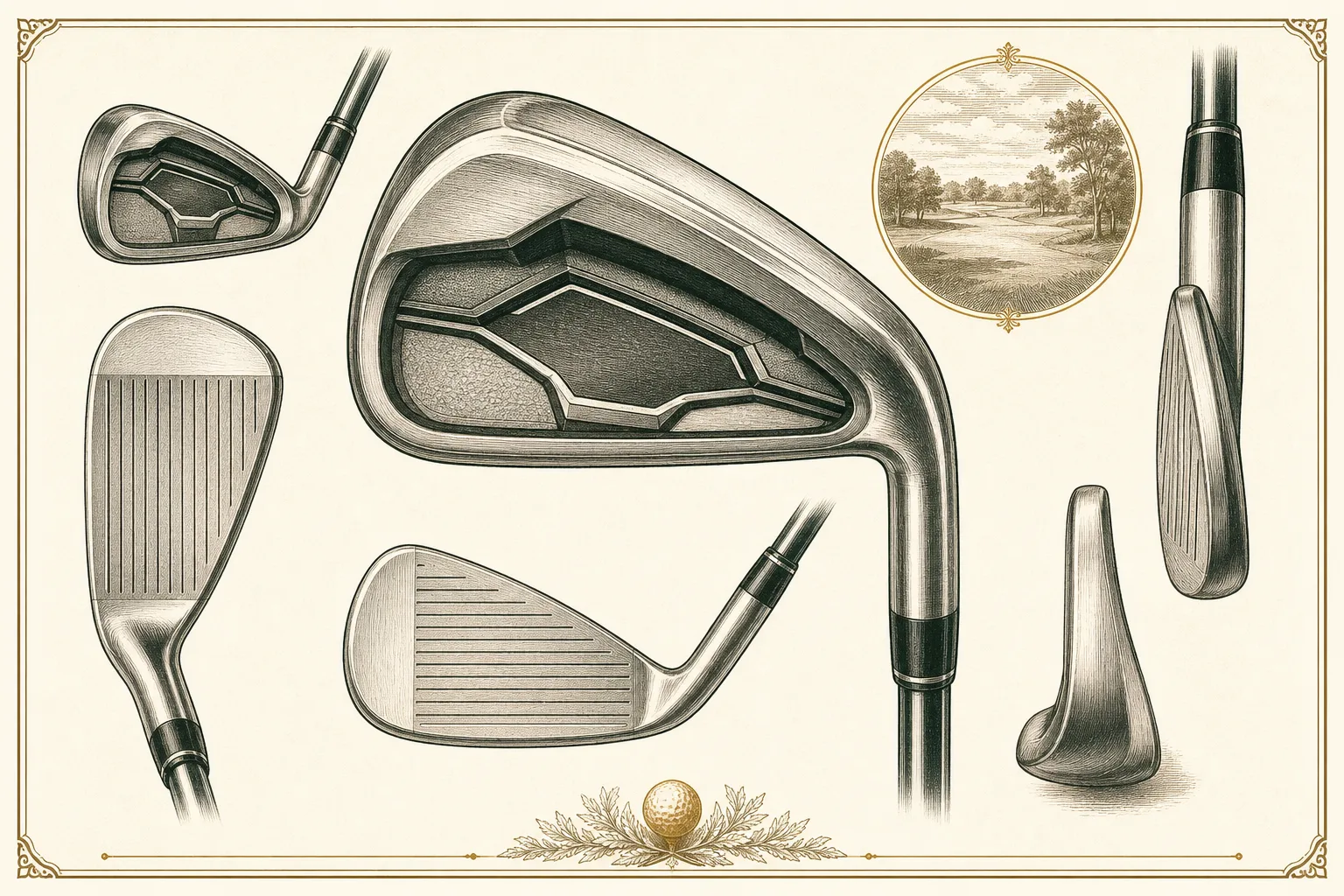
“Compact, less-offset Pro version for skilled players: a degree weaker and a quarter-inch shorter than the standard Steelhead XR for control, with a heavier XP 105 shaft. Best for consistent ball-strikers.”
The Steelhead XR Pro shrank the standard 2016 XR's head, thinned its topline, and trimmed roughly a quarter-inch of length and about a degree of loft off the set to give better ball-strikers a cleaner, more workable version of the same 360 Face Cup technology. Removing head weight from around the bore-through hosel area let Callaway's engineers reposition mass into strategic zones for MOI and per-iron CG placement, while a dark PVD-style finish made the head look visually smaller than the standard chrome XR at address. Reviewers (Plugged In Golf, The Hackers Paradise, Golfalot) generally agreed the performance gap to the standard XR was modest - close enough that some called the choice between them mostly a matter of look and feel preference rather than a hard performance tradeoff.
A competently reviewed players-distance iron riding the Steelhead nostalgia branding, but with no independent following, scarcity, or tour narrative of its own. Multiple reviewers explicitly noted its performance is close enough to the standard XR that the split is largely cosmetic preference - the definition of a solid, unremarkable commodity choice.
Better ball-strikers transitioning from a max-GI iron toward a players iron who still want cavity-back forgiveness and easy launch, per contemporary reviews aimed at that exact 'improving player' demographic. A high handicapper chasing maximum ease should choose the standard XR instead, which is longer, more offset, and slightly more forgiving for the same design family.
Launched alongside the standard Steelhead XR in Callaway's 2016 iron lineup as the better-player option, competing with TaylorMade's M2 Tour-adjacent CB offerings and Mizuno's JPX-900 Forged. Succeeded within two years by the Rogue Pro (2018), continuing Callaway's standard mainstream/pro-series iron pairing strategy.
Slightly less forgiving than the standard Steelhead XR by design - a shorter blade length, less offset, a thinner topline and a degree less loft trade a little stability and launch ease for a cleaner look and better workability - but it retains the same 360 Face Cup and repositioned internal weighting for real off-center ball speed retention. It sits as a genuine players-distance iron, between the max-forgiveness standard XR and a true blade or muscle-back.
Calibrated across the whole catalog — a tour blade scores low here on purpose; it means control, not ease.
Complete sets typically sell for $200-$300 in 2026 on eBay/2nd Swing, a modest step up from the standard XR reflecting its slightly newer-feeling 'Pro' positioning rather than any scarcity; it remains a common, non-collectible used set.
Reading is one thing — hitting is another. Book a bay and see the numbers for yourself before you buy anywhere.
“Compact, less-offset Pro version for skilled players: a degree weaker and a quarter-inch shorter than the standard Steelhead XR for control, with a heavier XP 105 shaft. Best for consistent ball-strikers.”
The Steelhead XR Pro shrank the standard 2016 XR's head, thinned its topline, and trimmed roughly a quarter-inch of length and about a degree of loft off the set to give better ball-strikers a cleaner, more workable version of the same 360 Face Cup technology. Removing head weight from around the bore-through hosel area let Callaway's engineers reposition mass into strategic zones for MOI and per-iron CG placement, while a dark PVD-style finish made the head look visually smaller than the standard chrome XR at address. Reviewers (Plugged In Golf, The Hackers Paradise, Golfalot) generally agreed the performance gap to the standard XR was modest - close enough that some called the choice between them mostly a matter of look and feel preference rather than a hard performance tradeoff.
A competently reviewed players-distance iron riding the Steelhead nostalgia branding, but with no independent following, scarcity, or tour narrative of its own. Multiple reviewers explicitly noted its performance is close enough to the standard XR that the split is largely cosmetic preference - the definition of a solid, unremarkable commodity choice.
Better ball-strikers transitioning from a max-GI iron toward a players iron who still want cavity-back forgiveness and easy launch, per contemporary reviews aimed at that exact 'improving player' demographic. A high handicapper chasing maximum ease should choose the standard XR instead, which is longer, more offset, and slightly more forgiving for the same design family.
Launched alongside the standard Steelhead XR in Callaway's 2016 iron lineup as the better-player option, competing with TaylorMade's M2 Tour-adjacent CB offerings and Mizuno's JPX-900 Forged. Succeeded within two years by the Rogue Pro (2018), continuing Callaway's standard mainstream/pro-series iron pairing strategy.
Slightly less forgiving than the standard Steelhead XR by design - a shorter blade length, less offset, a thinner topline and a degree less loft trade a little stability and launch ease for a cleaner look and better workability - but it retains the same 360 Face Cup and repositioned internal weighting for real off-center ball speed retention. It sits as a genuine players-distance iron, between the max-forgiveness standard XR and a true blade or muscle-back.
Calibrated across the whole catalog — a tour blade scores low here on purpose; it means control, not ease.
Complete sets typically sell for $200-$300 in 2026 on eBay/2nd Swing, a modest step up from the standard XR reflecting its slightly newer-feeling 'Pro' positioning rather than any scarcity; it remains a common, non-collectible used set.
Reading is one thing — hitting is another. Book a bay and see the numbers for yourself before you buy anywhere.