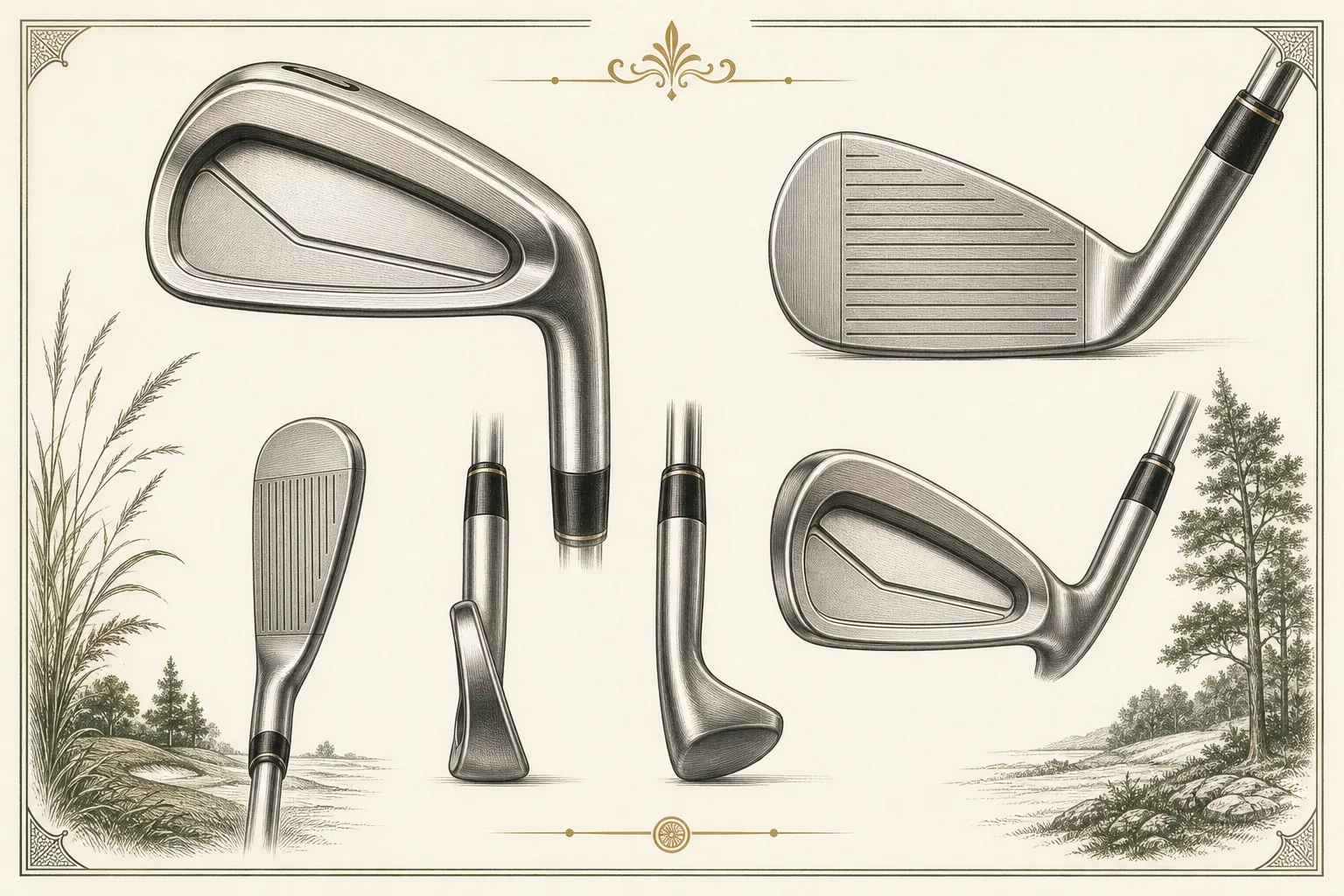
“The forged top of the 300-series family (the 320/360 casts were the game-improvement siblings). A clean players cavity for feel on a budget.”
TaylorMade's first forged cavity-back iron, launched in 2000 as the brand -- known mostly for metalwoods at the time -- made its serious play for the iron market. Built from carbon steel using TaylorMade's double-strike 'coining' forging process, it combined a classic thin top line, minimal offset and mirror-chrome finish with enough perimeter weighting to be genuinely forgiving for a forged iron, a rarer combination in 2000 than it is today. Ernie Els and other tour pros put it in play, lending professional credibility during TaylorMade's push to be taken seriously as an iron maker alongside Titleist, Mizuno and Callaway.
A quarter-century on, it still draws an active GolfWRX thread ('Anybody still play Taylor Made 300 forged iron?') and a 4.5-out-of-5 average across 89 user reviews on golfreview.com -- real, sustained affection from people who still own and play it, without the brand ever marketing it as a legacy/reissue product the way Mizuno has done with its MP line. That combination of genuine long-term user loyalty and zero corporate mythologizing is the sleeper pattern.
Low-to-mid handicappers who want a classic-profile forged cavity with real forgiveness and don't need modern distance numbers -- still playable today as a budget forged iron, but its 2000-era lofts (traditional, not jacked-strong) mean it will fly shorter than a current players-distance iron with the same nominal number.
Launched into a market TaylorMade did not yet dominate on the iron side, competing against Titleist's DCI, Mizuno's forged MP lines, and Callaway's early-2000s irons. It represented TaylorMade formally entering the forged-iron conversation before the brand's later RAC and Tour Preferred lines built on the same 'forgiving forged' positioning.
Notably forgiving for a forged iron of its era: TaylorMade's coining process concentrated weight at the perimeter, which reviewers at the time singled out as unusual for a forged design -- 'a level of forgiveness not often seen in forged irons.' Still a traditionally sized players' cavity by today's standards, so it lands mid-scale rather than in game-improvement territory.
Calibrated across the whole catalog — a tour blade scores low here on purpose; it means control, not ease.
Reconditioned-retail (2nd Swing) lists a single 3-PW steel-stiff set at $287.99, marked down from an original $799.99 MSRP -- but that reconditioned price sits well above realistic private-party value. On eBay/SidelineSwap, partial sets and single clubs commonly trade for $30-210 depending on completeness and shaft; a realistic full private-party set in 2026 runs roughly $100-200.
Reading is one thing — hitting is another. Book a bay and see the numbers for yourself before you buy anywhere.