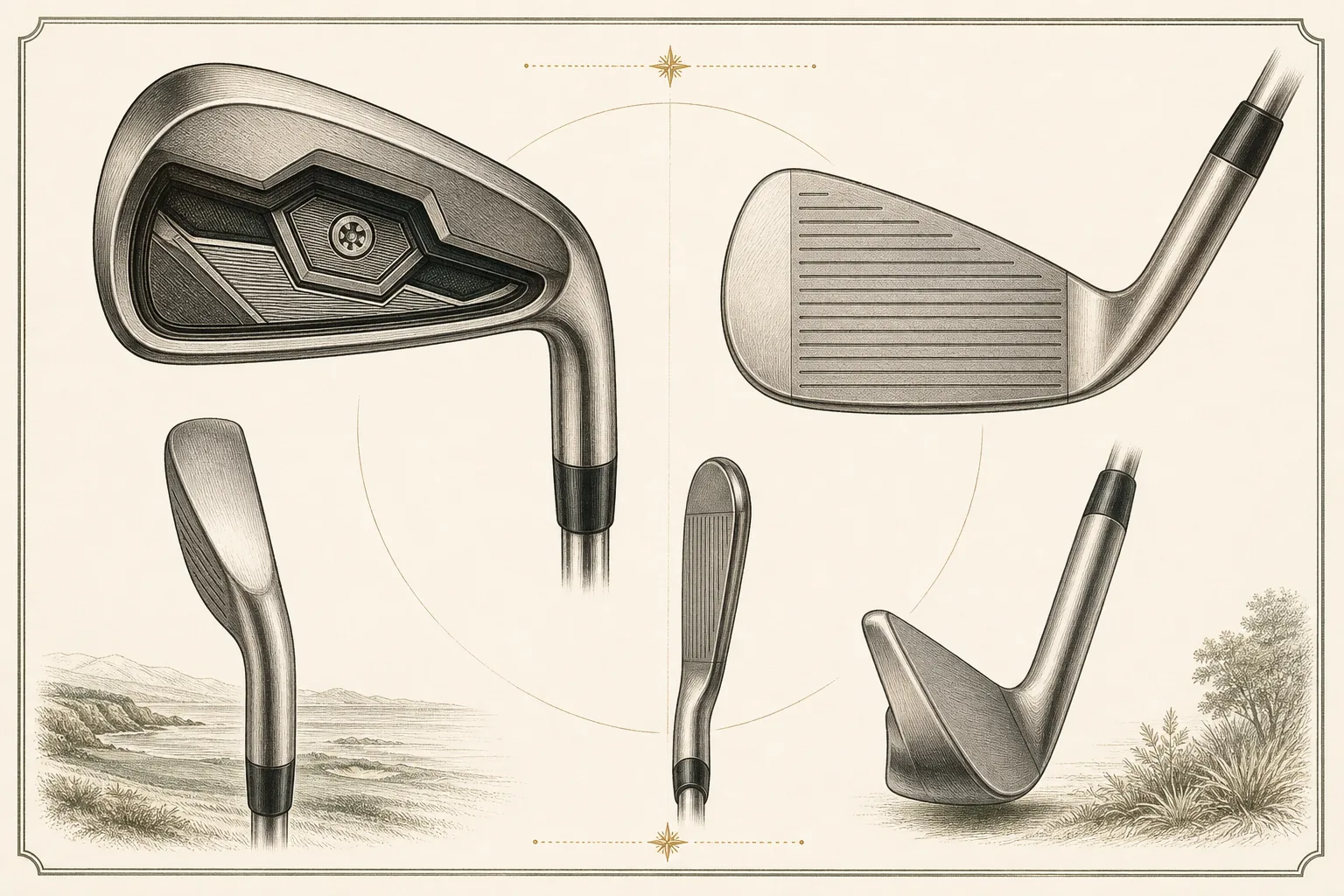
“A clean forged cavity from the Idea Pro Black line for accomplished ball-strikers. Rung-2, earned on strike.”
The 2011 follow-up that softened the Pro Black CB's edges for the 'aspiring player.' Still forged from soft 8620 carbon steel and finished in the line's black PVD, the CB2 added dual perimeter weighting to lower CG and lift both launch and MOI, a thin four-way cambered sole to move cleanly through turf, and progressive offset that makes the long irons easier while preserving short-iron control. It shipped with lighter stock shafts, the KBS Tour 90 in steel or Matrix Studio 84 in graphite, pushing it a touch further toward playability than the CB1's Project X setup. Reviewers of the day compared its feel and accuracy favorably to the Ping i15 and Mizuno MX-300, strong company for a brand not known for irons. It's a forged players' cavity that gives up a little workability for a little more help.
Like the CB1, it's a quietly excellent forged set overshadowed by its own brand's game-improvement image. It posts high user ratings (golfreview lists the CB2 Pro Black at 4.8/5 across a dozen reviews) and drew period comparisons to premium Ping and Mizuno players' irons, yet sells used for a fraction of them. Known and loved by forged-iron value hunters, ignored by everyone else: a sleeper, not a cult object.
For mid-handicaps and improving ball-strikers (roughly 5-15) who want forged feel with a bit more launch and forgiveness than a pure players' cavity, or a CB1 owner wanting an easier long iron. Lofts are traditional (4-iron ~23 degrees, GW ~50), so expect modern-short but high-stopping flight. Pure blade purists and distance-chasers should look elsewhere.
Launched 2011 between the CB1 (2010) and CB3 (2012), during Adams' strongest 'Pro' period. It squared off against the Ping i15/i20, Mizuno MX-300/MP-53, and Titleist AP2, and reviewers felt it genuinely belonged in that conversation. Its lighter KBS Tour 90 / Matrix Studio 84 stock shafts reflect the early-2010s move toward lighter steel in players' irons. Modern equivalent: a forgiving forged players-distance/cavity like a Mizuno Pro 245.
A shade more forgiving than the CB1 and one of the more playable forged players' cavities of its era, but still firmly a players' cavity. Dual perimeter weighting, the cambered sole, and progressive offset raise launch and stabilize the long irons versus the CB1, so mis-hits hold up a little better, hence a 6 rather than a 5. It is not a game-improvement iron: the head is compact, the topline thin, and off-center strikes still cost distance and feel relative to a true GI set.
Calibrated across the whole catalog — a tour blade scores low here on purpose; it means control, not ease.
Strong value, and a good illustration of reconditioned-retail inflation: Golf Avenue cites an average payout around $347 for a CB2 set, a store/trade figure, but realistic 2026 private-party value on eBay/SidelineSwap is more like $150-300 for a clean 4-PW/GW set depending on shaft and wear. It undercuts comparable Mizuno/Ping/Titleist forged sets of the same age, which is its whole appeal. No collector premium, purely a feel-per-dollar buy.
Reading is one thing — hitting is another. Book a bay and see the numbers for yourself before you buy anywhere.
“A clean forged cavity from the Idea Pro Black line for accomplished ball-strikers. Rung-2, earned on strike.”
The 2011 follow-up that softened the Pro Black CB's edges for the 'aspiring player.' Still forged from soft 8620 carbon steel and finished in the line's black PVD, the CB2 added dual perimeter weighting to lower CG and lift both launch and MOI, a thin four-way cambered sole to move cleanly through turf, and progressive offset that makes the long irons easier while preserving short-iron control. It shipped with lighter stock shafts, the KBS Tour 90 in steel or Matrix Studio 84 in graphite, pushing it a touch further toward playability than the CB1's Project X setup. Reviewers of the day compared its feel and accuracy favorably to the Ping i15 and Mizuno MX-300, strong company for a brand not known for irons. It's a forged players' cavity that gives up a little workability for a little more help.
Like the CB1, it's a quietly excellent forged set overshadowed by its own brand's game-improvement image. It posts high user ratings (golfreview lists the CB2 Pro Black at 4.8/5 across a dozen reviews) and drew period comparisons to premium Ping and Mizuno players' irons, yet sells used for a fraction of them. Known and loved by forged-iron value hunters, ignored by everyone else: a sleeper, not a cult object.
For mid-handicaps and improving ball-strikers (roughly 5-15) who want forged feel with a bit more launch and forgiveness than a pure players' cavity, or a CB1 owner wanting an easier long iron. Lofts are traditional (4-iron ~23 degrees, GW ~50), so expect modern-short but high-stopping flight. Pure blade purists and distance-chasers should look elsewhere.
Launched 2011 between the CB1 (2010) and CB3 (2012), during Adams' strongest 'Pro' period. It squared off against the Ping i15/i20, Mizuno MX-300/MP-53, and Titleist AP2, and reviewers felt it genuinely belonged in that conversation. Its lighter KBS Tour 90 / Matrix Studio 84 stock shafts reflect the early-2010s move toward lighter steel in players' irons. Modern equivalent: a forgiving forged players-distance/cavity like a Mizuno Pro 245.
A shade more forgiving than the CB1 and one of the more playable forged players' cavities of its era, but still firmly a players' cavity. Dual perimeter weighting, the cambered sole, and progressive offset raise launch and stabilize the long irons versus the CB1, so mis-hits hold up a little better, hence a 6 rather than a 5. It is not a game-improvement iron: the head is compact, the topline thin, and off-center strikes still cost distance and feel relative to a true GI set.
Calibrated across the whole catalog — a tour blade scores low here on purpose; it means control, not ease.
Strong value, and a good illustration of reconditioned-retail inflation: Golf Avenue cites an average payout around $347 for a CB2 set, a store/trade figure, but realistic 2026 private-party value on eBay/SidelineSwap is more like $150-300 for a clean 4-PW/GW set depending on shaft and wear. It undercuts comparable Mizuno/Ping/Titleist forged sets of the same age, which is its whole appeal. No collector premium, purely a feel-per-dollar buy.
Reading is one thing — hitting is another. Book a bay and see the numbers for yourself before you buy anywhere.