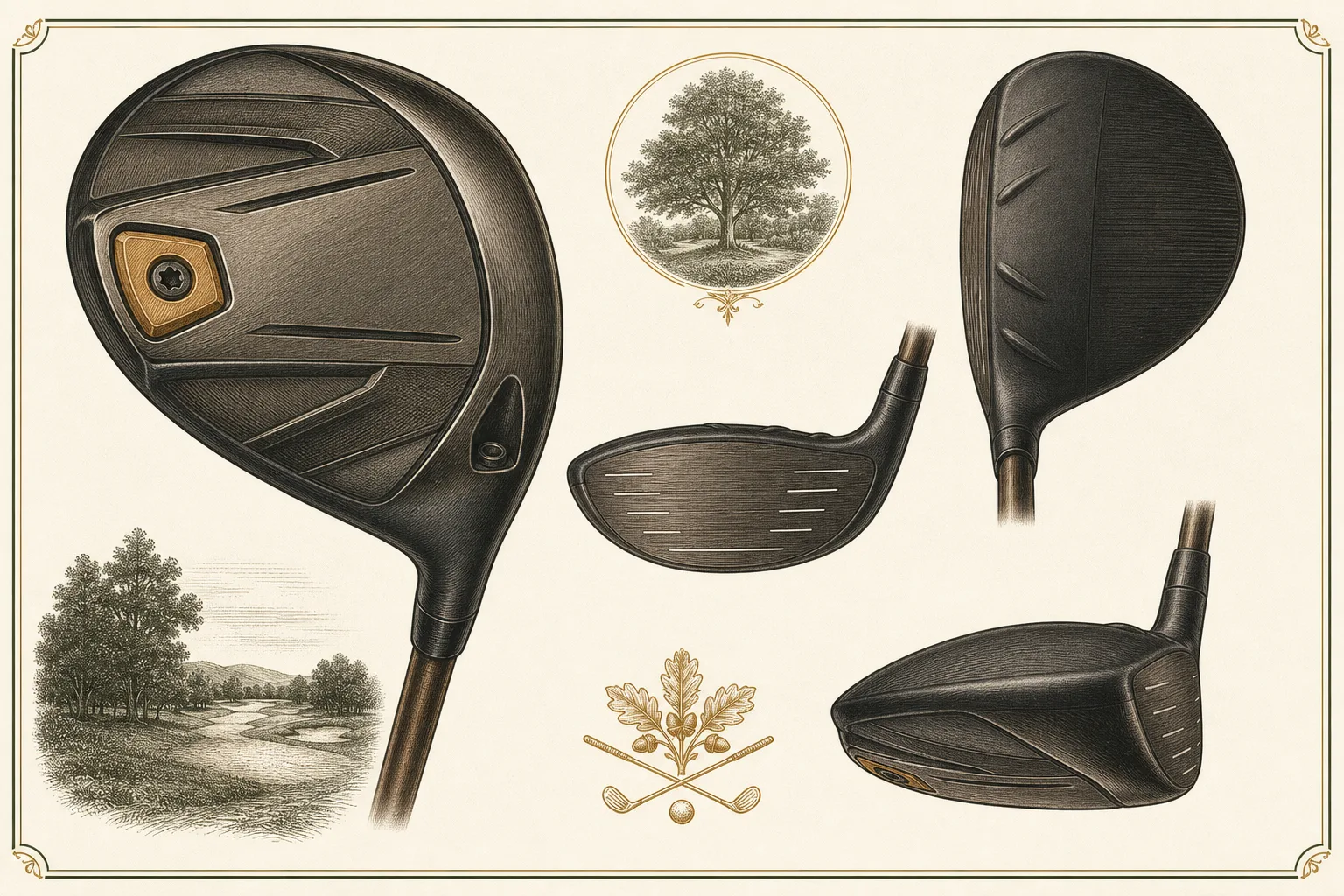
“A low-spin players' fairway wood (rung-3 posture) - strong, forward-CG performance for fast swings; slower swings give up launch and forgiveness.”
The Stretch was Ping's answer to the 'mini-driver' trend that TaylorMade and Callaway were riding hard in 2017: take the G400 3-wood platform, strengthen the loft to a single 13 degrees, grow the head 12cc to 193cc, and push the CG further forward than the standard G400 3-wood to kill spin off the tee. Ping deliberately left grooves out of the center of the face — reasoning that a club used mostly for driving-range-style tee shots doesn't need spin control there, only ball speed. The maraging-steel face (Ping's strongest face alloy at the time) added roughly 2 mph of ball speed over the prior G-series fairway faces. It slotted in as Ping's rung-3, low-spin fairway option alongside the more forgiving standard G400 and SFT fairways, aimed squarely at fast-swinging players who wanted a lower, more penetrating flight than a full-size driver but more forgiveness than a true 2-wood or strong 3-wood.
No cult footprint: it was a one-year variant inside the larger G400 fairway lineup, reviewed favorably as a solid low-spin option but never singled out as a must-hunt club the way some Ping fairways from the 1990s are. It was quietly succeeded by the G410/G410 LST fairway line in 2019 on Ping's normal product cycle.
Best for faster-swinging players (Ping's own fitting places it above roughly 95 mph total swing speed territory) who hit the standard G400 3-wood too high and too spinny and want a driver-off-the-deck option. Slower swingers give up launch and forgiveness versus the standard G400 or SFT fairway and should look at those instead.
Launched alongside the full G400 family (driver, SFT, LST, irons) in 2017, competing with TaylorMade's M1/M2 fairways and Callaway's Great Big Bertha Epic Sub Zero fairway for the low-spin tee-shot-alternative niche. Superseded in 2019 by the G410 LST Fairway, which cut roughly another 300-500 rpm of spin off the same low-spin concept.
Deliberately a low-spin, forward-CG players' fairway (rung 3 in Ping's own ladder), not a game-improvement club. The stronger loft and forward weighting that make it low-spinning for a fast swing also make it harder to launch and less forgiving on thin or off-center strikes for slower-speed players — a genuine trade-off, not a marketing gap.
Calibrated across the whole catalog — a tour blade scores low here on purpose; it means control, not ease.
A little-searched, single-season variant: realistic 2026 private-party pricing runs roughly $50-$90 for a clean head-and-shaft combo, similar to other 2017-era Ping fairway woods once the driver-alternative novelty faded. It is not a collectible; buyers are paying for a usable low-spin fairway, not the Stretch name.
Reading is one thing — hitting is another. Book a bay and see the numbers for yourself before you buy anywhere.