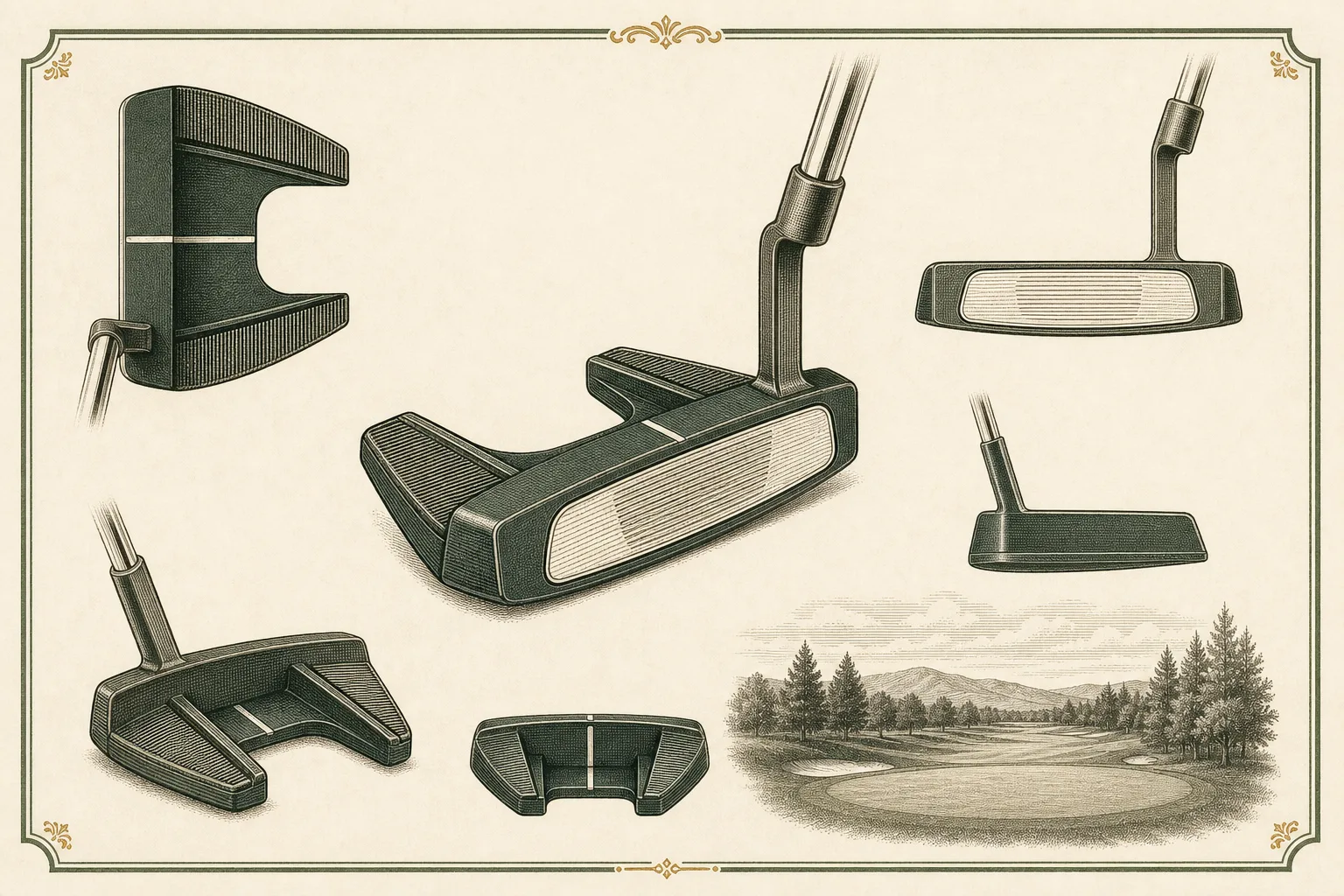
“Sigma 2 launched Oct 2018 with a dual-durometer Pebax face and adjustable-length shaft across Anser, Tyne, Fetch, Kushin shapes. Head style varies; the soft-yet-solid face is the pitch.”
Launched in October 2018, Sigma 2 was the generation that actually solved a fitting problem Ping had been talking about for years: an adjustable-length shaft, hidden mostly inside the grip, that lets a fitter or player change length from 32 to 36 inches in quarter-inch steps using a supplied key — built off Ping's own research claiming 8 of 10 golfers play the wrong length putter. It paired that with a new dual-durometer Pebax face, a soft front layer for touch on short putts backed by a firmer layer for distance control on longer ones, across eight head shapes from blade-style Anser and ZB2 to mallets like Fetch, Arna, Valor, and Wolverine.
Genuinely well-covered as a real innovation — Golf Digest called it a line that 'solves putter design's newest and oldest problems,' and it got dedicated first-look coverage from MyGolfSpy, PGA Tour's own equipment desk, and most major UK/Australian golf outlets. That's strong, substantive praise, but it's mainstream trade-press recognition of a smart engineering feature, not the grassroots forum-hunting or scarcity that marks an actual cult club.
Particularly useful for a golfer who has never been properly length-fit for a putter, since the adjustment lets a fitter dial in exact length without buying a new head. Head-shape choice (blade vs. mallet) should still be matched to stroke type as with any Ping putter. Less relevant for a player already using a professionally length-fit putter of a fixed length they trust.
Third and final generation in Ping's 2016-2018 putter refresh cycle (Sigma → Sigma G → Sigma 2), and the one that stuck around longest in Ping's catalog (through 2024) precisely because the adjustable-length feature had lasting fitting value rather than being a one-cycle cosmetic update.
A step up from the original Sigma: the dual-durometer face and retained True Roll groove pattern improve distance-control consistency across strike locations. As with any putter line spanning blades to mallets, the true number ranges roughly 5 (Anser blade) to 8 (Fetch/ZB2-style mallets) — 7 represents the line's blended midpoint, not any single head.
Calibrated across the whole catalog — a tour blade scores low here on purpose; it means control, not ease.
Realistic 2026 private-party pricing runs roughly $70-$140 depending on head shape and finish (Platinum finishes trend toward the higher end) — the most recent and longest-running Sigma generation, so it holds value better than the original Sigma or Scottsdale TR before it.
Reading is one thing — hitting is another. Book a bay and see the numbers for yourself before you buy anywhere.
“Sigma 2 launched Oct 2018 with a dual-durometer Pebax face and adjustable-length shaft across Anser, Tyne, Fetch, Kushin shapes. Head style varies; the soft-yet-solid face is the pitch.”
Launched in October 2018, Sigma 2 was the generation that actually solved a fitting problem Ping had been talking about for years: an adjustable-length shaft, hidden mostly inside the grip, that lets a fitter or player change length from 32 to 36 inches in quarter-inch steps using a supplied key — built off Ping's own research claiming 8 of 10 golfers play the wrong length putter. It paired that with a new dual-durometer Pebax face, a soft front layer for touch on short putts backed by a firmer layer for distance control on longer ones, across eight head shapes from blade-style Anser and ZB2 to mallets like Fetch, Arna, Valor, and Wolverine.
Genuinely well-covered as a real innovation — Golf Digest called it a line that 'solves putter design's newest and oldest problems,' and it got dedicated first-look coverage from MyGolfSpy, PGA Tour's own equipment desk, and most major UK/Australian golf outlets. That's strong, substantive praise, but it's mainstream trade-press recognition of a smart engineering feature, not the grassroots forum-hunting or scarcity that marks an actual cult club.
Particularly useful for a golfer who has never been properly length-fit for a putter, since the adjustment lets a fitter dial in exact length without buying a new head. Head-shape choice (blade vs. mallet) should still be matched to stroke type as with any Ping putter. Less relevant for a player already using a professionally length-fit putter of a fixed length they trust.
Third and final generation in Ping's 2016-2018 putter refresh cycle (Sigma → Sigma G → Sigma 2), and the one that stuck around longest in Ping's catalog (through 2024) precisely because the adjustable-length feature had lasting fitting value rather than being a one-cycle cosmetic update.
A step up from the original Sigma: the dual-durometer face and retained True Roll groove pattern improve distance-control consistency across strike locations. As with any putter line spanning blades to mallets, the true number ranges roughly 5 (Anser blade) to 8 (Fetch/ZB2-style mallets) — 7 represents the line's blended midpoint, not any single head.
Calibrated across the whole catalog — a tour blade scores low here on purpose; it means control, not ease.
Realistic 2026 private-party pricing runs roughly $70-$140 depending on head shape and finish (Platinum finishes trend toward the higher end) — the most recent and longest-running Sigma generation, so it holds value better than the original Sigma or Scottsdale TR before it.
Reading is one thing — hitting is another. Book a bay and see the numbers for yourself before you buy anywhere.