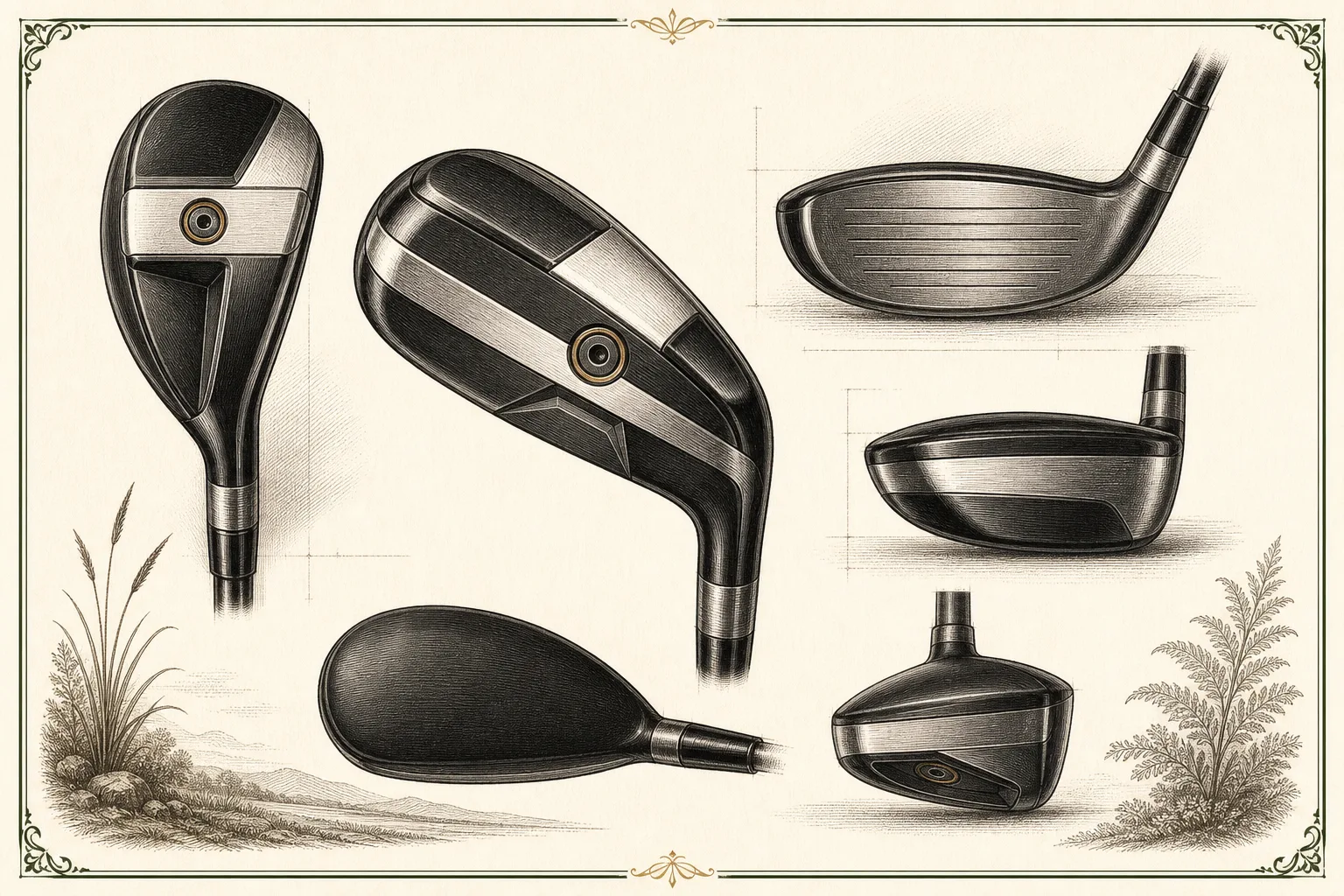
“The forgiving, easy-launch member of the GAPR family, essentially a compact hybrid. A rung-1 gap-filler that most players can hit.”
GAPR (pronounced 'gapper') was TaylorMade's 2018 attempt to formalize the no-man's-land between a golfer's longest playable iron and shortest fairway wood into its own three-club sub-category, and the HI was the most forgiving, most hybrid-like of the three. It paired a compact, mid-sized hybrid shape with a notably high launch and soft-ish feel versus the LO and MID siblings, aimed at players wanting the gap filled with maximum ease rather than maximum control. The family arrived with real Tour visibility -- Tiger Woods and Justin Rose were seen testing GAPR-style prototypes around the 2018 Open Championship, and Dustin Johnson trialed the LO -- unusual credibility for what was, functionally, a repackaged utility/hybrid concept.
Notable for genuine Tour attention at launch (Woods, Rose, Dustin Johnson all documented testing GAPR clubs around mid-2018) and for helping popularize 'driving iron/utility' as a distinct three-tier product category that other manufacturers followed, rather than for the HI model itself becoming a sought-after club. It did not spawn a numbered sequel line in the same GAPR name, and clean used units are common and cheap today -- a real footnote in utility-club history, not a cult classic.
Golfers who need to replace a 3- or 4-iron they can't launch and want the easiest, highest-flying option in the GAPR range -- effectively a rescue-club buyer, not a shot-shaper. A single-digit handicap wanting a driving-iron look and penetrating flight should choose the GAPR LO instead; the HI trades that workability for ease of launch.
Launched in August 2018 at $249 alongside the LO and MID as a coordinated three-club family, arriving into a hybrid/utility-iron market that already included Titleist's U500/U510 and Callaway's Apex Utility irons occupying similar gap-filling territory. TaylorMade did not carry the GAPR name forward as a numbered franchise the way it did with M-series or Stealth; the utility slot in later TaylorMade lineups was filled by dedicated 'UDI' driving irons and P-series utility irons instead. A modern equivalent is the TaylorMade P•UDI, chasing the same gap-filling brief in a single dedicated club rather than a three-model family.
The most forgiving model in the three-club GAPR family by clear design intent -- reviewers consistently described the HI as easier to launch and more cushioned/forgiving on mis-hits than the LO or MID, at the cost of the flatter, more iron-like ball flight better players in the family (the LO especially) were built to deliver. Within the broader hybrid category it sits toward the high-forgiveness end, aimed at replacing a hard-to-hit long iron for exactly the golfer who struggles with one.
Calibrated across the whole catalog — a tour blade scores low here on purpose; it means control, not ease.
Realistic 2026 private-party price is roughly $70-120 depending on shaft and condition -- a functional, still-current-feeling design at eight years old, priced well below its $249 retail because the specific GAPR name never built lasting demand despite its Tour visibility at launch.
Reading is one thing — hitting is another. Book a bay and see the numbers for yourself before you buy anywhere.
“The forgiving, easy-launch member of the GAPR family, essentially a compact hybrid. A rung-1 gap-filler that most players can hit.”
GAPR (pronounced 'gapper') was TaylorMade's 2018 attempt to formalize the no-man's-land between a golfer's longest playable iron and shortest fairway wood into its own three-club sub-category, and the HI was the most forgiving, most hybrid-like of the three. It paired a compact, mid-sized hybrid shape with a notably high launch and soft-ish feel versus the LO and MID siblings, aimed at players wanting the gap filled with maximum ease rather than maximum control. The family arrived with real Tour visibility -- Tiger Woods and Justin Rose were seen testing GAPR-style prototypes around the 2018 Open Championship, and Dustin Johnson trialed the LO -- unusual credibility for what was, functionally, a repackaged utility/hybrid concept.
Notable for genuine Tour attention at launch (Woods, Rose, Dustin Johnson all documented testing GAPR clubs around mid-2018) and for helping popularize 'driving iron/utility' as a distinct three-tier product category that other manufacturers followed, rather than for the HI model itself becoming a sought-after club. It did not spawn a numbered sequel line in the same GAPR name, and clean used units are common and cheap today -- a real footnote in utility-club history, not a cult classic.
Golfers who need to replace a 3- or 4-iron they can't launch and want the easiest, highest-flying option in the GAPR range -- effectively a rescue-club buyer, not a shot-shaper. A single-digit handicap wanting a driving-iron look and penetrating flight should choose the GAPR LO instead; the HI trades that workability for ease of launch.
Launched in August 2018 at $249 alongside the LO and MID as a coordinated three-club family, arriving into a hybrid/utility-iron market that already included Titleist's U500/U510 and Callaway's Apex Utility irons occupying similar gap-filling territory. TaylorMade did not carry the GAPR name forward as a numbered franchise the way it did with M-series or Stealth; the utility slot in later TaylorMade lineups was filled by dedicated 'UDI' driving irons and P-series utility irons instead. A modern equivalent is the TaylorMade P•UDI, chasing the same gap-filling brief in a single dedicated club rather than a three-model family.
The most forgiving model in the three-club GAPR family by clear design intent -- reviewers consistently described the HI as easier to launch and more cushioned/forgiving on mis-hits than the LO or MID, at the cost of the flatter, more iron-like ball flight better players in the family (the LO especially) were built to deliver. Within the broader hybrid category it sits toward the high-forgiveness end, aimed at replacing a hard-to-hit long iron for exactly the golfer who struggles with one.
Calibrated across the whole catalog — a tour blade scores low here on purpose; it means control, not ease.
Realistic 2026 private-party price is roughly $70-120 depending on shaft and condition -- a functional, still-current-feeling design at eight years old, priced well below its $249 retail because the specific GAPR name never built lasting demand despite its Tour visibility at launch.
Reading is one thing — hitting is another. Book a bay and see the numbers for yourself before you buy anywhere.