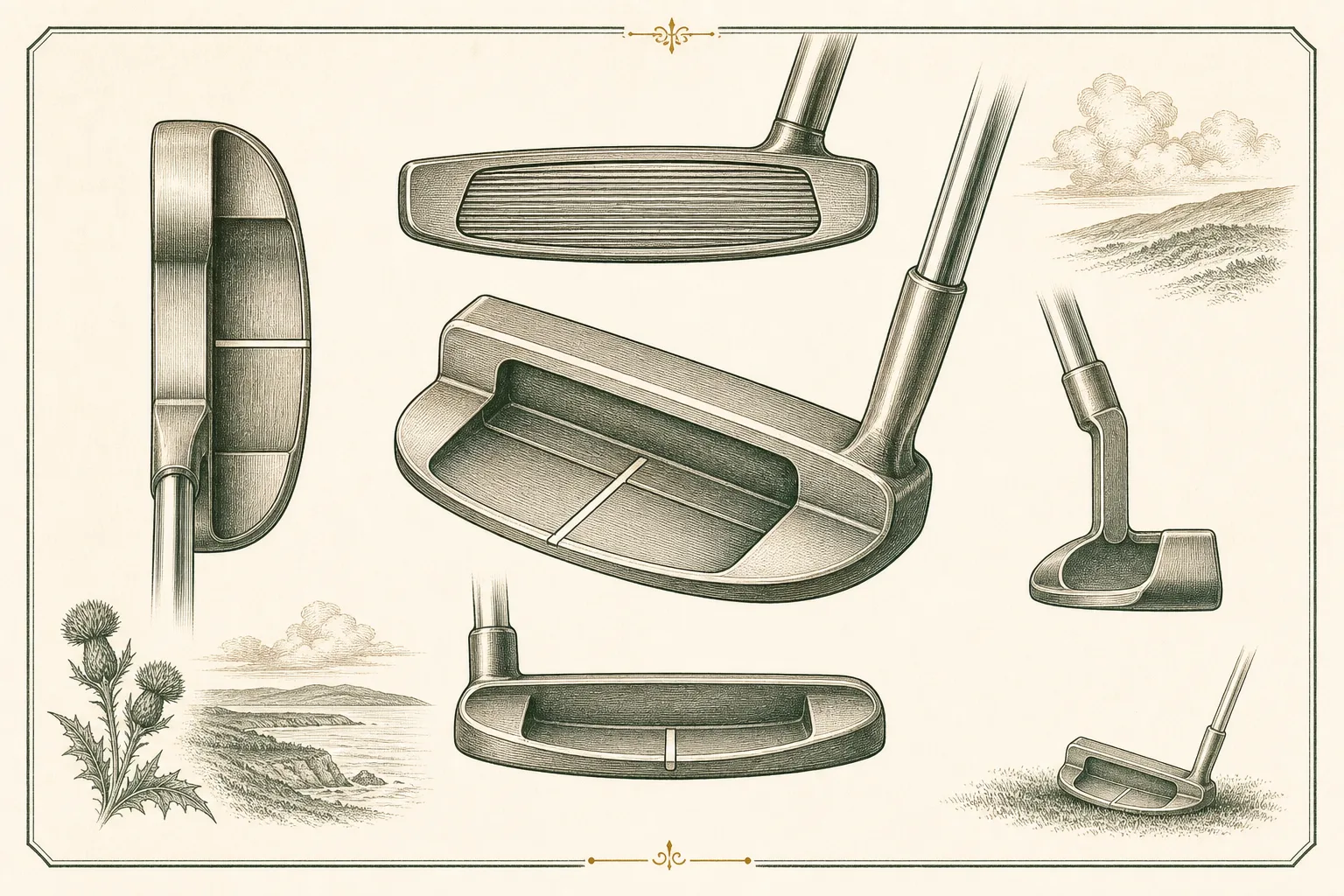
“A square, traditional blade whose heel counterweight makes it zero-torque, with the center of gravity in the middle of the face and aligned to the shaft. A rare balanced-blade that self-squares; works for any stroke type.”
The Joey took Axis1's torque-free platform and put it in the most traditional package the brand offered: a square, classic blade head with a heel counterweight hidden well enough that, at address, it reads as an ordinary blade rather than one of Axis1's more sculptural mallets. NBC Sports/Golf Channel covered its introduction as the brand's pitch to golfers who wanted the zero-torque benefit without the visual departure of Axis1's mallets. Reviewers consistently flagged the same two-sided verdict that follows every Axis1 putter: distance control and face-angle consistency improve noticeably, but the balanced feel makes it harder to feel exactly where on the face contact was made.
A steady favorite in fitting-oriented equipment coverage (MyGolfSpy, GolfWRX and Bunkers Paradise all reviewed it independently and positively) among golfers who specifically seek out zero-torque putters, but it has no tour-win or mainstream celebrity story attached the way the Rose model does -- a quiet, respected niche product rather than a broadly known one.
Traditionalists who want a blade silhouette but suffer from face rotation issues in their stroke; offered in 33-, 34- and 35-inch lengths to fit most builds. Not the pick for a golfer who wants standard mis-hit feedback through the hands, or who is already a confident, consistent stroke-mechanics putter.
Launched 2015 at $299 retail, during Axis1's gradual expansion from a single flagship model into a fuller lineup (Joey, Lynx, Tour) aimed at giving the torque-free concept more mainstream, traditional-looking options beyond the original Eagle's unusual shape.
Same torque-free trade-off as the rest of the family: the counterbalanced, CG-on-shaft-axis design keeps the face square through a wider range of strokes, which helps mis-hit line, but the balance also dulls the tactile feedback golfers normally use to sense a mis-hit -- a differently-forgiving putter rather than a larger effective sweet spot.
Calibrated across the whole catalog — a tour blade scores low here on purpose; it means control, not ease.
A used Axis1 Joey typically sells for $70-$130 privately in 2026, tracking the rest of the Axis1 lineup -- steady niche demand, no collector premium, priced as a functional putter rather than a keepsake.
Reading is one thing — hitting is another. Book a bay and see the numbers for yourself before you buy anywhere.
“A square, traditional blade whose heel counterweight makes it zero-torque, with the center of gravity in the middle of the face and aligned to the shaft. A rare balanced-blade that self-squares; works for any stroke type.”
The Joey took Axis1's torque-free platform and put it in the most traditional package the brand offered: a square, classic blade head with a heel counterweight hidden well enough that, at address, it reads as an ordinary blade rather than one of Axis1's more sculptural mallets. NBC Sports/Golf Channel covered its introduction as the brand's pitch to golfers who wanted the zero-torque benefit without the visual departure of Axis1's mallets. Reviewers consistently flagged the same two-sided verdict that follows every Axis1 putter: distance control and face-angle consistency improve noticeably, but the balanced feel makes it harder to feel exactly where on the face contact was made.
A steady favorite in fitting-oriented equipment coverage (MyGolfSpy, GolfWRX and Bunkers Paradise all reviewed it independently and positively) among golfers who specifically seek out zero-torque putters, but it has no tour-win or mainstream celebrity story attached the way the Rose model does -- a quiet, respected niche product rather than a broadly known one.
Traditionalists who want a blade silhouette but suffer from face rotation issues in their stroke; offered in 33-, 34- and 35-inch lengths to fit most builds. Not the pick for a golfer who wants standard mis-hit feedback through the hands, or who is already a confident, consistent stroke-mechanics putter.
Launched 2015 at $299 retail, during Axis1's gradual expansion from a single flagship model into a fuller lineup (Joey, Lynx, Tour) aimed at giving the torque-free concept more mainstream, traditional-looking options beyond the original Eagle's unusual shape.
Same torque-free trade-off as the rest of the family: the counterbalanced, CG-on-shaft-axis design keeps the face square through a wider range of strokes, which helps mis-hit line, but the balance also dulls the tactile feedback golfers normally use to sense a mis-hit -- a differently-forgiving putter rather than a larger effective sweet spot.
Calibrated across the whole catalog — a tour blade scores low here on purpose; it means control, not ease.
A used Axis1 Joey typically sells for $70-$130 privately in 2026, tracking the rest of the Axis1 lineup -- steady niche demand, no collector premium, priced as a functional putter rather than a keepsake.
Reading is one thing — hitting is another. Book a bay and see the numbers for yourself before you buy anywhere.