“The most-gamed putter on tour and the family flagship; a compact toe-hang blade for a slight-arc stroke. If a member owns one Scotty, it is almost always this.”
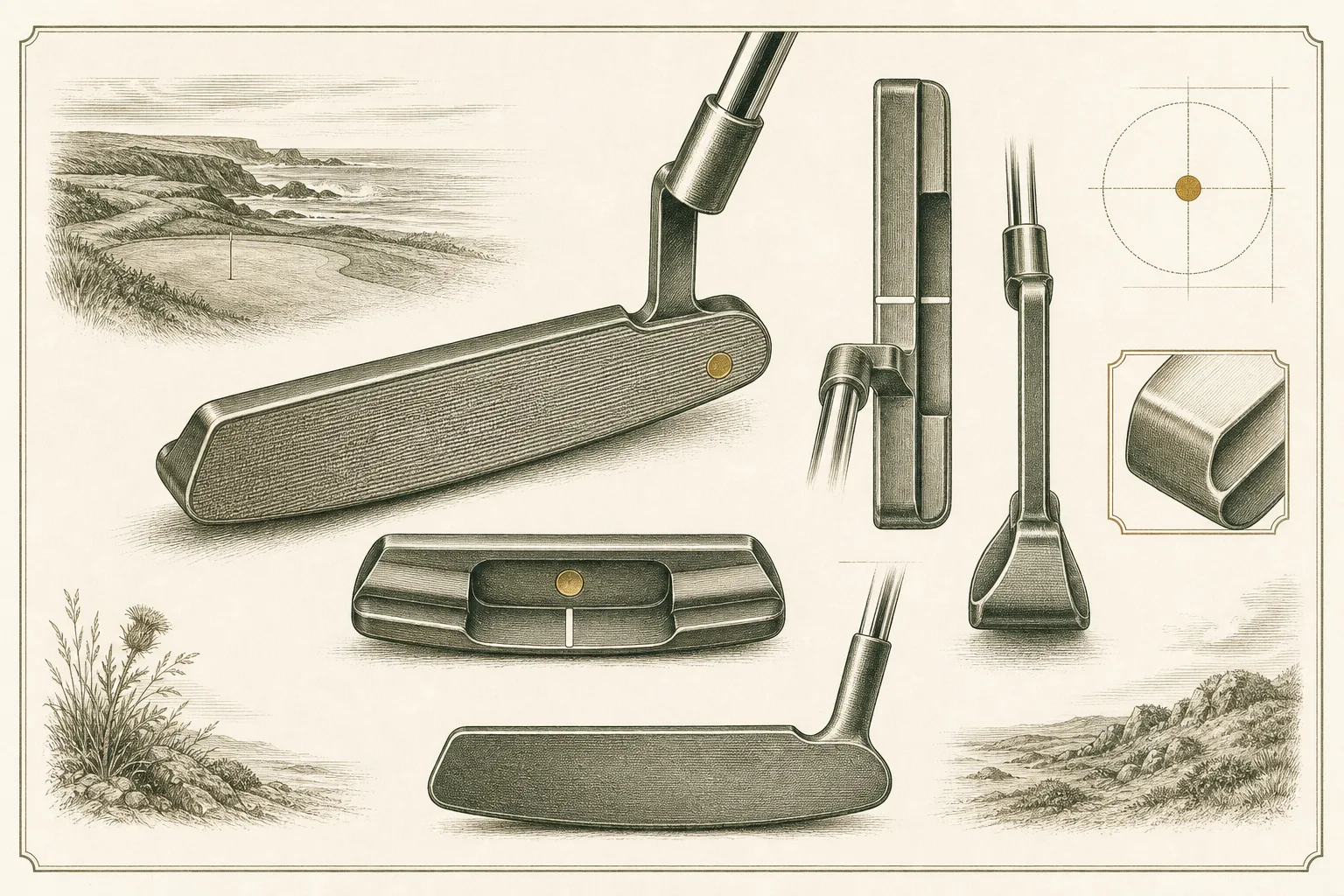
The Newport 2 is Scotty Cameron's flagship head shape, descended from hand-built Newport blades Cameron made for himself and Titleist tour staff before the line went commercial in 1994. The '2' shortened the plumber's neck and reworked the socket radius where neck meets topline, trimming toe hang slightly from the original Newport and giving a cleaner ball/leading-edge view at address. Milled from 303 stainless in the Studio Stainless era and now built in the current Super Select and Special Select lines with a soft-face insert, tri-sole, and I-beam plumbing neck, the head shape has barely changed in three decades — Cameron keeps re-milling the same silhouette because Tour players keep asking for it. It is the putter most golfers picture when they picture 'a Scotty.'
Tiger Woods won 14 of his 15 major championships with a custom Newport 2 GSS he put in play in 1999, and GolfWRX calls it 'arguably the most famous putter head shape in the world.' It has been Cameron's best-selling model for roughly 30 years running, is the reference shape GolfWRX/Team Titleist forum threads return to when comparing every other Cameron mallet or blade, and Scotty Cameron's own site frames the Newport/Newport 2 pairing as the brand's defining silhouette rather than one SKU among many.
Best for players with a natural arc (open-to-square-to-closed) stroke who value feel and a compact, uncluttered look at address over forgiveness. A player with a straight-back-straight-through stroke or one who mishits toward the edges of the face regularly will putt more consistently with a face-balanced mallet like the Phantom 5/7/9/11 — the Newport 2's reputation makes it tempting to buy on name alone, which is the wrong reason.
Launched into a Studio Stainless catalog era (2003) that also included the Newport, Newport 2.5, Newport Beach and Newport 2 Plus as neck/width variants of the same head family; it has since been rebuilt through Studio Select, Select, Special Select and today's Super Select lines with era-appropriate face inserts and milling. Its closest living relative in the current catalog is the Special Select Newport 2, and its high-MOI-mallet opposite number is the 2024 Phantom line (see Phantom 5/7/9/11 in this same batch).
A compact toe-hang blade with a small sweet spot and minimal offset — this is a shape built for feel and a slight-arc stroke, not mis-hit insurance. Off-center hits (especially toward the toe or heel) lose ball speed and start-line accuracy noticeably more than a modern high-MOI mallet. It rewards a repeatable, center-face stroke; a 3 here reflects a blade doing exactly what a blade does, not a flaw.
Calibrated across the whole catalog — a tour blade scores low here on purpose; it means control, not ease.
Vintage 2003/2004 Studio Stainless Newport 2 heads trade actively: per eBay sales data aggregated by ScottyIndex, the median sale is about $295 with a typical range of roughly $243–$369, though clean 'first of run' or low-serial examples have sold well above $900 and pristine documented rarities into the thousands. Rough or refinished examples with no headcover can go for $60–$150. This is a genuinely liquid collector market, unlike most 20-year-old clubs — buy based on documented condition and headcover presence, not the model name alone.
The Legends Rack
The grail of grails. Tiger's Newport 2 GSS won 14 of his 15 majors, and the Scotty collector market (tracked by dedicated price indexes) treats these like watches. Even standard used Newports hold $250+; the aura is the product and the product delivers. Who'll love it: everyone will want a stroke with it. Chain it to the rack.
Who it suitsAll
Reading is one thing — hitting is another. Book a bay and see the numbers for yourself before you buy anywhere.
“The most-gamed putter on tour and the family flagship; a compact toe-hang blade for a slight-arc stroke. If a member owns one Scotty, it is almost always this.”
The Newport 2 is Scotty Cameron's flagship head shape, descended from hand-built Newport blades Cameron made for himself and Titleist tour staff before the line went commercial in 1994. The '2' shortened the plumber's neck and reworked the socket radius where neck meets topline, trimming toe hang slightly from the original Newport and giving a cleaner ball/leading-edge view at address. Milled from 303 stainless in the Studio Stainless era and now built in the current Super Select and Special Select lines with a soft-face insert, tri-sole, and I-beam plumbing neck, the head shape has barely changed in three decades — Cameron keeps re-milling the same silhouette because Tour players keep asking for it. It is the putter most golfers picture when they picture 'a Scotty.'
Tiger Woods won 14 of his 15 major championships with a custom Newport 2 GSS he put in play in 1999, and GolfWRX calls it 'arguably the most famous putter head shape in the world.' It has been Cameron's best-selling model for roughly 30 years running, is the reference shape GolfWRX/Team Titleist forum threads return to when comparing every other Cameron mallet or blade, and Scotty Cameron's own site frames the Newport/Newport 2 pairing as the brand's defining silhouette rather than one SKU among many.
Best for players with a natural arc (open-to-square-to-closed) stroke who value feel and a compact, uncluttered look at address over forgiveness. A player with a straight-back-straight-through stroke or one who mishits toward the edges of the face regularly will putt more consistently with a face-balanced mallet like the Phantom 5/7/9/11 — the Newport 2's reputation makes it tempting to buy on name alone, which is the wrong reason.
Launched into a Studio Stainless catalog era (2003) that also included the Newport, Newport 2.5, Newport Beach and Newport 2 Plus as neck/width variants of the same head family; it has since been rebuilt through Studio Select, Select, Special Select and today's Super Select lines with era-appropriate face inserts and milling. Its closest living relative in the current catalog is the Special Select Newport 2, and its high-MOI-mallet opposite number is the 2024 Phantom line (see Phantom 5/7/9/11 in this same batch).
A compact toe-hang blade with a small sweet spot and minimal offset — this is a shape built for feel and a slight-arc stroke, not mis-hit insurance. Off-center hits (especially toward the toe or heel) lose ball speed and start-line accuracy noticeably more than a modern high-MOI mallet. It rewards a repeatable, center-face stroke; a 3 here reflects a blade doing exactly what a blade does, not a flaw.
Calibrated across the whole catalog — a tour blade scores low here on purpose; it means control, not ease.
Vintage 2003/2004 Studio Stainless Newport 2 heads trade actively: per eBay sales data aggregated by ScottyIndex, the median sale is about $295 with a typical range of roughly $243–$369, though clean 'first of run' or low-serial examples have sold well above $900 and pristine documented rarities into the thousands. Rough or refinished examples with no headcover can go for $60–$150. This is a genuinely liquid collector market, unlike most 20-year-old clubs — buy based on documented condition and headcover presence, not the model name alone.
The Legends Rack
The grail of grails. Tiger's Newport 2 GSS won 14 of his 15 majors, and the Scotty collector market (tracked by dedicated price indexes) treats these like watches. Even standard used Newports hold $250+; the aura is the product and the product delivers. Who'll love it: everyone will want a stroke with it. Chain it to the rack.
Who it suitsAll
Reading is one thing — hitting is another. Book a bay and see the numbers for yourself before you buy anywhere.