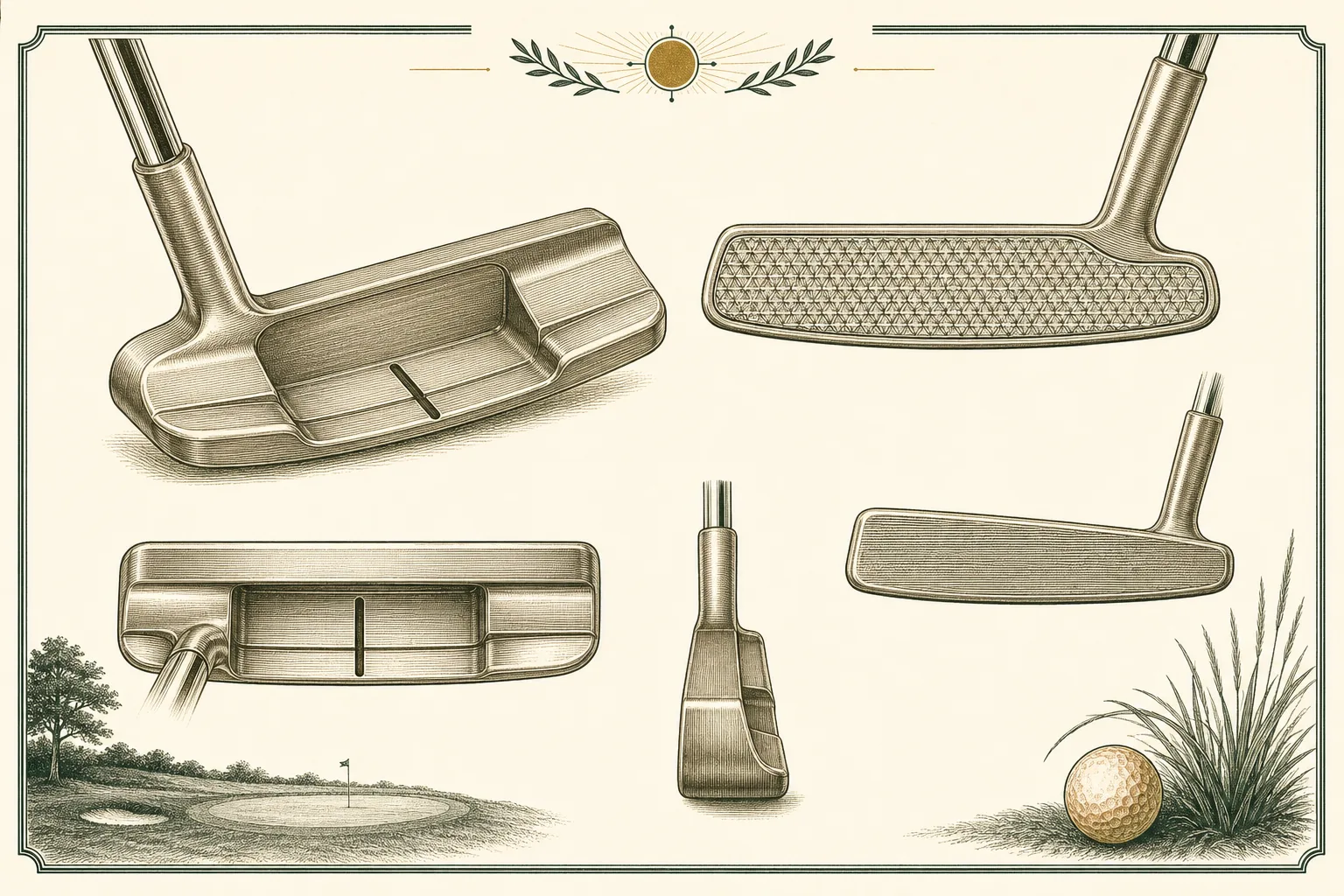
“Bettinardi's core milled line (SS3, SS9, SS28, etc.) with the honeycomb face milling; blades are toe-hang, mallets face-balanced. A tour-grade premium alternative to Scotty. Confirm the model number.”
The original Studio Stock series launched in 2011 as Bettinardi's step up from the BB line: heads precision-milled from a proprietary soft-carbon-steel blend rather than 303 stainless, finished in a molecularly-bonded 'Borealis Black' coating built to resist corrosion and tarnish. The 2011 launch covered four heel-toe head styles under one Studio Stock umbrella -- SS5 (plumber's neck, straight-back players), SS6 (a classic blade), SS7 (a face-balanced mallet with a double-bend shaft), and SS8 (heel-toe weighted with a raised toe) -- all at a shared 345-gram head weight (35-inch length) with the patented TOUR F.I.T. milled face and a single milled sight line. Bettinardi later reused the Studio Stock name and even the SS7/SS8 numbers for an unrelated 2019 relaunch in 303 stainless with a different finish and face pattern (see the separate Studio Stock 7/8 entries), so 'Studio Stock' spans two distinct generations of hardware under one family name.
The original 2011 soft-carbon-steel Studio Stock heads are prized among Bettinardi collectors specifically because the brand later moved the numbered names to 303 stainless -- the Borealis Black carbon heads are the earlier, rarer generation -- but this is a collector niche within an already-boutique brand, not a broadly documented cult object with tour-win mythology attached to it by name.
Collectors and better players chasing the original soft-carbon-steel Bettinardi feel from the early 2010s, before the brand's 2019 stainless-steel relaunch changed the material and face pattern under the same model names. Not a starting point for a buyer who just wants 'a Bettinardi Studio Stock' off a shelf today -- current retail Studio Stock putters are the 303-stainless 2019-and-later generation.
Introduced in 2011 alongside Bettinardi's revived BB series, at a moment when the brand was expanding beyond its pure blade heritage into more accessible, mid-priced milled lines. The naming and numbering (SS5 through SS8) was carried forward into the unrelated 2019 relaunch, making 'Studio Stock 7' and 'Studio Stock 8' ambiguous without a year attached -- a genuine documentation gap this entry flags rather than papers over.
At a shared 345g across four head styles including true blades (SS6) and heel-toe designs (SS5/SS8), the original Studio Stock family skews toward compact, feel-first shapes rather than forgiveness. The one mallet in the original four (SS7) is meaningfully more forgiving than its blade siblings, which is why this family-level entry lands low: it spans real blades, not a single forgiving shape.
Calibrated across the whole catalog — a tour blade scores low here on purpose; it means control, not ease.
Genuine 2011-era soft-carbon-steel Studio Stock heads are uncommon in the resold market compared to the far more plentiful 2019+ stainless versions; clean examples with intact Borealis Black finish (which can wear/patina faster than stainless PVD) run roughly $120-220 in 2026, with buyers needing to verify generation from the finish and face pattern since eBay/2nd Swing listings frequently don't distinguish 2011 from 2019+ 'Studio Stock' by name alone.
Reading is one thing — hitting is another. Book a bay and see the numbers for yourself before you buy anywhere.
“Bettinardi's core milled line (SS3, SS9, SS28, etc.) with the honeycomb face milling; blades are toe-hang, mallets face-balanced. A tour-grade premium alternative to Scotty. Confirm the model number.”
The original Studio Stock series launched in 2011 as Bettinardi's step up from the BB line: heads precision-milled from a proprietary soft-carbon-steel blend rather than 303 stainless, finished in a molecularly-bonded 'Borealis Black' coating built to resist corrosion and tarnish. The 2011 launch covered four heel-toe head styles under one Studio Stock umbrella -- SS5 (plumber's neck, straight-back players), SS6 (a classic blade), SS7 (a face-balanced mallet with a double-bend shaft), and SS8 (heel-toe weighted with a raised toe) -- all at a shared 345-gram head weight (35-inch length) with the patented TOUR F.I.T. milled face and a single milled sight line. Bettinardi later reused the Studio Stock name and even the SS7/SS8 numbers for an unrelated 2019 relaunch in 303 stainless with a different finish and face pattern (see the separate Studio Stock 7/8 entries), so 'Studio Stock' spans two distinct generations of hardware under one family name.
The original 2011 soft-carbon-steel Studio Stock heads are prized among Bettinardi collectors specifically because the brand later moved the numbered names to 303 stainless -- the Borealis Black carbon heads are the earlier, rarer generation -- but this is a collector niche within an already-boutique brand, not a broadly documented cult object with tour-win mythology attached to it by name.
Collectors and better players chasing the original soft-carbon-steel Bettinardi feel from the early 2010s, before the brand's 2019 stainless-steel relaunch changed the material and face pattern under the same model names. Not a starting point for a buyer who just wants 'a Bettinardi Studio Stock' off a shelf today -- current retail Studio Stock putters are the 303-stainless 2019-and-later generation.
Introduced in 2011 alongside Bettinardi's revived BB series, at a moment when the brand was expanding beyond its pure blade heritage into more accessible, mid-priced milled lines. The naming and numbering (SS5 through SS8) was carried forward into the unrelated 2019 relaunch, making 'Studio Stock 7' and 'Studio Stock 8' ambiguous without a year attached -- a genuine documentation gap this entry flags rather than papers over.
At a shared 345g across four head styles including true blades (SS6) and heel-toe designs (SS5/SS8), the original Studio Stock family skews toward compact, feel-first shapes rather than forgiveness. The one mallet in the original four (SS7) is meaningfully more forgiving than its blade siblings, which is why this family-level entry lands low: it spans real blades, not a single forgiving shape.
Calibrated across the whole catalog — a tour blade scores low here on purpose; it means control, not ease.
Genuine 2011-era soft-carbon-steel Studio Stock heads are uncommon in the resold market compared to the far more plentiful 2019+ stainless versions; clean examples with intact Borealis Black finish (which can wear/patina faster than stainless PVD) run roughly $120-220 in 2026, with buyers needing to verify generation from the finish and face pattern since eBay/2nd Swing listings frequently don't distinguish 2011 from 2019+ 'Studio Stock' by name alone.
Reading is one thing — hitting is another. Book a bay and see the numbers for yourself before you buy anywhere.