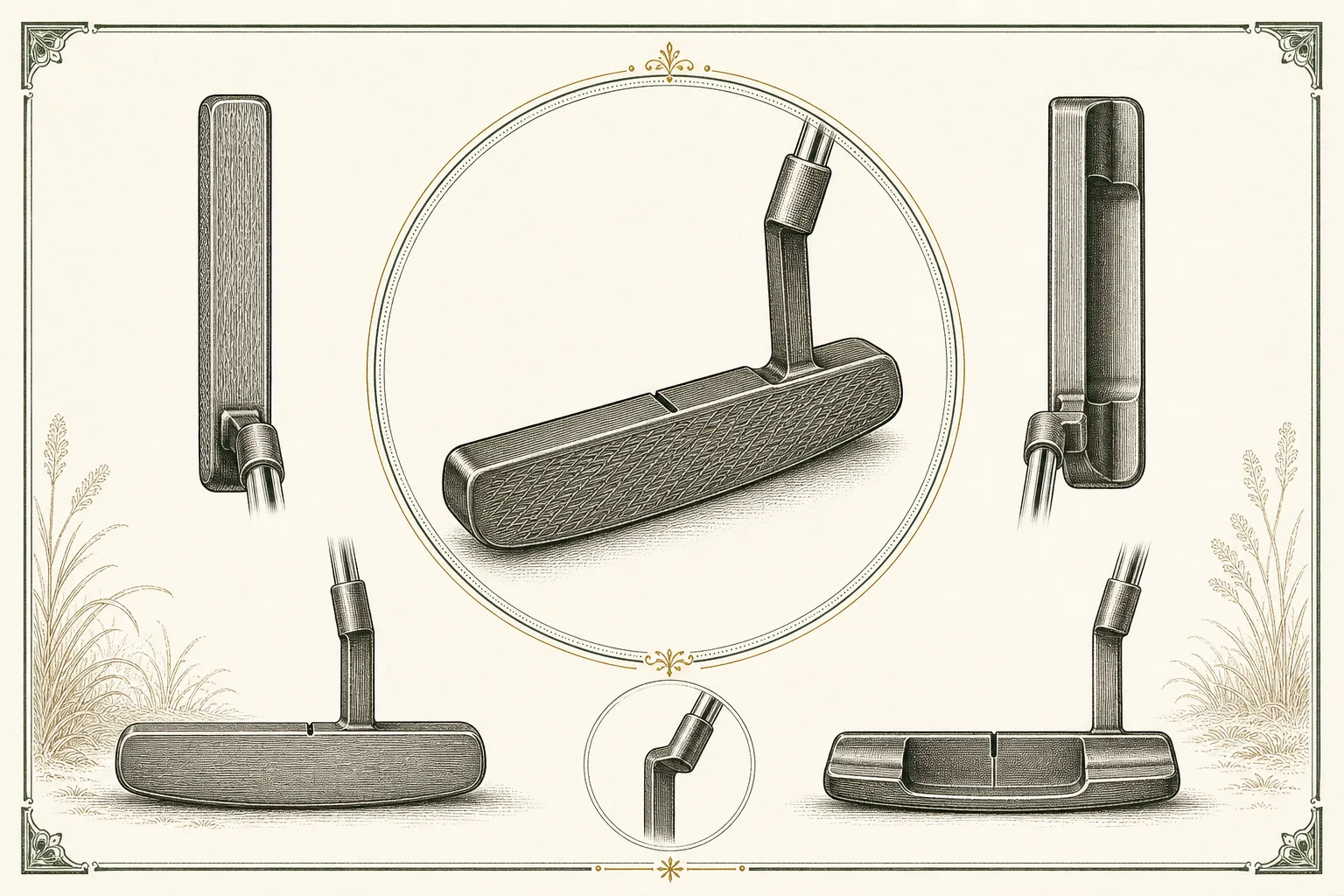
“The classic Bettinardi Anser-style blade, one-piece milled since 1999 with about half a shaft of toe hang. Best for a slight-to-moderate arc stroke. Firm, precise feel that Bettinardi built its name on.”
The BB1 is Bettinardi's signature blade – its Scotty Cameron Newport, the model against which the whole brand is measured. It launched with the six-model founding lineup when Robert J. Bettinardi went independent (1998–99, alongside the BB1MS, BB2, BB8, BB10 and BB12), and it has been refined continuously ever since as 'RJB's modern mastery of a classic blade head shape.' It is a heel-toe-weighted Anser-style blade, one-piece milled from a solid block of soft carbon steel, carrying Bettinardi's signature honeycomb/face milling for a firm-but-soft roll. Decades of iteration – right up to the 2026 version's Variable Depth Flymill face – keep a fundamentally 1990s shape at the sharp end of milled-putter craftsmanship.
The BB1 is Bettinardi's flagship and defining product – continuously produced from the brand's 1998–99 founding lineup through 2026, and independent reviews (Today's Golfer, Plugged In Golf) treat the Bettinardi/BB1 name as the brand-name synonym for the milled Anser blade the way 'Newport' is for Scotty Cameron. But that is a statement about market standing, not cult mania: reviewers explicitly describe it as 'more workhorse than show horse' and a durable everyday player, with no forum-thread hunting, no aggregate user-rating scarcity signal, and no tour-win legend attached to this specific model. Long-running and respected – the honest label is notable, not cult classic.
Arc-stroke putters (slight-to-strong inside-square-inside) who want feel, feedback and a timeless Anser look, and who are willing to pay for milled-in-USA quality. Golfers who push/pull putts or want maximum stability should choose a mallet (Bettinardi's Inovai/Antidote mallets or the Queen B 10) instead of the BB1.
One of the six models Bettinardi launched on going independent in 1998, the culmination of Robert Bettinardi's 1990s milling work – he built the first one-piece milled putter from solid steel and milled putters for Titleist/Scotty Cameron from 1993–98 before starting his own brand. The BB1 has run through many generations (2020 BB1/BB1 Flow, 2022, 2024, 2026 with VDF milling) and sits opposite Scotty Cameron's Newport as the premium American milled-blade alternative.
A classic heel-toe-weighted Anser blade and scored like one: modest MOI, meaningful toe hang, and a compact head mean off-center strikes lose speed and the face is easy to twist on a mis-timed stroke. Heel-toe weighting makes it forgiving FOR A BLADE, but it offers none of the twist-resistance of a mallet, which is the whole point of the design – feel and feedback over stability. A 3 reflects blade-class forgiveness, not a knock on the club.
Calibrated across the whole catalog — a tour blade scores low here on purpose; it means control, not ease.
Because the BB1 is produced every year, the used market is deep and generation-dependent. Realistic private-party value for an older standard BB1 (e.g. 2020/2022) runs roughly $150–300 in 2026; limited/blackout and tour-department releases run higher. Watch for reconditioned-retail inflation – graded 2nd Swing listings for limited BB1s sit near $330–380 (mint), close to new-ish pricing, which overstates what an ordinary used example fetches privately. Standard finishes hold value moderately; limited runs are the ones that appreciate.
Reading is one thing — hitting is another. Book a bay and see the numbers for yourself before you buy anywhere.