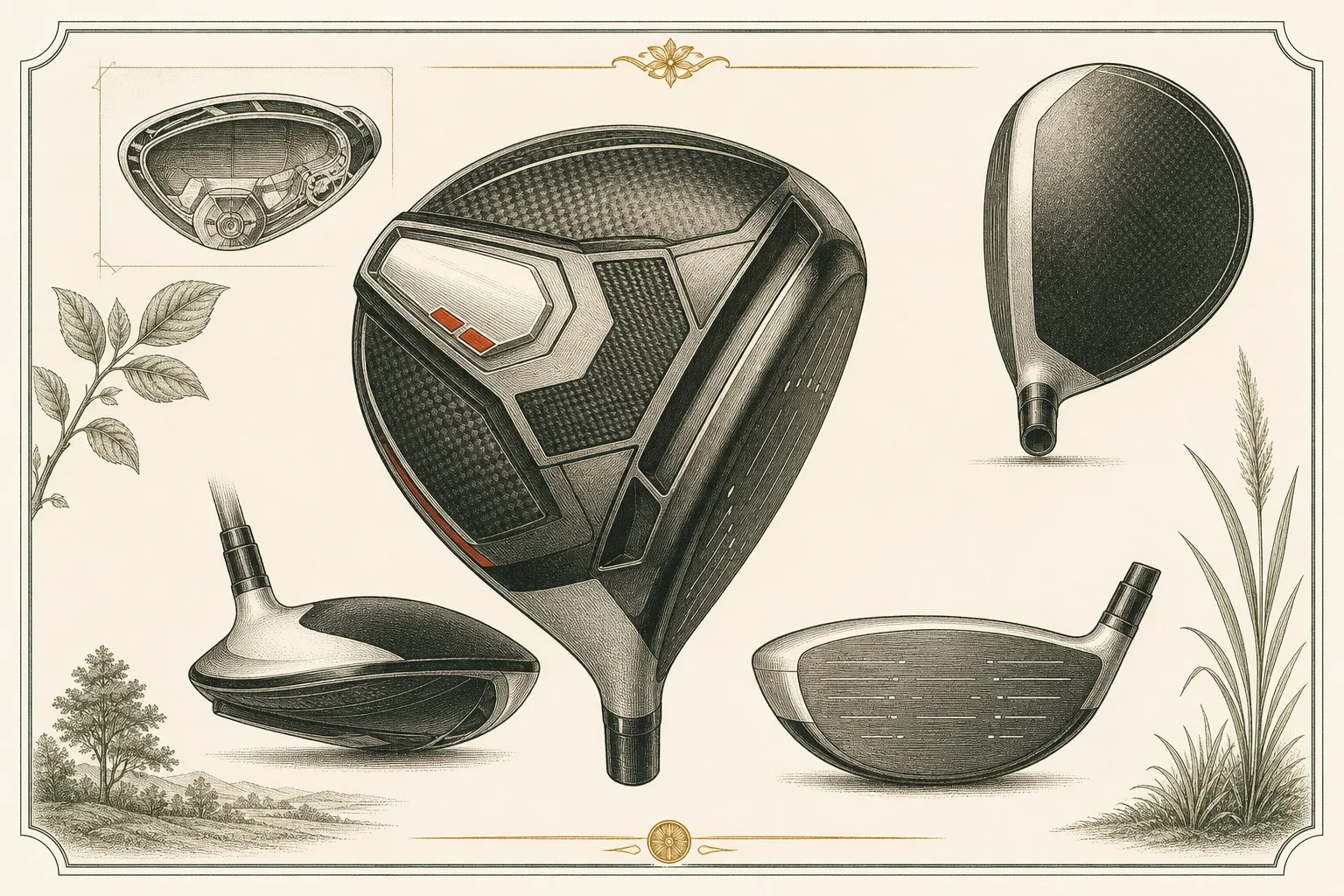
“Speed-injected forgiveness with a choice of two Atmos launch profiles. A superb rung-1 gamer for moderate swings and a strong used value; sold through 2020 before SIM took over.”
The M6 was the forgiving half of TaylorMade's 2019 driver pairing, built around the same Speed Injected Twist Face as the M5 but wrapped in a chassis with 54% more carbon fiber than the outgoing 2018 M4 driver, freeing up 46g of discretionary weight to sit low and deep in what TaylorMade branded the Inertia Generator. That mass placement, combined with Twist Face's mis-hit correction and a flexible Hammerhead slot, made it TaylorMade's high-MOI option for players who wanted forgiveness without a fitting-heavy adjustable-weight track. It sold at $499.99, fifty dollars under the M5, and drew some of the highest user ratings of any TaylorMade driver that year — 4.7/5 on Global Golf, 4.8/5 on TaylorMade's own site.
Outstanding reviews and consumer ratings for a mainstream, one-generation flagship, but no independent legend: it was the higher-forgiveness sibling on TaylorMade's standard annual driver cycle, replaced within two seasons by the SIM Max, and is remembered as an excellent forgiving driver of 2019 rather than a club that developed scarcity or cult status.
Moderate swing speeds (roughly 80-105 mph) and players who want strong out-of-box forgiveness without an involved adjustable-weight fitting process — a strong all-around gamer for the everyday player. Better players chasing lower spin or active shot-shape tuning should choose the M5 from the same release instead.
Released alongside the M5 as the forgiving half of TaylorMade's 2019 two-tier driver strategy, competing with Callaway's Epic Flash Max and Ping's G410 Plus. It replaced the 2018 M4 driver and was itself succeeded by the SIM Max driver in 2020.
Explicitly TaylorMade's forgiveness-first driver of the pairing: the 54% carbon-fiber increase over the M4 and resulting 46g of low, deep discretionary mass (the Inertia Generator) target high MOI over the M5's tunable-but-demanding sliding-weight track, and Twist Face further tightens mis-hit dispersion. It falls short of a 9-10 only because it still lacks a true adjustable perimeter-weight system found on some rivals' max-forgiveness heads.
Calibrated across the whole catalog — a tour blade scores low here on purpose; it means control, not ease.
A strong used-value driver given its high original sales volume and forgiveness reputation: private-party prices in 2026 typically run roughly $80-$150 depending on shaft and condition, generally on par with or slightly below the pricier M5 from the same year.
Reading is one thing — hitting is another. Book a bay and see the numbers for yourself before you buy anywhere.
“Speed-injected forgiveness with a choice of two Atmos launch profiles. A superb rung-1 gamer for moderate swings and a strong used value; sold through 2020 before SIM took over.”
The M6 was the forgiving half of TaylorMade's 2019 driver pairing, built around the same Speed Injected Twist Face as the M5 but wrapped in a chassis with 54% more carbon fiber than the outgoing 2018 M4 driver, freeing up 46g of discretionary weight to sit low and deep in what TaylorMade branded the Inertia Generator. That mass placement, combined with Twist Face's mis-hit correction and a flexible Hammerhead slot, made it TaylorMade's high-MOI option for players who wanted forgiveness without a fitting-heavy adjustable-weight track. It sold at $499.99, fifty dollars under the M5, and drew some of the highest user ratings of any TaylorMade driver that year — 4.7/5 on Global Golf, 4.8/5 on TaylorMade's own site.
Outstanding reviews and consumer ratings for a mainstream, one-generation flagship, but no independent legend: it was the higher-forgiveness sibling on TaylorMade's standard annual driver cycle, replaced within two seasons by the SIM Max, and is remembered as an excellent forgiving driver of 2019 rather than a club that developed scarcity or cult status.
Moderate swing speeds (roughly 80-105 mph) and players who want strong out-of-box forgiveness without an involved adjustable-weight fitting process — a strong all-around gamer for the everyday player. Better players chasing lower spin or active shot-shape tuning should choose the M5 from the same release instead.
Released alongside the M5 as the forgiving half of TaylorMade's 2019 two-tier driver strategy, competing with Callaway's Epic Flash Max and Ping's G410 Plus. It replaced the 2018 M4 driver and was itself succeeded by the SIM Max driver in 2020.
Explicitly TaylorMade's forgiveness-first driver of the pairing: the 54% carbon-fiber increase over the M4 and resulting 46g of low, deep discretionary mass (the Inertia Generator) target high MOI over the M5's tunable-but-demanding sliding-weight track, and Twist Face further tightens mis-hit dispersion. It falls short of a 9-10 only because it still lacks a true adjustable perimeter-weight system found on some rivals' max-forgiveness heads.
Calibrated across the whole catalog — a tour blade scores low here on purpose; it means control, not ease.
A strong used-value driver given its high original sales volume and forgiveness reputation: private-party prices in 2026 typically run roughly $80-$150 depending on shaft and condition, generally on par with or slightly below the pricier M5 from the same year.
Reading is one thing — hitting is another. Book a bay and see the numbers for yourself before you buy anywhere.