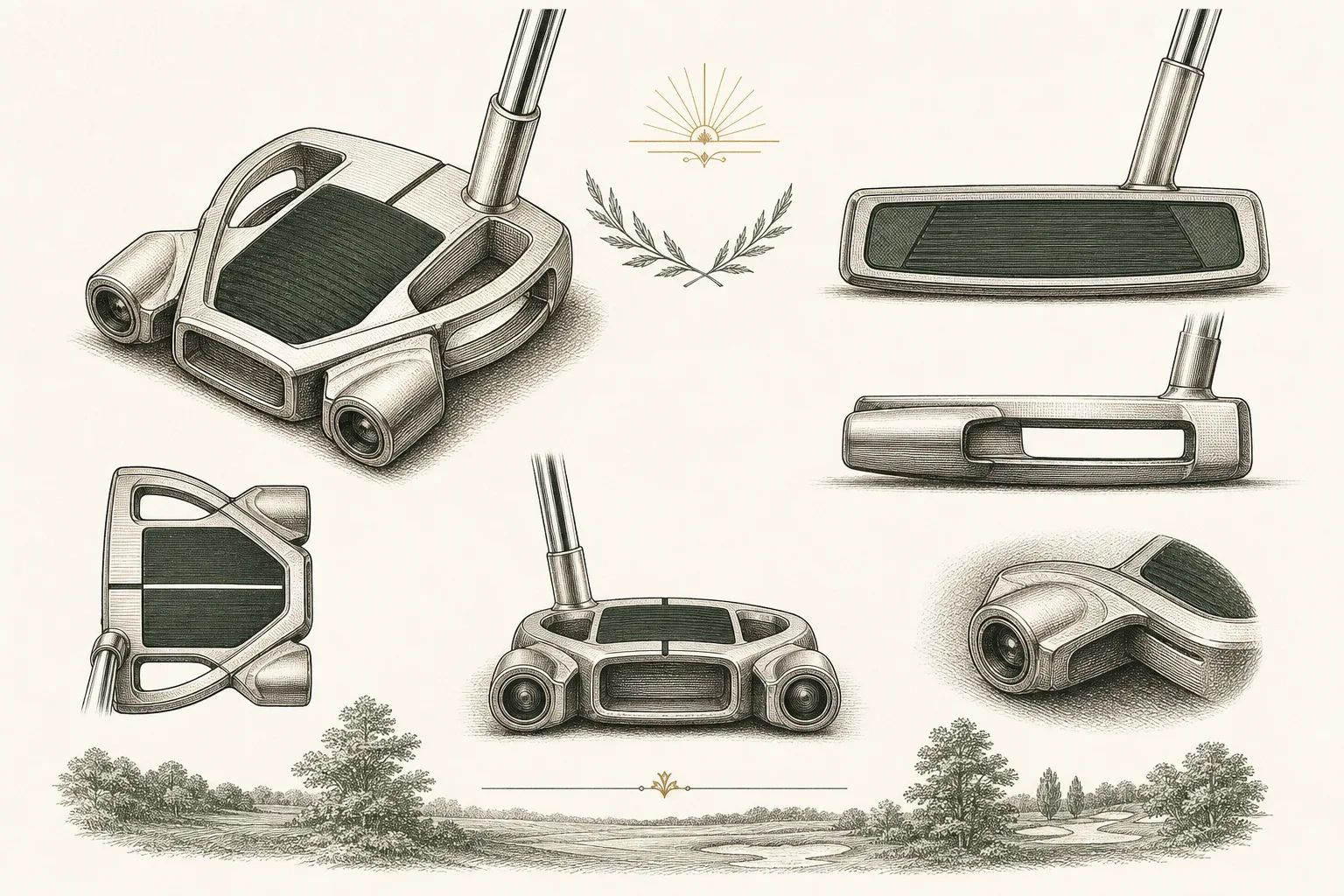
“The original Spider (including the famous red and black Ghost Spider runs) that launched the high-MOI mallet craze; face-balanced for a straight stroke. Foundational and still gamed.”
TaylorMade's original Spider — the 'Monza Spider' internally — arrived in 2008 built around one idea: push as much mass as possible to the perimeter of a mallet head for maximum MOI, using an unconventional twin-rail cutout shape unlike anything else on the market. TaylorMade planned roughly 30,000 units; demand blew past that and it sold over 200,000 in its first year, validating the high-MOI mallet as mainstream, not niche. It won on tour almost at once — JB Holmes, then regarded as one of the Tour's worst putters, beat Phil Mickelson in a playoff at the 2008 FBR Open using it. Tour feedback led TaylorMade to shrink the shape into the 'Itsy Bitsy Spider,' the template for the whole Spider line — including the red, black and white 'Ghost' finishes — that followed for 15-plus years.
Golf.com's own retrospective on the line calls its 15-year run 'from unconventional to iconic,' and the record backs the framing: it went from a planned 30,000-unit run to 200,000-plus units sold in year one, won on tour within months of release (JB Holmes, 2008 FBR Open), and directly spawned every subsequent Spider generation — a lineage that remains TaylorMade's flagship putter family today and arguably the single design most responsible for making high-MOI mallets the dominant tour putter shape of the 2010s and 2020s.
Any golfer wanting a face-balanced mallet for a straight-back-straight-through stroke, then and now — its stability and alignment help remain genuinely useful, not just nostalgic. Golfers with a strong arced stroke needing significant toe rotation were, and still are, better served by a heel-shafted blade or a lower-MOI toe-hang design; the Spider's face-balanced weighting resists the face rotation an arc-stroke player relies on.
Launched into a putter market still dominated by Scotty Cameron-style blades and smaller mallets; its 2008 debut and the shrunken 'Itsy Bitsy' follow-up effectively created the modern high-MOI-mallet category that Odyssey (Ten, Two-Ball), Scotty Cameron (Phantom) and TaylorMade's own later Spider generations have competed in ever since. Every subsequent Spider — Tour, X, EX, FCG, GT, GTx — iterates the same core perimeter-weighting idea it introduced.
Groundbreaking heel-toe weight distribution for 2008 — the entire design brief was maximizing MOI via a perimeter-weighted, twin-wing mallet shape, and it was significantly more stable on off-center hits than the blades and small mallets that dominated putting at the time. Scored 8, not 10, because later Spider generations (GTx, GT Max) and other brands' ultra-high-MOI mallets have since pushed measured MOI numbers further — the original was revolutionary for its moment, not today's forgiveness ceiling.
Calibrated across the whole catalog — a tour blade scores low here on purpose; it means control, not ease.
A genuine cult piece on the used market: clean original 2008-era Spider heads, especially the red/black Ghost color runs, commonly sell for roughly $80-180 in 2026 — noticeably more than a typical 18-year-old putter — driven by ongoing demand from players who specifically want the original shape rather than a later Spider generation. Rare tour-only or limited-color heads can exceed that.
Reading is one thing — hitting is another. Book a bay and see the numbers for yourself before you buy anywhere.
“The original Spider (including the famous red and black Ghost Spider runs) that launched the high-MOI mallet craze; face-balanced for a straight stroke. Foundational and still gamed.”
TaylorMade's original Spider — the 'Monza Spider' internally — arrived in 2008 built around one idea: push as much mass as possible to the perimeter of a mallet head for maximum MOI, using an unconventional twin-rail cutout shape unlike anything else on the market. TaylorMade planned roughly 30,000 units; demand blew past that and it sold over 200,000 in its first year, validating the high-MOI mallet as mainstream, not niche. It won on tour almost at once — JB Holmes, then regarded as one of the Tour's worst putters, beat Phil Mickelson in a playoff at the 2008 FBR Open using it. Tour feedback led TaylorMade to shrink the shape into the 'Itsy Bitsy Spider,' the template for the whole Spider line — including the red, black and white 'Ghost' finishes — that followed for 15-plus years.
Golf.com's own retrospective on the line calls its 15-year run 'from unconventional to iconic,' and the record backs the framing: it went from a planned 30,000-unit run to 200,000-plus units sold in year one, won on tour within months of release (JB Holmes, 2008 FBR Open), and directly spawned every subsequent Spider generation — a lineage that remains TaylorMade's flagship putter family today and arguably the single design most responsible for making high-MOI mallets the dominant tour putter shape of the 2010s and 2020s.
Any golfer wanting a face-balanced mallet for a straight-back-straight-through stroke, then and now — its stability and alignment help remain genuinely useful, not just nostalgic. Golfers with a strong arced stroke needing significant toe rotation were, and still are, better served by a heel-shafted blade or a lower-MOI toe-hang design; the Spider's face-balanced weighting resists the face rotation an arc-stroke player relies on.
Launched into a putter market still dominated by Scotty Cameron-style blades and smaller mallets; its 2008 debut and the shrunken 'Itsy Bitsy' follow-up effectively created the modern high-MOI-mallet category that Odyssey (Ten, Two-Ball), Scotty Cameron (Phantom) and TaylorMade's own later Spider generations have competed in ever since. Every subsequent Spider — Tour, X, EX, FCG, GT, GTx — iterates the same core perimeter-weighting idea it introduced.
Groundbreaking heel-toe weight distribution for 2008 — the entire design brief was maximizing MOI via a perimeter-weighted, twin-wing mallet shape, and it was significantly more stable on off-center hits than the blades and small mallets that dominated putting at the time. Scored 8, not 10, because later Spider generations (GTx, GT Max) and other brands' ultra-high-MOI mallets have since pushed measured MOI numbers further — the original was revolutionary for its moment, not today's forgiveness ceiling.
Calibrated across the whole catalog — a tour blade scores low here on purpose; it means control, not ease.
A genuine cult piece on the used market: clean original 2008-era Spider heads, especially the red/black Ghost color runs, commonly sell for roughly $80-180 in 2026 — noticeably more than a typical 18-year-old putter — driven by ongoing demand from players who specifically want the original shape rather than a later Spider generation. Rare tour-only or limited-color heads can exceed that.
Reading is one thing — hitting is another. Book a bay and see the numbers for yourself before you buy anywhere.