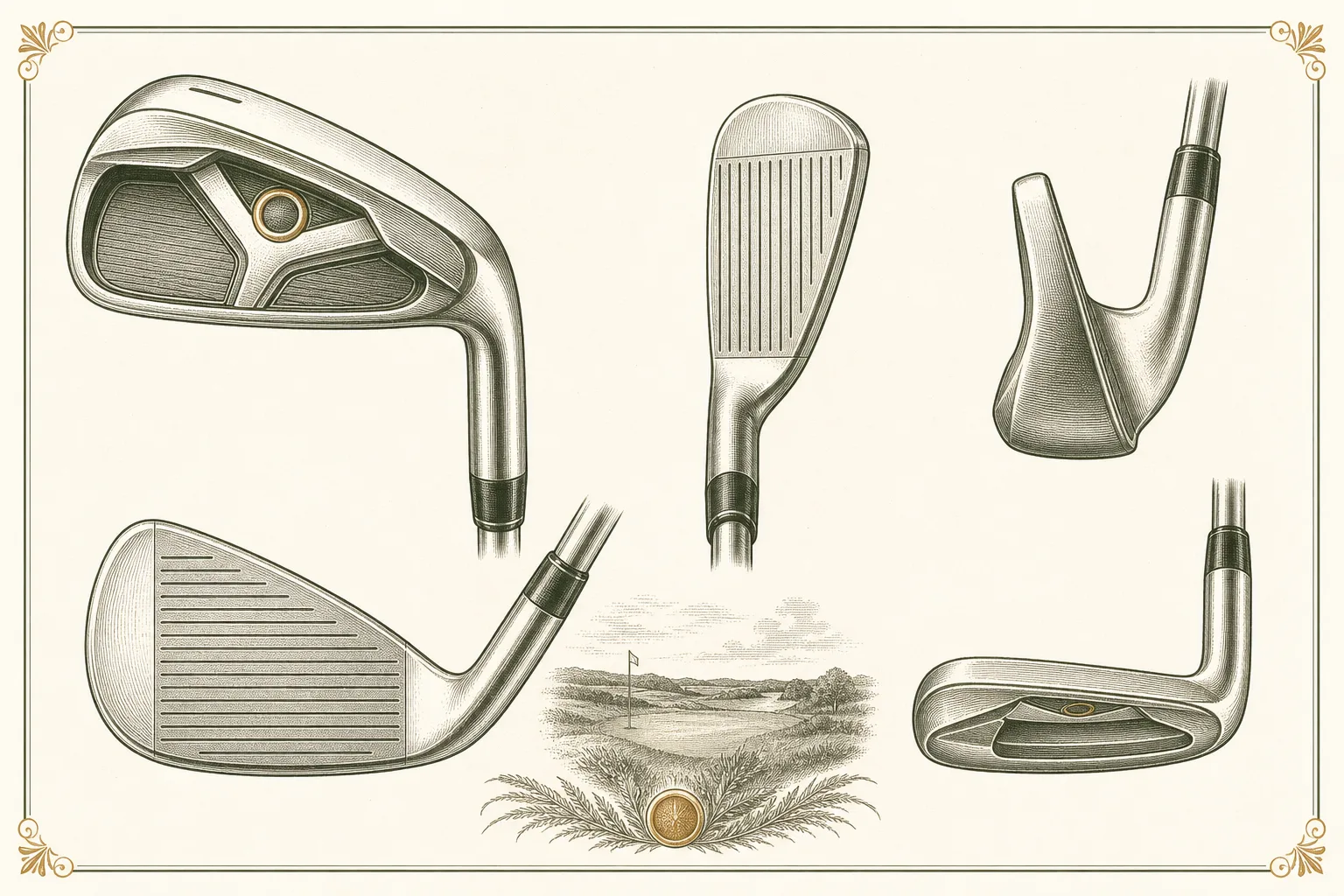
“8620 carbon-steel forging in black PVD with progressive heel-toe weighting. A players-distance-forged rung aimed at low-handicap ball-strikers, not the hybrid crowd.”
The Idea Pro a12 was Adams' forged answer to the better-player market in 2011, a year before TaylorMade absorbed the company. Heads are forged from 8620 carbon steel, finished in black PVD, and triple-milled -- face, cavity, and grooves cut separately for tighter tolerances than a one-step casting. Progressive heel-toe weighting keeps the long irons stable while letting the short irons and wedges work the ball. Adams also sold a cast 'a12 OS' game-improvement sibling under nearly the same name, so retailers and used listings still mix the two up; the Pro a12 here is the thinner-topline, narrower-sole forged version built for a repeatable strike, not the max-forgiveness OS casting.
MyGolfSpy ran a full 'Ultimate Review' on the a12, National Club Golfer tested it independently, and golfreview.com shows a perfect user score -- but from only 5 reviews, a small sample. That is real, positive period coverage, not manufactured hype, but there is no forum reverence, no scarcity, and no tour legend attached to it; it reads as a solidly regarded forged players-distance iron from Adams' last stretch as a semi-independent brand, not a chased classic.
Best for 8-16 handicap ball-strikers per National Club Golfer's own framing -- a 'transitional' iron between a true players' cavity and a game-improvement set. Not for high handicappers wanting maximum forgiveness (see the Adams Super S/Tech V3 lines) and not for scratch players wanting a blade.
Launched in 2011, a year before TaylorMade's 2012 acquisition of Adams Golf, competing against Titleist's AP2, TaylorMade's own Tour Preferred CB, and Callaway's RAZR X Muscleback. It sits between Adams' cast game-improvement irons and any true blade the company never really made -- Adams built its identity on hybrids and forgiveness, so a forged players-distance iron like this was a departure for the brand.
Progressive heel-toe weighting gives real stability in the long irons, but the thin topline and narrower sole (Adams' own marketing pitch against the OS casting) put this squarely in players-distance territory, not game-improvement. A mid-to-low handicapper who catches it clean gets workability and feel; thin or toe strikes lose distance faster than the Super S/Tech V3 game-improvement clubs elsewhere in this same catalog.
Calibrated across the whole catalog — a tour blade scores low here on purpose; it means control, not ease.
Complete sets in steel run roughly $150-280 in 2026 private-party condition; individual irons commonly sell for $25-45 on eBay. It holds a modest premium over Adams' cast game-improvement irons of the same era because of the forged construction and KBS Tour shaft, but this is still an obsolete mid-market iron, not a collectible.
Reading is one thing — hitting is another. Book a bay and see the numbers for yourself before you buy anywhere.
“8620 carbon-steel forging in black PVD with progressive heel-toe weighting. A players-distance-forged rung aimed at low-handicap ball-strikers, not the hybrid crowd.”
The Idea Pro a12 was Adams' forged answer to the better-player market in 2011, a year before TaylorMade absorbed the company. Heads are forged from 8620 carbon steel, finished in black PVD, and triple-milled -- face, cavity, and grooves cut separately for tighter tolerances than a one-step casting. Progressive heel-toe weighting keeps the long irons stable while letting the short irons and wedges work the ball. Adams also sold a cast 'a12 OS' game-improvement sibling under nearly the same name, so retailers and used listings still mix the two up; the Pro a12 here is the thinner-topline, narrower-sole forged version built for a repeatable strike, not the max-forgiveness OS casting.
MyGolfSpy ran a full 'Ultimate Review' on the a12, National Club Golfer tested it independently, and golfreview.com shows a perfect user score -- but from only 5 reviews, a small sample. That is real, positive period coverage, not manufactured hype, but there is no forum reverence, no scarcity, and no tour legend attached to it; it reads as a solidly regarded forged players-distance iron from Adams' last stretch as a semi-independent brand, not a chased classic.
Best for 8-16 handicap ball-strikers per National Club Golfer's own framing -- a 'transitional' iron between a true players' cavity and a game-improvement set. Not for high handicappers wanting maximum forgiveness (see the Adams Super S/Tech V3 lines) and not for scratch players wanting a blade.
Launched in 2011, a year before TaylorMade's 2012 acquisition of Adams Golf, competing against Titleist's AP2, TaylorMade's own Tour Preferred CB, and Callaway's RAZR X Muscleback. It sits between Adams' cast game-improvement irons and any true blade the company never really made -- Adams built its identity on hybrids and forgiveness, so a forged players-distance iron like this was a departure for the brand.
Progressive heel-toe weighting gives real stability in the long irons, but the thin topline and narrower sole (Adams' own marketing pitch against the OS casting) put this squarely in players-distance territory, not game-improvement. A mid-to-low handicapper who catches it clean gets workability and feel; thin or toe strikes lose distance faster than the Super S/Tech V3 game-improvement clubs elsewhere in this same catalog.
Calibrated across the whole catalog — a tour blade scores low here on purpose; it means control, not ease.
Complete sets in steel run roughly $150-280 in 2026 private-party condition; individual irons commonly sell for $25-45 on eBay. It holds a modest premium over Adams' cast game-improvement irons of the same era because of the forged construction and KBS Tour shaft, but this is still an obsolete mid-market iron, not a collectible.
Reading is one thing — hitting is another. Book a bay and see the numbers for yourself before you buy anywhere.