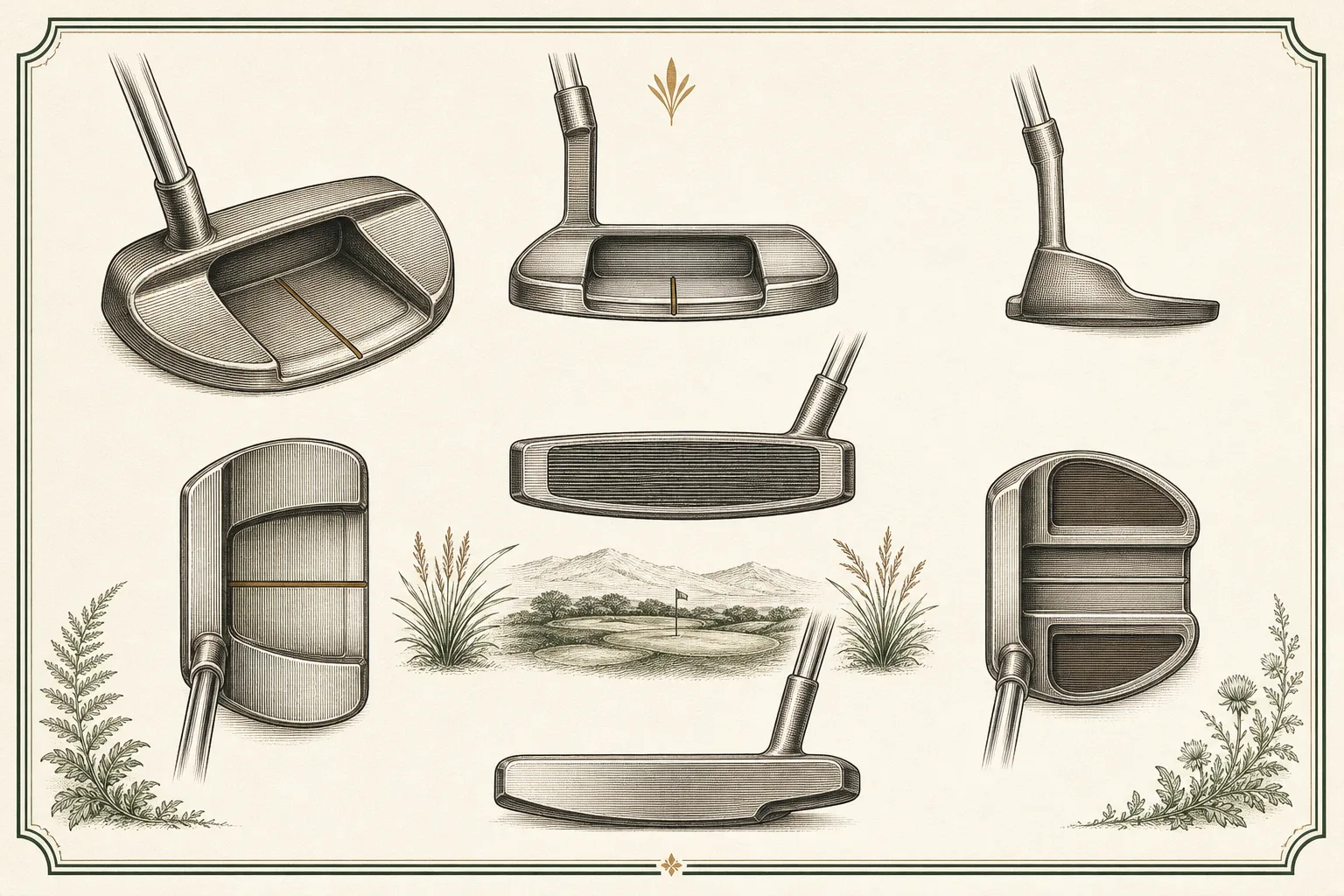
“The H-Series (H1 through H4) are medium-to-large face-balanced mallets built on Boccieri's back-weighting system. Their balance and mass suit a straight-back-straight-through stroke and calm the hands.”
Stephen Boccieri spent 25 years at Stone & Webster designing piping systems for nuclear power plants before an off-hours obsession with club physics produced the Heavy Putter, launched at the 2005 PGA Merchandise Show. The H-Series mallets carry his Weight Management System: a roughly 250-gram plug high in the grip end and head weights of 450-550 grams against a conventional 330-350, raising the balance point about 75 percent so the stroke runs off the shoulders, chest and core instead of twitchy hands and wrists. The H1 is a center-shafted, face-balanced mallet with a parabola alignment channel and single sightline; the H3 shifts to a heel-shafted double-bend with half-shaft offset. After testers found the original 900-gram builds punishing, the Mid-Weight line trimmed total mass about 20 percent to 750 grams, and the company (renamed Boccieri Golf in 2006) claimed to have tripled its market share in 2009 on the back of it.
Company announcements touted a 2009 Golf Digest Hot List selection and first place in GOLF Magazine's 2009 putter test, and long-running GolfWRX threads ('I'm a heavy putter lover', 'Still Using a Heavy Putter?') show a small, genuine following among golfers fighting handsy strokes and the yips — devotion without mainstream adoption.
Best for a golfer whose misses come from wrist breakdown, deceleration or the yips — the mass physically damps small-muscle twitches. A player with good natural touch who relies on hands for lag speed will fight the weight; anyone wanting a conventional-feeling putter should pass. Cheap enough used to be a low-risk experiment for a shaky stroke.
The H-Series arrived when 330-350 gram heads and standard grips were universal, several years before counterbalanced putters and heavy oversized grips went mainstream in the early 2010s — Boccieri's back-weighting idea was early to a trend the big brands later embraced. His company reported wins across the PGA, European, Champions and Nationwide Tours, and John Daly gamed a Heavy Putter K4 while finishing runner-up at the BMW Italian Open.
The whole design brief is mishit resistance: enormous head mass plus high MOI means off-center putts twist the face far less than a conventional blade or mid-mallet, and the face balance suits a straight-back-straight-through stroke. The trade-off is feel, not forgiveness — one Orlando Golf Blogger review that sank five straight 20-footers still called contact 'clunky' and said long lag putts feel 'like a hammer striking a nail,' so distance touch on fast greens takes real adjustment.
Calibrated across the whole catalog — a tour blade scores low here on purpose; it means control, not ease.
Cheap and thinly traded: 2nd Swing lists Heavy Putter models around $48, eBay examples commonly run $30-75, and Golf Blue Book pegs resale of the original A1 (a $229.95 club new) at $40-55. Condition matters less than finding one at all — supply is sparse since the brand faded from big-box retail.
Reading is one thing — hitting is another. Book a bay and see the numbers for yourself before you buy anywhere.
“The H-Series (H1 through H4) are medium-to-large face-balanced mallets built on Boccieri's back-weighting system. Their balance and mass suit a straight-back-straight-through stroke and calm the hands.”
Stephen Boccieri spent 25 years at Stone & Webster designing piping systems for nuclear power plants before an off-hours obsession with club physics produced the Heavy Putter, launched at the 2005 PGA Merchandise Show. The H-Series mallets carry his Weight Management System: a roughly 250-gram plug high in the grip end and head weights of 450-550 grams against a conventional 330-350, raising the balance point about 75 percent so the stroke runs off the shoulders, chest and core instead of twitchy hands and wrists. The H1 is a center-shafted, face-balanced mallet with a parabola alignment channel and single sightline; the H3 shifts to a heel-shafted double-bend with half-shaft offset. After testers found the original 900-gram builds punishing, the Mid-Weight line trimmed total mass about 20 percent to 750 grams, and the company (renamed Boccieri Golf in 2006) claimed to have tripled its market share in 2009 on the back of it.
Company announcements touted a 2009 Golf Digest Hot List selection and first place in GOLF Magazine's 2009 putter test, and long-running GolfWRX threads ('I'm a heavy putter lover', 'Still Using a Heavy Putter?') show a small, genuine following among golfers fighting handsy strokes and the yips — devotion without mainstream adoption.
Best for a golfer whose misses come from wrist breakdown, deceleration or the yips — the mass physically damps small-muscle twitches. A player with good natural touch who relies on hands for lag speed will fight the weight; anyone wanting a conventional-feeling putter should pass. Cheap enough used to be a low-risk experiment for a shaky stroke.
The H-Series arrived when 330-350 gram heads and standard grips were universal, several years before counterbalanced putters and heavy oversized grips went mainstream in the early 2010s — Boccieri's back-weighting idea was early to a trend the big brands later embraced. His company reported wins across the PGA, European, Champions and Nationwide Tours, and John Daly gamed a Heavy Putter K4 while finishing runner-up at the BMW Italian Open.
The whole design brief is mishit resistance: enormous head mass plus high MOI means off-center putts twist the face far less than a conventional blade or mid-mallet, and the face balance suits a straight-back-straight-through stroke. The trade-off is feel, not forgiveness — one Orlando Golf Blogger review that sank five straight 20-footers still called contact 'clunky' and said long lag putts feel 'like a hammer striking a nail,' so distance touch on fast greens takes real adjustment.
Calibrated across the whole catalog — a tour blade scores low here on purpose; it means control, not ease.
Cheap and thinly traded: 2nd Swing lists Heavy Putter models around $48, eBay examples commonly run $30-75, and Golf Blue Book pegs resale of the original A1 (a $229.95 club new) at $40-55. Condition matters less than finding one at all — supply is sparse since the brand faded from big-box retail.
Reading is one thing — hitting is another. Book a bay and see the numbers for yourself before you buy anywhere.