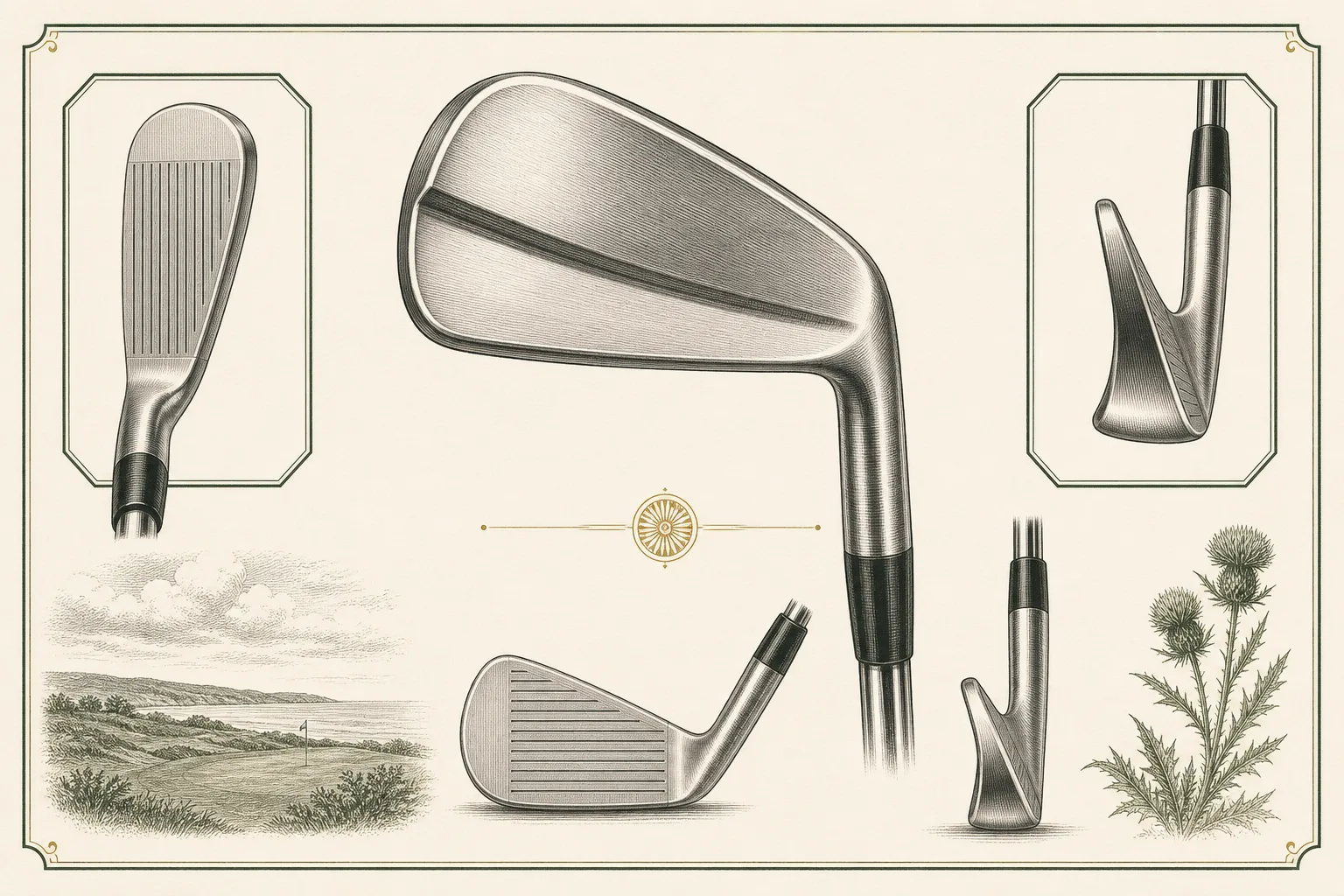
“A pure tour muscleback with no cavity forgiveness. Rung-4 only -- the recommendation stands regardless of who's asking: earn the strike numbers first.”
The 710 MB was Titleist's flagship one-piece forged blade for tour-caliber ball-strikers in the late 2000s: forged from 1025 mild carbon steel with bright chrome plating, a uniform muscle profile behind impact, and constant blade length with minimal progressive offset. It sat at the top of the four-model 710 iron ladder (AP1/AP2/CB/MB) that Titleist would repeat through the 712 and 714 generations. It was a well-made, well-regarded blade with no gimmicks and no forgiveness engineering to speak of, and it was quietly replaced after two years by the 712 MB, whose designers specifically narrowed the sole for cleaner turf interaction versus this model.
Genuinely well-regarded within its narrow blade-buying audience, but no distinct cult narrative separate from being 'a good Titleist blade of its era' — forum retrospectives (GolfWRX's 'Titleist 710 MB (any love still??)') treat it as a fondly-remembered predecessor rather than an object people actively hunt down today, and it was routinely superseded by the 712 MB within two years.
Accomplished players (scratch to low single digits) who value workability and forged feel over forgiveness. A mid-to-high handicapper will be punished for mishits and should look at a cavity-back or game-improvement iron instead.
Launched as the top tier of Titleist's 710 lineup alongside the 710 CB, AP1 and AP2, competing against Mizuno's MP-67/MP-68 and Callaway's X-Forged blades of the same window. Replaced in late 2011 by the narrower-soled 712 MB.
Pure muscleback blade: no perimeter weighting, minimal offset, narrow cambered sole. Off-center strikes lose real distance and curve; built entirely for centered contact, not as a safety net.
Calibrated across the whole catalog — a tour blade scores low here on purpose; it means control, not ease.
Clean 3-PW sets, now 15+ years old, typically bring roughly $150-$300 in 2026 on eBay/2nd Swing depending on shaft and condition; original retail was around $1,200/set. Chrome wear and worn grooves on the mild-steel forging pull value down, while tour shafts (Dynamic Gold, Project X) hold value better than stock offerings.
Reading is one thing — hitting is another. Book a bay and see the numbers for yourself before you buy anywhere.