“Twist Face plus high MOI in a fixed-weight, forgiving package with Geocoustic engineering. One of the era's best rung-1 gamers and still a smart, easy-to-hit used buy.”
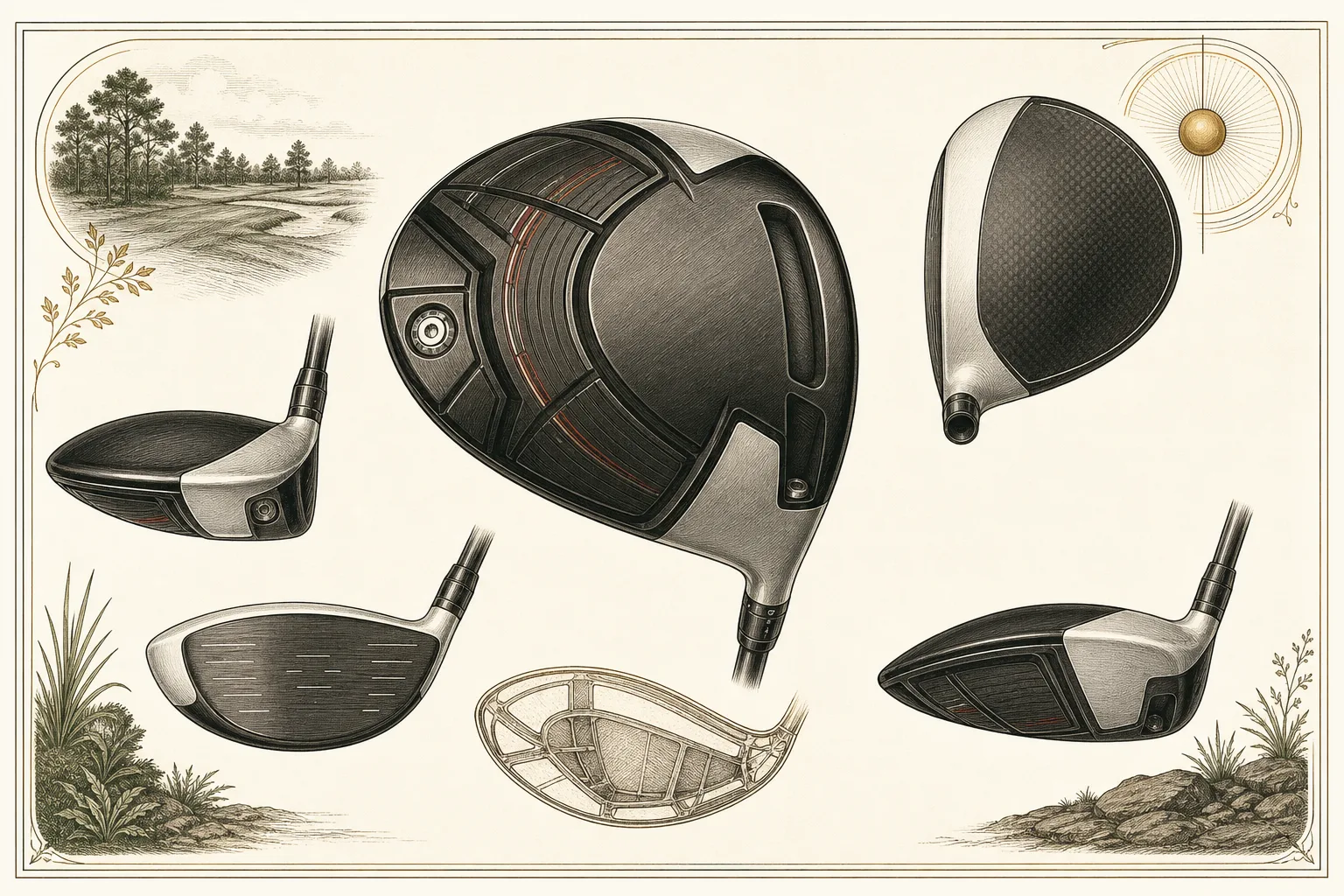
The M4 was TaylorMade's 2018 game-improvement driver, sitting beside the more tunable M3 as the max-forgiveness option: same Twist Face and Hammerhead sole slot, but with 86% more weight positioned low-and-back than the previous M2 to push MOI up and create what TaylorMade measured as a 67% larger effective sweet spot than the 2017 M2. Rather than the M3's movable Y-Track, the M4 used a fixed, heavier backweight for stability, plus Geocoustic shaping for a more refined sound off a thin, flexible face. It shipped in 8.5, 9.5, 10.5 and 12 degree lofts with a stock Fujikura Atmos Red shaft.
It sold as a mainstream, high-volume game-improvement driver and did its job well by contemporary reviews, but it carries none of the markers of a cult club: no forum reverence, no scarcity, no lasting collector interest. TaylorMade has released a faster, more forgiving flagship GI driver (M5/M6, SIM, Stealth, Qi) every year or two since, and the M4 was simply superseded on schedule.
Mid-to-high handicappers and any player prioritizing consistency and simple point-and-shoot forgiveness over shot-shaping adjustability. A better player who wants to actively work the ball or fine-tune CG position should look at the M3 instead; either would be a real downgrade for a 2026 buyer versus a current forgiving driver like a Ping G430 Max or TaylorMade Qi10 Max.
Released alongside the M3 as TaylorMade's 2018 driver pairing, replacing the M2 in the game-improvement slot and competing directly with Callaway's Rogue and Ping's G400 Max. Retired after one season for the M6 (2019), continuing TaylorMade's roughly annual driver-refresh cadence; the low-forward-CG, high-MOI blueprint it used lives on in every subsequent 'Max' or D-Type-style TaylorMade driver.
Built specifically to maximize forgiveness: a heavily rear-weighted head raises MOI well above the M3, and the Hammerhead slot's three sections plus Twist Face combine to keep ball speed and side-spin control high even on strikes well off-center. This is near the top of the forgiveness scale for its era, just short of a true max-MOI/draw-biased design like its own D-Type sibling.
Calibrated across the whole catalog — a tour blade scores low here on purpose; it means control, not ease.
Used complete units with stock Atmos Red shaft typically run about $130-$190 in 2026 across eBay and SidelineSwap listings, tracking slightly below the M3 given its simpler tech and larger original production run.
Reading is one thing — hitting is another. Book a bay and see the numbers for yourself before you buy anywhere.
“Twist Face plus high MOI in a fixed-weight, forgiving package with Geocoustic engineering. One of the era's best rung-1 gamers and still a smart, easy-to-hit used buy.”
The M4 was TaylorMade's 2018 game-improvement driver, sitting beside the more tunable M3 as the max-forgiveness option: same Twist Face and Hammerhead sole slot, but with 86% more weight positioned low-and-back than the previous M2 to push MOI up and create what TaylorMade measured as a 67% larger effective sweet spot than the 2017 M2. Rather than the M3's movable Y-Track, the M4 used a fixed, heavier backweight for stability, plus Geocoustic shaping for a more refined sound off a thin, flexible face. It shipped in 8.5, 9.5, 10.5 and 12 degree lofts with a stock Fujikura Atmos Red shaft.
It sold as a mainstream, high-volume game-improvement driver and did its job well by contemporary reviews, but it carries none of the markers of a cult club: no forum reverence, no scarcity, no lasting collector interest. TaylorMade has released a faster, more forgiving flagship GI driver (M5/M6, SIM, Stealth, Qi) every year or two since, and the M4 was simply superseded on schedule.
Mid-to-high handicappers and any player prioritizing consistency and simple point-and-shoot forgiveness over shot-shaping adjustability. A better player who wants to actively work the ball or fine-tune CG position should look at the M3 instead; either would be a real downgrade for a 2026 buyer versus a current forgiving driver like a Ping G430 Max or TaylorMade Qi10 Max.
Released alongside the M3 as TaylorMade's 2018 driver pairing, replacing the M2 in the game-improvement slot and competing directly with Callaway's Rogue and Ping's G400 Max. Retired after one season for the M6 (2019), continuing TaylorMade's roughly annual driver-refresh cadence; the low-forward-CG, high-MOI blueprint it used lives on in every subsequent 'Max' or D-Type-style TaylorMade driver.
Built specifically to maximize forgiveness: a heavily rear-weighted head raises MOI well above the M3, and the Hammerhead slot's three sections plus Twist Face combine to keep ball speed and side-spin control high even on strikes well off-center. This is near the top of the forgiveness scale for its era, just short of a true max-MOI/draw-biased design like its own D-Type sibling.
Calibrated across the whole catalog — a tour blade scores low here on purpose; it means control, not ease.
Used complete units with stock Atmos Red shaft typically run about $130-$190 in 2026 across eBay and SidelineSwap listings, tracking slightly below the M3 given its simpler tech and larger original production run.
Reading is one thing — hitting is another. Book a bay and see the numbers for yourself before you buy anywhere.