
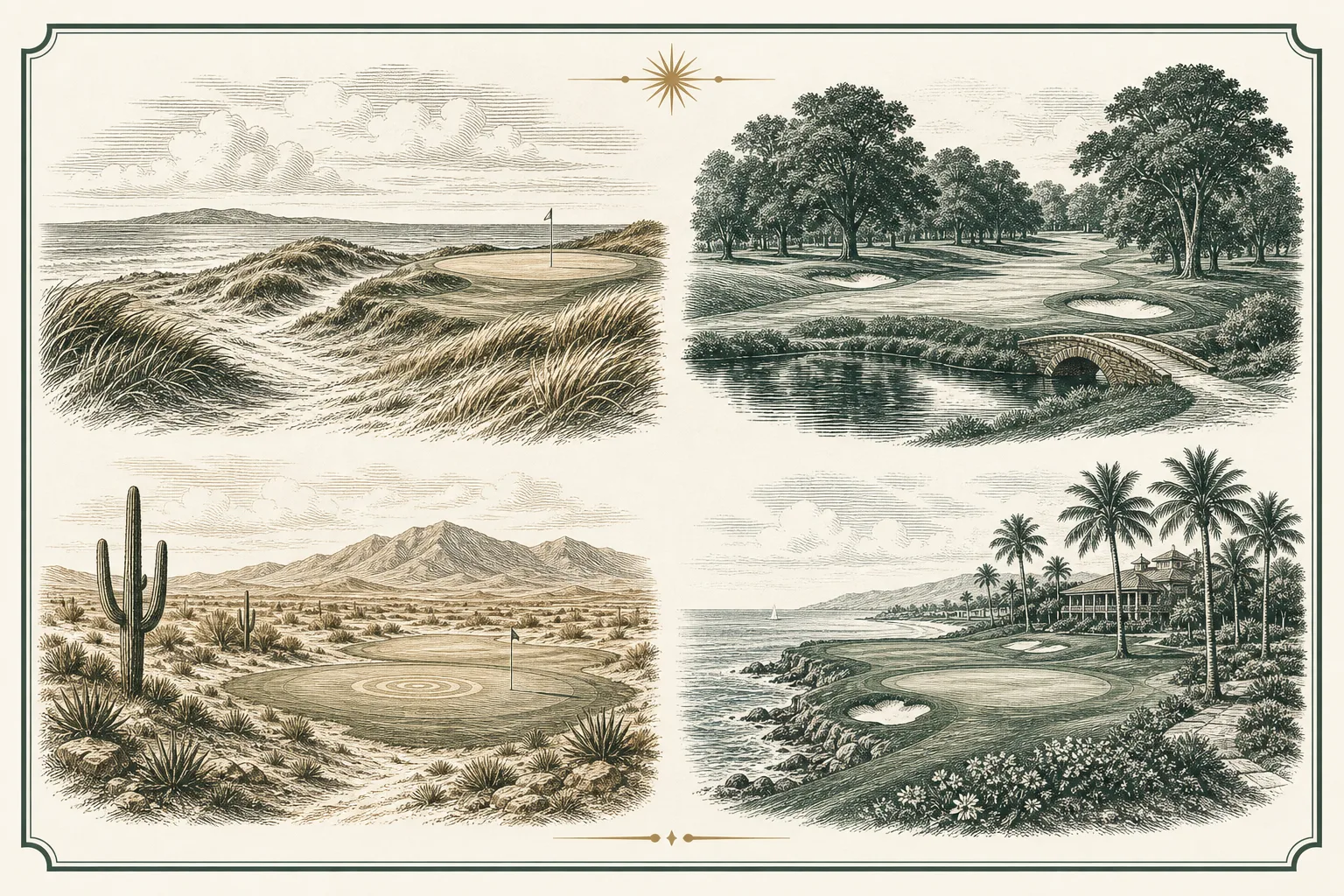
Watch golf on TV for a month and you'll see what looks like four different sports. In July, players at The Open punch low, running shots into brown, treeless ground in Scotland. In April at Augusta, they throw towering iron shots at emerald greens framed by pines and azaleas. In February in Scottsdale, they fire over cactus-studded desert to islands of grass. Same clubs, same ball, wildly different games. That's because the course type — the land itself — dictates how golf gets played on it. Understanding the archetypes makes you a smarter player and a much better spectator. And since you can play all of them in a sim bay, this isn't trivia. It's a menu.
Links: where the game was born
A true links course sits on coastal "linksland" — the sandy, dune-covered strip between the sea and farmable ground. The word comes from the Old English hlinc, meaning rising ground or ridge. This is the oldest form of golf course, developed in Scotland because that land was useless for anything else, and it produces a very specific kind of golf: firm, fast, treeless, and windy.
The defining feature is the ground game. Links turf is firm and sandy, so the ball bounces and runs — sometimes 20 or 30 yards after landing. Greens accept run-up shots through open fronts. When the wind is up (and it's always up), the smart play from 100 yards is often not a lofted wedge but a 7-iron landed 30 yards short and released to the hole. Add deep pot bunkers, wispy fescue rough, and humps and hollows that kick your ball sideways, and you get golf that demands imagination and acceptance in equal measure. The Open Championship is played exclusively on links courses — St Andrews, Carnoustie, Royal Troon, Royal Portrush. In the U.S., true links are rare, but Bandon Dunes on the Oregon coast is the real thing.
Parkland: golf in a garden
Parkland is what most Americans picture when they hear "golf course": inland, tree-lined, lush, green, and manicured, often with ponds and creeks worked into the design. The name is literal — it looks like a park. The turf is softer, the ball stops closer to where it lands, and trees rather than wind are the main defense.
That changes the game completely. Parkland golf is an aerial game. You're rewarded for flying the ball a precise distance and landing it softly, which is why high, spinning approach shots matter so much on these courses. Augusta National — home of the Masters — is the most famous parkland course on earth, and U.S. Open venues like Winged Foot and Oakmont are brutal variations on the theme. If you learned golf in America, you almost certainly learned parkland golf, and your instincts (fly it at the flag, stop it fast) were built for it.
Desert: target golf
Desert golf barely existed before the 1960s — Desert Forest Golf Club in Arizona, opened in 1962, is widely considered the first true desert course. The concept: instead of wall-to-wall grass, you get ribbons and islands of irrigated turf threaded through raw desert — sand, rock, arroyos, saguaro cactus. Miss the grass and you're playing from hardpan, gravel, or worse.
This is "target golf" in its purest form. Tee shots demand forced carries over desert to defined landing zones; there is no ground game to a target you can't run the ball across. The compensations are real, though: desert air is dry, fairways are firm with generous rollout, and winter conditioning in places like Scottsdale is immaculate. Desert Mountain's six Jack Nicklaus courses and TPC Scottsdale (home of the rowdiest event in golf, the WM Phoenix Open) are the marquee examples. If your driver is wild, desert golf will find you out faster than any other type.
Resort and stadium courses
"Resort course" describes ownership and intent more than terrain: it's a course attached to a resort property, built to give traveling golfers a memorable day. The best ones are designed by big-name architects, kept in tournament condition, and — importantly for you — playable. Resorts want guests to have fun, so fairways tend to be wider and forced carries more optional than at a championship members' club. Pebble Beach, Whistling Straits, Kapalua's Plantation Course, and Pinehurst are all resort courses, which tells you "resort" doesn't mean "easy" — it means "open to you, for a price."
One important overlap: categories stack. Bandon Dunes is a resort of links courses. TPC Sawgrass — home of the island-green 17th — is a resort course and also the original "stadium course," a subtype designed with mounding so spectators can see. When someone calls a course "a links-style resort course," they're describing terrain and business model at once.
So what is Florida golf?
Here's the one that matters most to you. Florida golf is its own animal, and it's worth being precise about what it is and is not.
It is not links golf, despite the wind and the sandy soil. Florida courses are irrigated, green, and soft by links standards, and the architecture is mostly parkland-style — with two huge twists. First, water: Florida is flat and the water table is high, so architects dig ponds for drainage and fill material, then route holes around them. Water in play on a dozen or more holes is normal here. Second, grass: Florida greens are Bermuda, which grows with a pronounced grain — putts roll faster and break more down-grain, and slower into it. The grass even looks shiny down-grain and dark into it. Combine flat terrain (nothing blocks the wind), constant forced carries, and grainy greens, and you get an aerial, target-style game played at sea level. If you learned golf in Tampa, you can fly a ball over water all day but may have never hit a real bump-and-run.
The great exception proves the rule: Streamsong, about an hour from Wesley Chapel, was built on reclaimed phosphate-mine land whose massive man-made dunes let Coore & Crenshaw, Tom Doak, and Gil Hanse build genuinely links-style courses in the middle of Florida. It's the closest you can get to Scotland without a passport, and it feels nothing like the rest of the state.
Play all four this week
This is where a sim bay beats real-world golf travel by about $10,000. GSPro has faithful versions of famous links, parkland, desert, and resort courses, so you can play St Andrews and a Scottsdale desert course back to back and feel the difference in one evening. Two things to try: on a links course, hit low, running shots into greens — take two extra clubs, ball back in your stance, abbreviated finish — and watch the rollout do the work. Then on a parkland or Florida-style course, do the opposite and work on carrying the ball a precise number, because that's the skill your home state demands. Your launch monitor shows carry and total distance separately on every shot, which is exactly the difference between these two games, in two columns. Once you can flight the ball both ways on command, no course type will scare you.
From the glossary
Related reading: Playing the Great Courses in GSPro (Tonight) · The Majors and the Courses That Host Them · The Bucket List: Courses Worth Traveling For · How to Pick a Beginner-Friendly Course

The Most Forgiving Drivers of the 2010s, Ranked by the Data
From roughly 2014 to 2019, every major manufacturer spent its entire driver budget chasing one number: MOI — how much the head resists twisting when you miss the middle. Carbon crowns, tungsten back weights, faces engineered to fight your specific mishit. Those flagships were the most forgiving drivers ever built to that point, and forgiveness does not expire. Your heel strike in 2026 is the same heel strike it was in 2018, and a head that held ball speed on it then holds ball speed on it now.