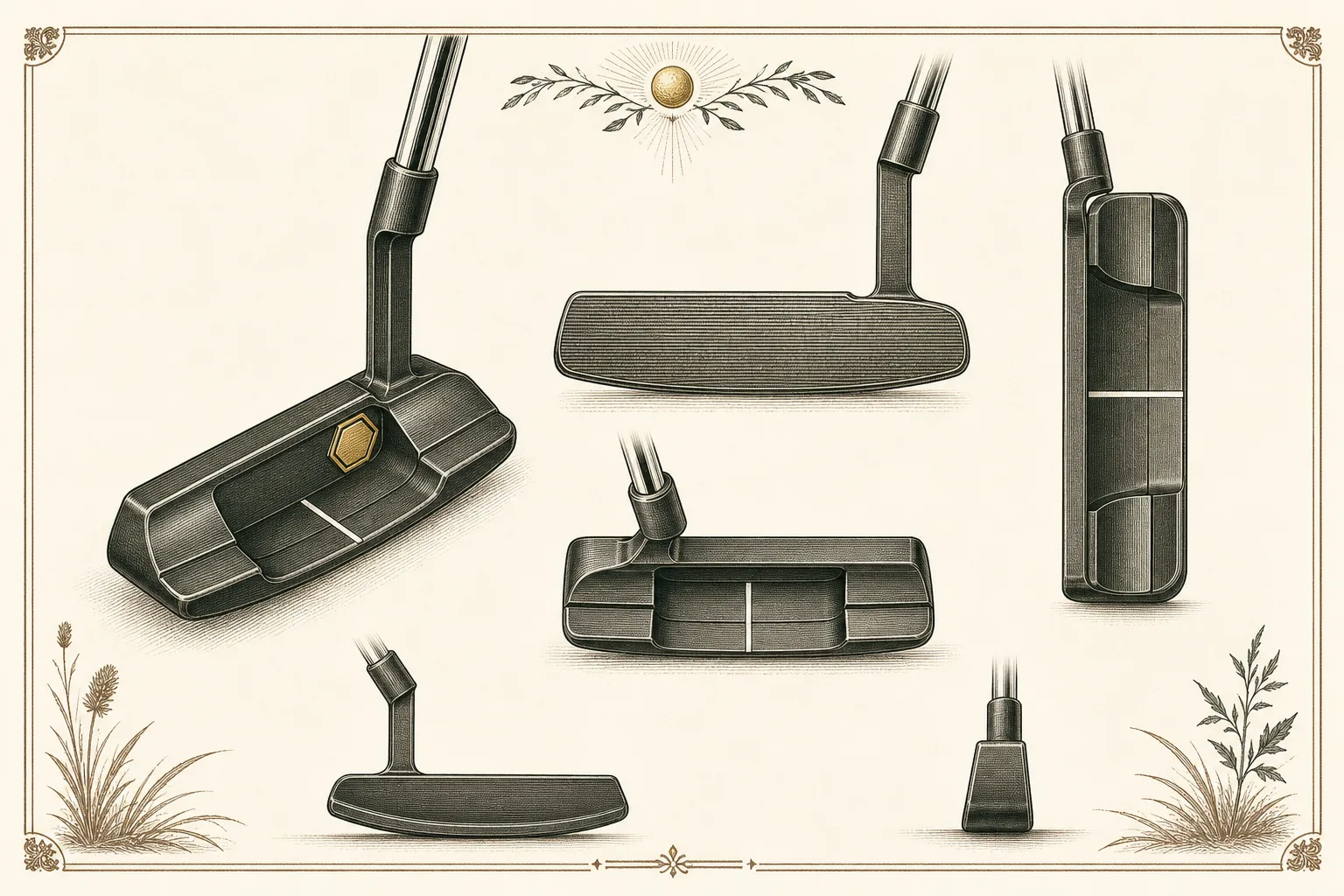
“A wider-bodied Studio Stock blade with more forgiveness than the SS3 and a bit less toe hang. Suits a slight arc stroke and players who want blade looks with extra stability.”
The 2019-generation Studio Stock 7 reuses a number from Bettinardi's original 2011 Studio Stock family (where SS7 was a face-balanced mallet with a double-bend shaft) but is a different piece of hardware: a compact mid-mallet with a distinctive half-moon-shaped flange, milled from 303 stainless in a Diamond Blast finish at 358 grams, with Bettinardi's asymmetrical Roll Control face groove and a spud-neck, single-bend shaft configuration. It's face-balanced, and the curved flange is explicitly built to help golfers line the ball up at address -- an alignment-first design rather than a pure feel play. Plugged In Golf's 2021 review treats it as a mature, tour-informed shape by that point, evidence the 2019 launch head held up well enough to keep selling with only minor changes.
This is a well-reviewed, steadily-selling shape within a respected boutique brand, not a cult object: no tour-win legend, no scarcity, no forum reverence beyond routine positive equipment reviews. It's good, honest mid-mallet hardware that Bettinardi kept in rotation because it works, which is a perfectly respectable but unremarkable market position.
Straight-back-straight-through putters who want a compact mallet's alignment help without a large footprint at address -- a good fit for someone who finds full-size mallets visually distracting but still wants more stability than a blade.
Part of the January 2019 Studio Stock refresh alongside the SS28 and SS38; the SS7 name had already been used by Bettinardi on an unrelated 2011 carbon-steel mallet (see the separate 'Studio Stock' family entry), a naming overlap noted rather than conflated.
Face-balanced with a compact mid-mallet body and a curved alignment flange, the SS7 sits ahead of Bettinardi's blades on forgiveness but behind the brand's dedicated cavity-back/high-MOI mallets (SS38, Jumbo) in this same catalog -- a genuinely useful but not maximal amount of MOI, consistent with its half-moon shape rather than a wide-winged mallet body.
Calibrated across the whole catalog — a tour blade scores low here on purpose; it means control, not ease.
Clean examples with headcover typically bring $220-300 in 2026 against a $450 launch MSRP -- reconditioned-retail listings (2nd Swing-style graded stock) can run higher, but realistic private-party pricing sits meaningfully below that graded-retail number, the same gap the X-18 exemplar flags for any milled putter with an active reconditioned-retail channel.
Reading is one thing — hitting is another. Book a bay and see the numbers for yourself before you buy anywhere.
“A wider-bodied Studio Stock blade with more forgiveness than the SS3 and a bit less toe hang. Suits a slight arc stroke and players who want blade looks with extra stability.”
The 2019-generation Studio Stock 7 reuses a number from Bettinardi's original 2011 Studio Stock family (where SS7 was a face-balanced mallet with a double-bend shaft) but is a different piece of hardware: a compact mid-mallet with a distinctive half-moon-shaped flange, milled from 303 stainless in a Diamond Blast finish at 358 grams, with Bettinardi's asymmetrical Roll Control face groove and a spud-neck, single-bend shaft configuration. It's face-balanced, and the curved flange is explicitly built to help golfers line the ball up at address -- an alignment-first design rather than a pure feel play. Plugged In Golf's 2021 review treats it as a mature, tour-informed shape by that point, evidence the 2019 launch head held up well enough to keep selling with only minor changes.
This is a well-reviewed, steadily-selling shape within a respected boutique brand, not a cult object: no tour-win legend, no scarcity, no forum reverence beyond routine positive equipment reviews. It's good, honest mid-mallet hardware that Bettinardi kept in rotation because it works, which is a perfectly respectable but unremarkable market position.
Straight-back-straight-through putters who want a compact mallet's alignment help without a large footprint at address -- a good fit for someone who finds full-size mallets visually distracting but still wants more stability than a blade.
Part of the January 2019 Studio Stock refresh alongside the SS28 and SS38; the SS7 name had already been used by Bettinardi on an unrelated 2011 carbon-steel mallet (see the separate 'Studio Stock' family entry), a naming overlap noted rather than conflated.
Face-balanced with a compact mid-mallet body and a curved alignment flange, the SS7 sits ahead of Bettinardi's blades on forgiveness but behind the brand's dedicated cavity-back/high-MOI mallets (SS38, Jumbo) in this same catalog -- a genuinely useful but not maximal amount of MOI, consistent with its half-moon shape rather than a wide-winged mallet body.
Calibrated across the whole catalog — a tour blade scores low here on purpose; it means control, not ease.
Clean examples with headcover typically bring $220-300 in 2026 against a $450 launch MSRP -- reconditioned-retail listings (2nd Swing-style graded stock) can run higher, but realistic private-party pricing sits meaningfully below that graded-retail number, the same gap the X-18 exemplar flags for any milled putter with an active reconditioned-retail channel.
Reading is one thing — hitting is another. Book a bay and see the numbers for yourself before you buy anywhere.