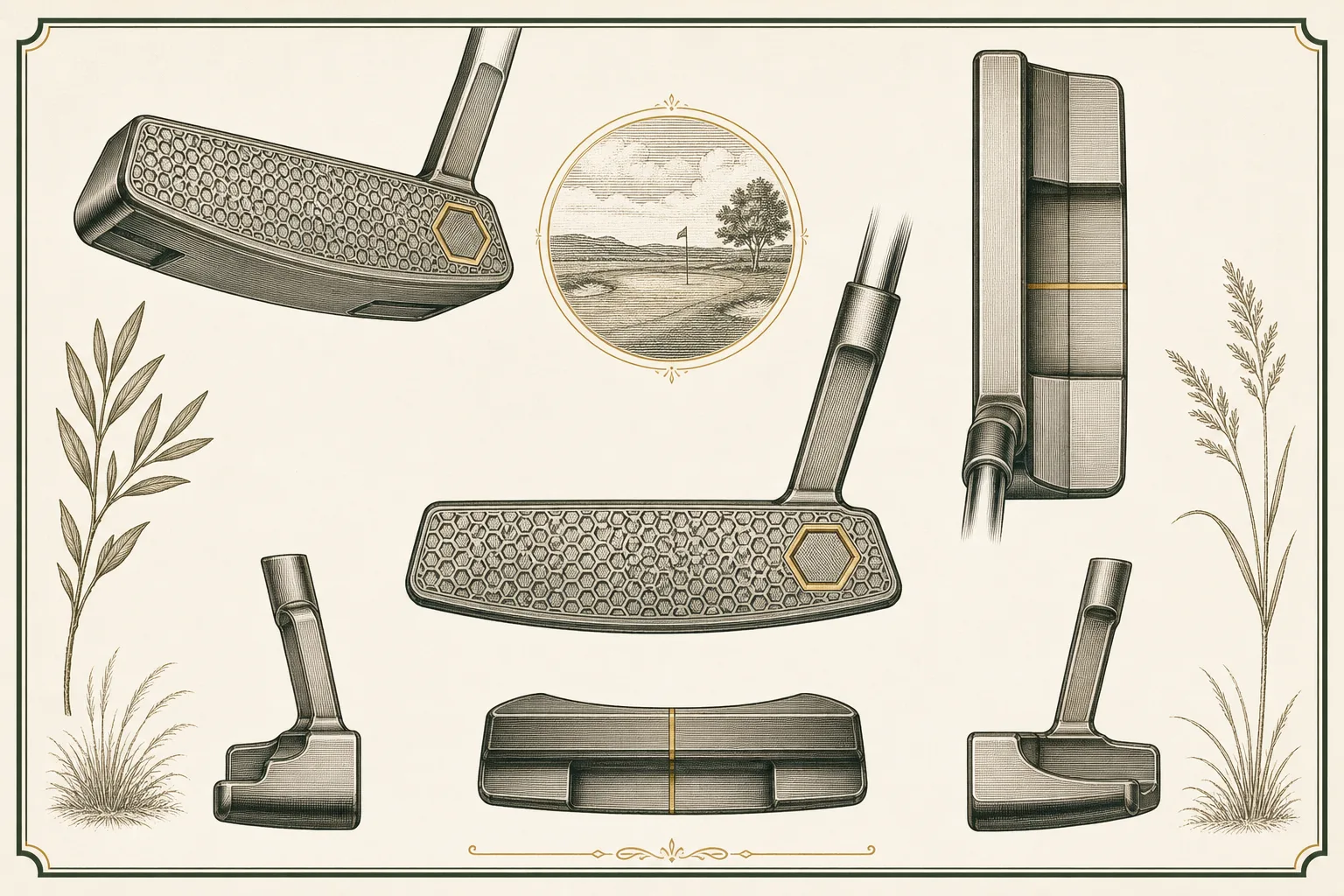
“A wider, more forgiving blade than the BB1 with a slightly larger footprint and half-shaft offset. Slight toe hang for a gentle arc stroke, a bit more stability behind the ball.”
BB8 was one of the six original models Bettinardi launched in 1999 (alongside BB1, BB1MS, BB2, BB10, and BB12) when Robert Bettinardi took his milling operation - which had built putters for Callaway and, exclusively, for Scotty Cameron/Titleist through the 1990s - out on its own. The shape is a squared-off blade reviewers have compared to a Ping Anser 2, and it has been re-cut and re-released across nearly every subsequent Bettinardi retail wave. The version most golfers know today is the 'BB8-Wide,' which Bettinardi launched January 20, 2020 (with a Blackout Graphite Grey PVD limited edition released almost two months early, in December 2019): the same classic BB8 outline milled with a wider flange, a longer sightline, and flatter, more compressed bumpers for extra visual stability at address, cut from soft carbon steel with a half-shaft (plumber's) neck.
BB8 has been in continuous or near-continuous production across 25+ years of Bettinardi retail cycles - 1999, the 2014-era BB lineup, 2020, 2022, 2024, and 2026 - which is unusually durable for a single head shape in a boutique putter line, and it has drawn repeat reviews from Plugged In Golf, Today's Golfer, and MyGolfSpy across multiple release years. That is real staying power, though it lacks a single documented signature tour win or forum-mythology moment tied specifically to the BB8 (as opposed to Bettinardi putters generally), so it reads as a genuinely respected mainstay rather than a mythologized cult object.
Suits players with a moderate arc who like a traditional squared blade look but want more visual and physical stability at address than a slim blade offers - a step up in confidence from BB0/BB1 without going to a full mallet. Not the right choice for a dead-straight, face-balanced stroke (better served by an Inovai), nor for a big-arc player who wants the extra toe hang a flow-neck BB1F/BBF provides.
Inside Bettinardi's own BB lineup it sits between the compact BB0/BB1 blades and the mallet-class Inovai and BB6.0/BB7.0 shapes, functioning as the brand's 'forgiving blade' option. Historically it has competed against the same players' blades it was compared to at launch (Ping Anser-style putters) and, in its current Wide form, against Scotty Cameron Phantom/Newport models and Odyssey White Hot OG blades occupying the same premium shelf.
The Wide execution specifically widens the flange versus the standard BB8/BB1 blade and lengthens the sightline and flattens the bumpers, which spreads mass further from center than a slim blade without going as far as a full mallet; Bettinardi's own materials describe roughly 1/2 toe hang off the half-shaft plumber's neck. It is more stable through impact and more forgiving of a slightly mishit stroke than Bettinardi's slimmer blades (BB0, BB1, BBF), but still well short of a face-balanced, high-MOI mallet like the Inovai.
Calibrated across the whole catalog — a tour blade scores low here on purpose; it means control, not ease.
2nd Swing lists used 2026-generation BB-8W putters starting around $381.99-$481.99 depending on condition, while eBay listings for slightly older examples (2020-2022 vintages) commonly run $180-$370 depending on year, length, and cosmetic condition - a comparatively strong resale range for a used putter, reflecting steady ongoing demand for the shape.
Reading is one thing — hitting is another. Book a bay and see the numbers for yourself before you buy anywhere.
“A wider, more forgiving blade than the BB1 with a slightly larger footprint and half-shaft offset. Slight toe hang for a gentle arc stroke, a bit more stability behind the ball.”
BB8 was one of the six original models Bettinardi launched in 1999 (alongside BB1, BB1MS, BB2, BB10, and BB12) when Robert Bettinardi took his milling operation - which had built putters for Callaway and, exclusively, for Scotty Cameron/Titleist through the 1990s - out on its own. The shape is a squared-off blade reviewers have compared to a Ping Anser 2, and it has been re-cut and re-released across nearly every subsequent Bettinardi retail wave. The version most golfers know today is the 'BB8-Wide,' which Bettinardi launched January 20, 2020 (with a Blackout Graphite Grey PVD limited edition released almost two months early, in December 2019): the same classic BB8 outline milled with a wider flange, a longer sightline, and flatter, more compressed bumpers for extra visual stability at address, cut from soft carbon steel with a half-shaft (plumber's) neck.
BB8 has been in continuous or near-continuous production across 25+ years of Bettinardi retail cycles - 1999, the 2014-era BB lineup, 2020, 2022, 2024, and 2026 - which is unusually durable for a single head shape in a boutique putter line, and it has drawn repeat reviews from Plugged In Golf, Today's Golfer, and MyGolfSpy across multiple release years. That is real staying power, though it lacks a single documented signature tour win or forum-mythology moment tied specifically to the BB8 (as opposed to Bettinardi putters generally), so it reads as a genuinely respected mainstay rather than a mythologized cult object.
Suits players with a moderate arc who like a traditional squared blade look but want more visual and physical stability at address than a slim blade offers - a step up in confidence from BB0/BB1 without going to a full mallet. Not the right choice for a dead-straight, face-balanced stroke (better served by an Inovai), nor for a big-arc player who wants the extra toe hang a flow-neck BB1F/BBF provides.
Inside Bettinardi's own BB lineup it sits between the compact BB0/BB1 blades and the mallet-class Inovai and BB6.0/BB7.0 shapes, functioning as the brand's 'forgiving blade' option. Historically it has competed against the same players' blades it was compared to at launch (Ping Anser-style putters) and, in its current Wide form, against Scotty Cameron Phantom/Newport models and Odyssey White Hot OG blades occupying the same premium shelf.
The Wide execution specifically widens the flange versus the standard BB8/BB1 blade and lengthens the sightline and flattens the bumpers, which spreads mass further from center than a slim blade without going as far as a full mallet; Bettinardi's own materials describe roughly 1/2 toe hang off the half-shaft plumber's neck. It is more stable through impact and more forgiving of a slightly mishit stroke than Bettinardi's slimmer blades (BB0, BB1, BBF), but still well short of a face-balanced, high-MOI mallet like the Inovai.
Calibrated across the whole catalog — a tour blade scores low here on purpose; it means control, not ease.
2nd Swing lists used 2026-generation BB-8W putters starting around $381.99-$481.99 depending on condition, while eBay listings for slightly older examples (2020-2022 vintages) commonly run $180-$370 depending on year, length, and cosmetic condition - a comparatively strong resale range for a used putter, reflecting steady ongoing demand for the shape.
Reading is one thing — hitting is another. Book a bay and see the numbers for yourself before you buy anywhere.