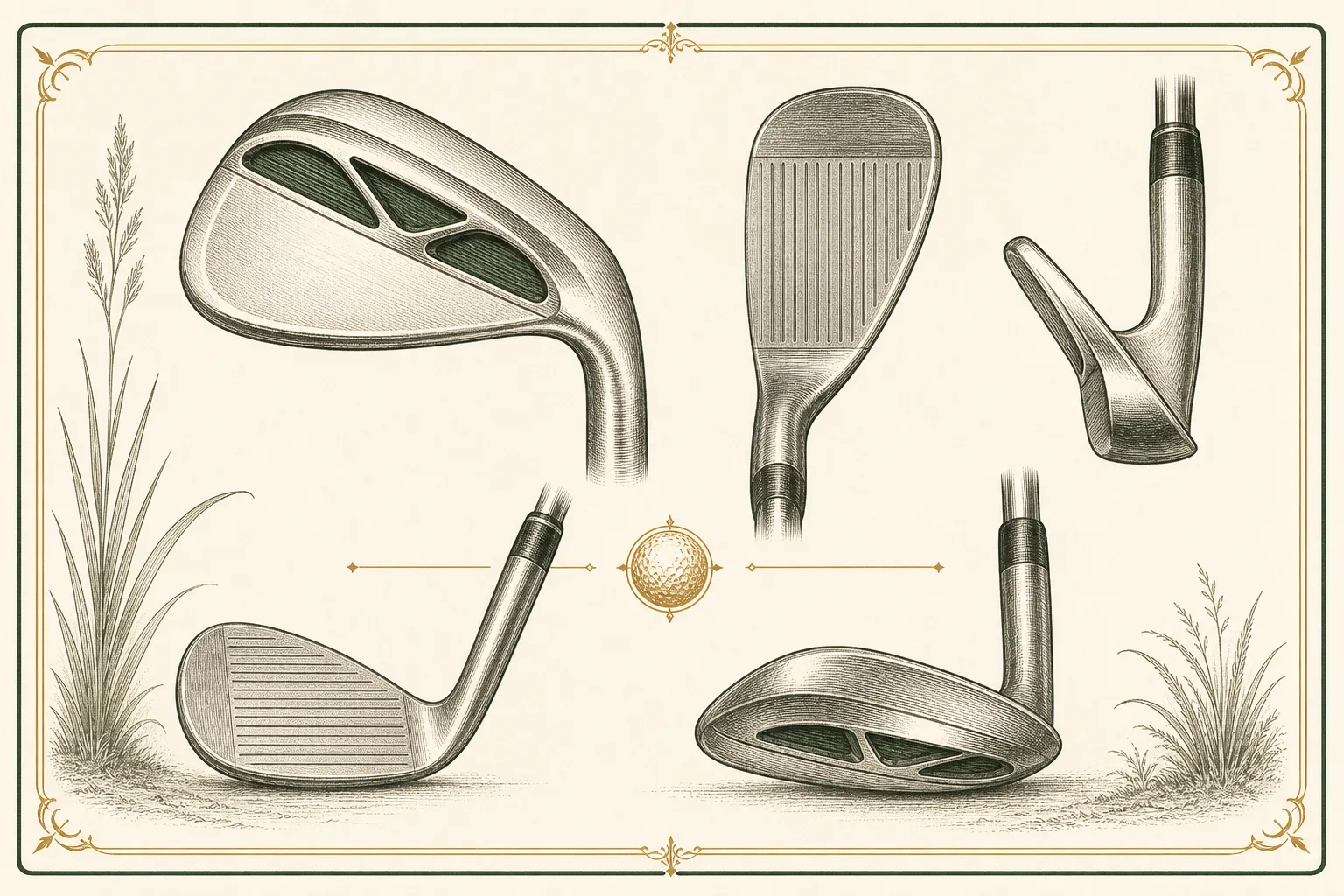
“One versatile sole grind meant to work from any lie or opening. Steel players' wedge; a single-grind identity club, simple and durable.”
TaylorMade built the ATV around a deliberately unconventional bet: instead of stamping a bounce number on the hosel and letting golfers pick a grind for one job, it shipped a single wide, mostly-flat sole with a convex section that hides bounce until the face is opened, plus generous heel and toe relief so the head stays playable no matter how it's presented at address. Product manager Brian Bazzel explained the thinking directly - there is no single bounce number because different parts of the sole are meant to work for different shots, from bump-and-runs to flop shots to bunker play. Marketed as 'the most versatile wedge in golf,' it was a tour-derived, steel, players' wedge aimed at golfers who manipulate the face rather than carry three or four single-purpose grinds.
It never displaced Vokey or Cleveland as the wedge golfers reach for by default, but it built a quiet, specific following among short-game-focused reviewers: GolfWRX ran a dedicated design deep-dive quoting TaylorMade's own product manager, and independent testers at Today's Golfer (4/5 overall, 5/5 owner rating) and TheSandTrap both singled out the wide sole's chunk-reducing effect as genuinely distinctive rather than marketing spin.
Best for better players who actively open and close the face for different short-game shots and want one grind to cover that range, rather than carrying several single-purpose wedges. Golfers who prefer a simple, high-bounce dig-in wedge for one specific job (deep bunkers, thick rough) may find the ambiguous bounce concept harder to trust than a conventional stamped-bounce grind.
Launched in 2012 alongside Titleist's Vokey SM4/SM5 generation and Cleveland's CG15/RTX lines, which doubled down on multiple named grinds rather than one universal sole - the industry ultimately followed Vokey's multi-grind philosophy, not TaylorMade's single-sole approach, making the ATV something of a design road not taken.
The wide, mostly camber-free sole with a convex relief section and heavy heel/toe relief is specifically engineered to survive a poor entry angle and an open face without digging, which independent testing showed measurably reduces chunked shots around the green. The tradeoff is average groove performance versus post-2010 wedge standards and a cast-stainless feel that lacks the softness of forged tour wedges.
Calibrated across the whole catalog — a tour blade scores low here on purpose; it means control, not ease.
A cheap, plentiful used wedge today: 2nd Swing, Golf Avenue and SidelineSwap all carry regular used stock across its loft range, and being a 2012-14 model with no collector interest, played examples typically sell well under half of its original roughly $120 retail.
Reading is one thing — hitting is another. Book a bay and see the numbers for yourself before you buy anywhere.