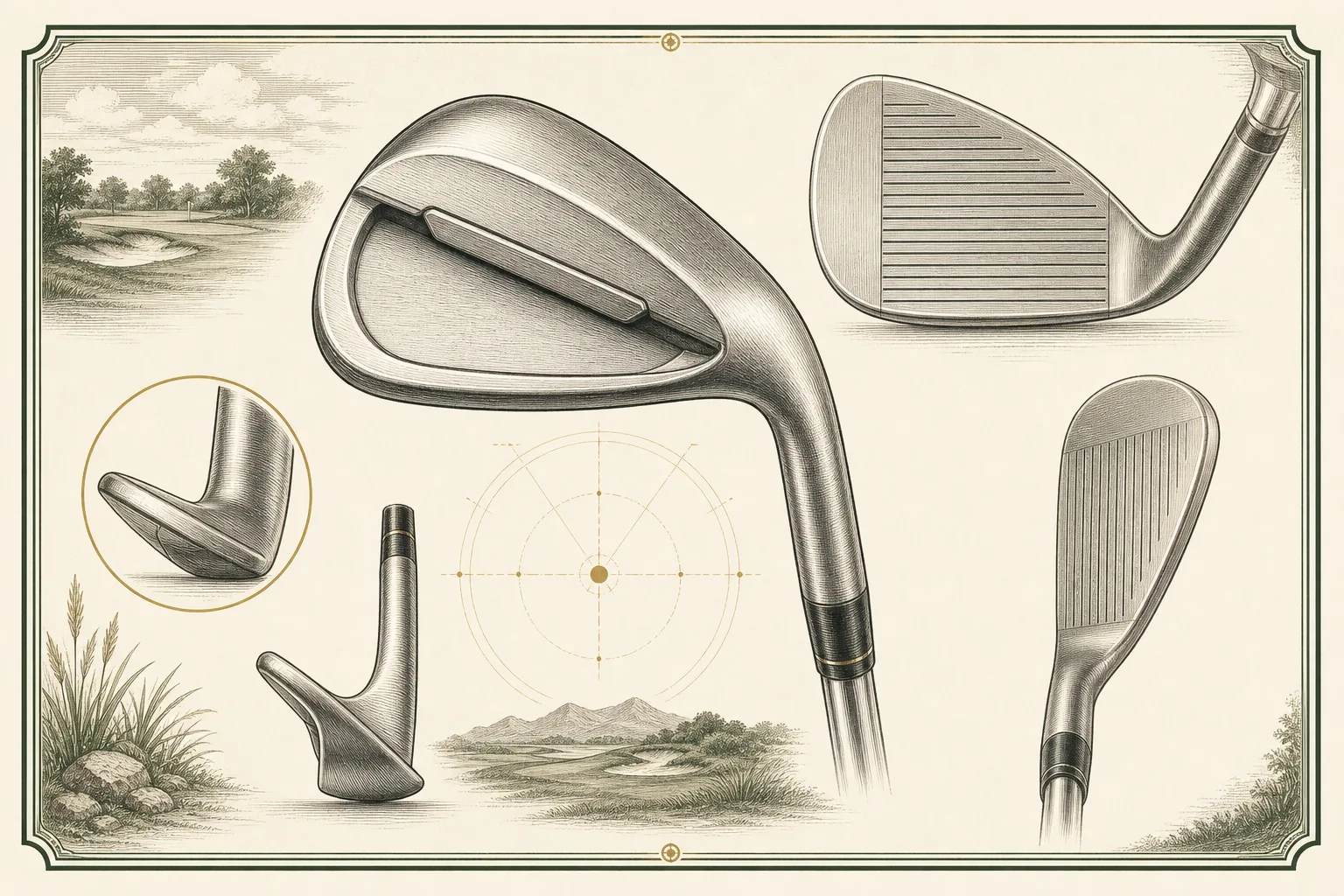
Ping's Glide line launched in 2014 as the brand's re-entry into a fitted, sole-driven wedge category after years of the Tour/Tour Gorge series; the follow-up "Glide 2.0," released in 2017, is the generation this record's year aligns with. Glide 2.0 kept Ping's four-sole-grind fitting system - Standard (SS), Wide (WS), Thin (TS) and Eye (ES, modeled on the Eye2) - while adding an extra groove to each loft (one on 46-52 degree wedges, two on 54-60 degree wedges) via a new precision-milling process that Ping said lifted full-shot spin by nearly 350 rpm and greenside spin by roughly 200 rpm over the original Glide. It also introduced Ping's extra-long "Dyla-wedge" grip, tapered less than a standard grip for easier choke-down control on finesse shots.
Reviewed favorably nearly everywhere (PGA Tour equipment desk, GolfWRX, Plugged In Golf, Golfalot, MyGolfSpy) for its four-sole fitting system and spin gains, and it launched the modern Glide dynasty (2.0 through today's 4.0/5.0) that made Ping wedges tour-relevant again - a genuinely important product cycle, but not one with an independent cult or scarcity story of its own.
Good for golfers of most skill levels who get properly fit into the right sole grind - the ES (Eye2-inspired) grind in particular suits bunker-heavy players, while WS suits steep, divot-taking swings. A golfer unwilling to get fit for a specific grind loses much of the wedge's advantage; today's Glide 4.0 improves further on the milling and grind lineup.
The original Glide (2014) succeeded Ping's Tour/S-series and Tour Gorge wedges; Glide 2.0 (2017) then gave way to Glide 3.0 (2019) and Glide 4.0 (2021), each generation iterating on groove milling and sole options while keeping the four-grind fitting concept intact.
The four interchangeable sole grinds (SS/WS/TS/ES) let a fitter match bounce and turf interaction to a golfer's attack angle and course conditions, meaningfully reducing chunked/bladed misses versus a one-sole wedge; it remains a compact, tour-oriented head rather than a wide-sole game-improvement design, so raw forgiveness tops out well below a max-GI wedge.
Calibrated across the whole catalog — a tour blade scores low here on purpose; it means control, not ease.
Now two generations behind Ping's current Glide 4.0, original Glide/Glide 2.0 wedges are inexpensive used - individual wedges commonly sell in the $40-$70 range depending on condition, well down from typical $100-$150 wedge retail pricing.
Reading is one thing — hitting is another. Book a bay and see the numbers for yourself before you buy anywhere.
Ping's Glide line launched in 2014 as the brand's re-entry into a fitted, sole-driven wedge category after years of the Tour/Tour Gorge series; the follow-up "Glide 2.0," released in 2017, is the generation this record's year aligns with. Glide 2.0 kept Ping's four-sole-grind fitting system - Standard (SS), Wide (WS), Thin (TS) and Eye (ES, modeled on the Eye2) - while adding an extra groove to each loft (one on 46-52 degree wedges, two on 54-60 degree wedges) via a new precision-milling process that Ping said lifted full-shot spin by nearly 350 rpm and greenside spin by roughly 200 rpm over the original Glide. It also introduced Ping's extra-long "Dyla-wedge" grip, tapered less than a standard grip for easier choke-down control on finesse shots.
Reviewed favorably nearly everywhere (PGA Tour equipment desk, GolfWRX, Plugged In Golf, Golfalot, MyGolfSpy) for its four-sole fitting system and spin gains, and it launched the modern Glide dynasty (2.0 through today's 4.0/5.0) that made Ping wedges tour-relevant again - a genuinely important product cycle, but not one with an independent cult or scarcity story of its own.
Good for golfers of most skill levels who get properly fit into the right sole grind - the ES (Eye2-inspired) grind in particular suits bunker-heavy players, while WS suits steep, divot-taking swings. A golfer unwilling to get fit for a specific grind loses much of the wedge's advantage; today's Glide 4.0 improves further on the milling and grind lineup.
The original Glide (2014) succeeded Ping's Tour/S-series and Tour Gorge wedges; Glide 2.0 (2017) then gave way to Glide 3.0 (2019) and Glide 4.0 (2021), each generation iterating on groove milling and sole options while keeping the four-grind fitting concept intact.
The four interchangeable sole grinds (SS/WS/TS/ES) let a fitter match bounce and turf interaction to a golfer's attack angle and course conditions, meaningfully reducing chunked/bladed misses versus a one-sole wedge; it remains a compact, tour-oriented head rather than a wide-sole game-improvement design, so raw forgiveness tops out well below a max-GI wedge.
Calibrated across the whole catalog — a tour blade scores low here on purpose; it means control, not ease.
Now two generations behind Ping's current Glide 4.0, original Glide/Glide 2.0 wedges are inexpensive used - individual wedges commonly sell in the $40-$70 range depending on condition, well down from typical $100-$150 wedge retail pricing.
Reading is one thing — hitting is another. Book a bay and see the numbers for yourself before you buy anywhere.