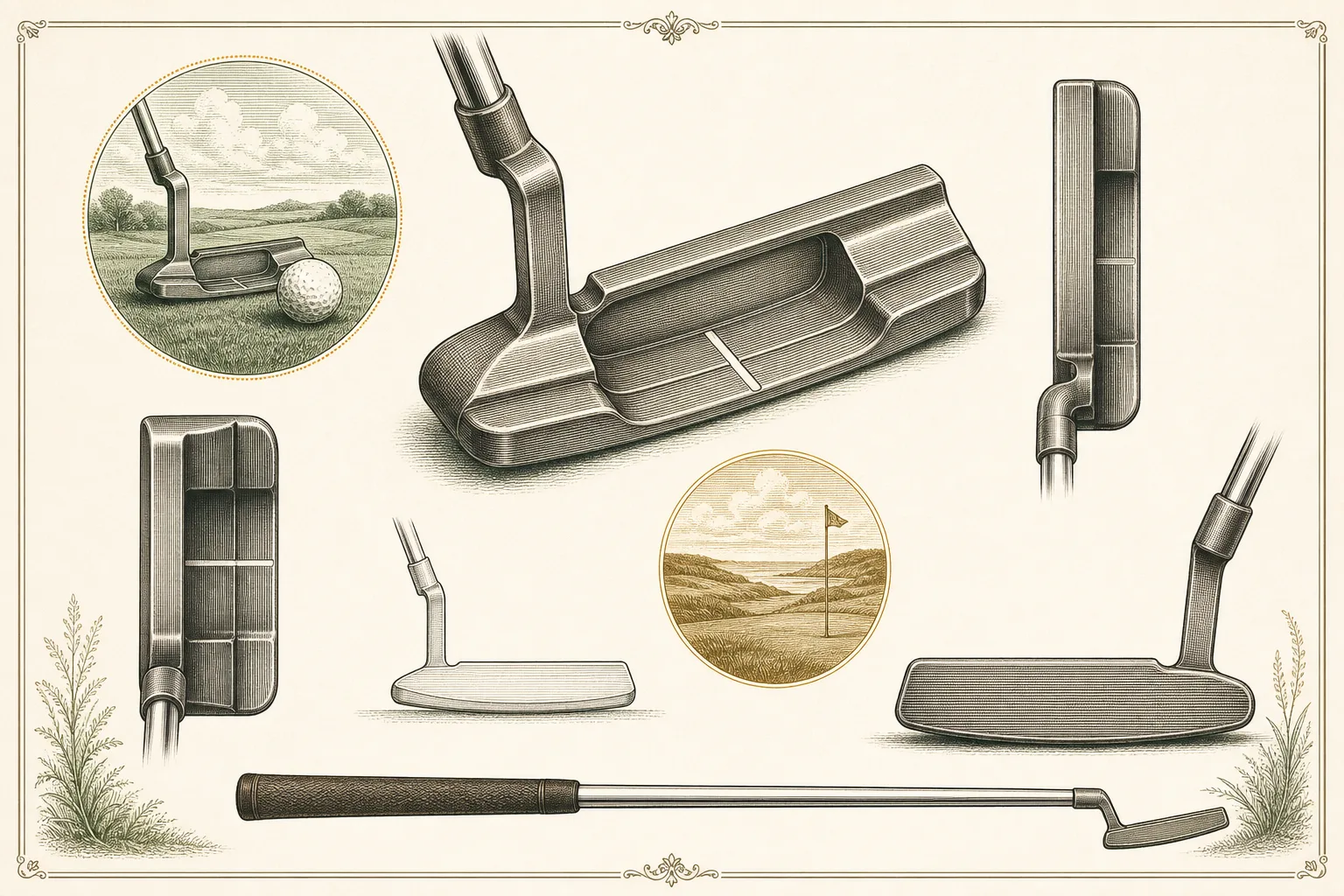
“Anser 4 with a shorter slant neck for a touch more toe hang; a blade for a moderate arc stroke. A recurring Ping blade variant.”
The Anser 4 name has done double duty in Ping's catalog. The version matching this entry's specs and price point is Ping's long-running 'Classic Stainless' Anser 4 - a cast 17-4 stainless blade with a satin finish, heel-toe weighting and a low CG, sold at a mainstream price point alongside catalog stablemates like the Anser 2, Zing 2, B60 and Pal 2. It is a longer-hosel, slightly more toe-hang variant of the base Anser shape, built for a stronger arcing stroke rather than a straight-back-straight-through putt. Confusingly, Ping also ran a separate, premium 'Precision Milled Anser' line in 2010-2011 that independently numbered six models 1 through 6 by stroke type, and its own red-shaft-band 'Anser 4' denoted the same strong-arc fit, matched via Ping's iPING iPhone app - an early, genuinely novel stroke-analysis tool. The two Anser 4s share a fitting philosophy but are different products at different price tiers, a naming overlap rather than one continuous model.
There is no scarcity or forum mythology around this specific SKU: it is Ping's everyday, mass-produced cast Anser blade, priced well below Ping's milled and PLD putters and marketed on fit and finish rather than heritage. Its cult equity is borrowed - it trades on the 1966 Anser silhouette and on the adjacent Precision Milled line's iPING app novelty - rather than earned on its own.
Golfers with a pronounced arcing putting stroke who want a traditional blade look and feel at a mainstream price, not the premium of Ping's milled or PLD lines. A player with a straight-back-straight-through stroke should look at a face-balanced Ping model instead - the extra toe hang here will fight that stroke.
Sold continuously through Ping's 'Classic Stainless' catalog roughly 2010-2020 alongside decades-old shapes like the Anser 2 and Zing 2, while Ping's premium putter effort moved through the 2010-2011 Precision Milled Anser line, then years later into the PLD Milled program opened to retail customers in 2022 - including a fully reworked '2021 Anser 4' reviewed by Golf Monthly, underscoring that Ping treats 'Anser 4' as a recurring name it revisits rather than a single fixed product.
Heel-toe weighting and a low CG give it more stability than a pure blade, but it is still a blade at heart: a compact face, minimal offset and a small forgiving zone. It rewards a repeatable strike and a genuine strong-arc stroke (the reason it carries more toe hang than the standard Anser or Anser 2); mis-hits toward the toe or heel lose roll speed and line quickly.
Calibrated across the whole catalog — a tour blade scores low here on purpose; it means control, not ease.
Used Anser 4s commonly sell in the roughly $55-$93 range today against an original retail price near $170, ordinary depreciation for a mass-produced cast putter with no collector premium attached to this specific tier.
Reading is one thing — hitting is another. Book a bay and see the numbers for yourself before you buy anywhere.
“Anser 4 with a shorter slant neck for a touch more toe hang; a blade for a moderate arc stroke. A recurring Ping blade variant.”
The Anser 4 name has done double duty in Ping's catalog. The version matching this entry's specs and price point is Ping's long-running 'Classic Stainless' Anser 4 - a cast 17-4 stainless blade with a satin finish, heel-toe weighting and a low CG, sold at a mainstream price point alongside catalog stablemates like the Anser 2, Zing 2, B60 and Pal 2. It is a longer-hosel, slightly more toe-hang variant of the base Anser shape, built for a stronger arcing stroke rather than a straight-back-straight-through putt. Confusingly, Ping also ran a separate, premium 'Precision Milled Anser' line in 2010-2011 that independently numbered six models 1 through 6 by stroke type, and its own red-shaft-band 'Anser 4' denoted the same strong-arc fit, matched via Ping's iPING iPhone app - an early, genuinely novel stroke-analysis tool. The two Anser 4s share a fitting philosophy but are different products at different price tiers, a naming overlap rather than one continuous model.
There is no scarcity or forum mythology around this specific SKU: it is Ping's everyday, mass-produced cast Anser blade, priced well below Ping's milled and PLD putters and marketed on fit and finish rather than heritage. Its cult equity is borrowed - it trades on the 1966 Anser silhouette and on the adjacent Precision Milled line's iPING app novelty - rather than earned on its own.
Golfers with a pronounced arcing putting stroke who want a traditional blade look and feel at a mainstream price, not the premium of Ping's milled or PLD lines. A player with a straight-back-straight-through stroke should look at a face-balanced Ping model instead - the extra toe hang here will fight that stroke.
Sold continuously through Ping's 'Classic Stainless' catalog roughly 2010-2020 alongside decades-old shapes like the Anser 2 and Zing 2, while Ping's premium putter effort moved through the 2010-2011 Precision Milled Anser line, then years later into the PLD Milled program opened to retail customers in 2022 - including a fully reworked '2021 Anser 4' reviewed by Golf Monthly, underscoring that Ping treats 'Anser 4' as a recurring name it revisits rather than a single fixed product.
Heel-toe weighting and a low CG give it more stability than a pure blade, but it is still a blade at heart: a compact face, minimal offset and a small forgiving zone. It rewards a repeatable strike and a genuine strong-arc stroke (the reason it carries more toe hang than the standard Anser or Anser 2); mis-hits toward the toe or heel lose roll speed and line quickly.
Calibrated across the whole catalog — a tour blade scores low here on purpose; it means control, not ease.
Used Anser 4s commonly sell in the roughly $55-$93 range today against an original retail price near $170, ordinary depreciation for a mass-produced cast putter with no collector premium attached to this specific tier.
Reading is one thing — hitting is another. Book a bay and see the numbers for yourself before you buy anywhere.